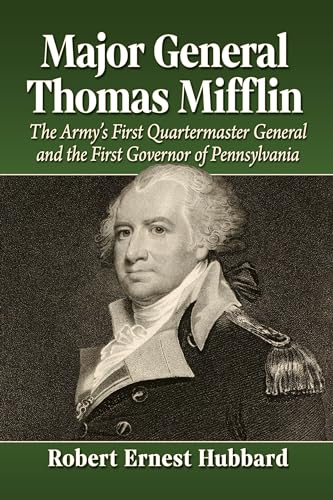
Major General Thomas Mifflin
by Robert Ernest Hubbard
"The Army's First Quartermaster General and the First Governor of Pennsylvania"
Popularity
3.68 / 5
* A book's popularity is determined by how it compares to all other books on this website.
Where to buy?
Buy from Amazon* If you buy this book through the link above, we may receive a small commission at no extra cost to you.
Major General Thomas Mifflin by Robert Ernest Hubbard
Details
War:
American Revolutionary War
Perspective:
Logistics
Military Unit:
US Army
True Story:
Yes
Biography:
Yes
Region:
North America
Page Count:
237
Published Date:
2025
ISBN13:
9781476692029
Summary
This biography examines Thomas Mifflin, a significant but often overlooked figure in American Revolutionary history. Hubbard chronicles Mifflin's dual legacy as the Continental Army's first quartermaster general under George Washington and later as Pennsylvania's first governor. The book explores his military contributions during the Revolution, his complex relationship with Washington, and his political career in the early republic. Through detailed research, Hubbard presents a comprehensive portrait of this founding father whose achievements have been overshadowed by his more famous contemporaries.
Review of Major General Thomas Mifflin by Robert Ernest Hubbard
Robert Ernest Hubbard's biography of Thomas Mifflin fills a notable gap in Revolutionary War scholarship by examining a figure whose contributions have often been overshadowed by more celebrated founders. Mifflin's career was remarkable in its breadth: he served as the Continental Army's first quartermaster general, sat in the Continental Congress, signed the Constitution, and ultimately became the first governor of Pennsylvania under its new constitution. Hubbard's book traces this trajectory with careful attention to both the political and military dimensions of Mifflin's public life.
The early chapters establish Mifflin's background as a Philadelphia merchant and his rise within the patriot cause. Hubbard does well to contextualize the logistical chaos facing the Continental Army in its earliest years, explaining why George Washington turned to Mifflin, a man with commercial experience rather than military training, to organize the army's supply chain. The quartermaster general's role was thankless and complicated, requiring coordination across colonies with limited resources and constant shortages. Hubbard presents this material clearly, avoiding unnecessary technical detail while still conveying the magnitude of the challenge Mifflin faced.
One of the book's strengths lies in its willingness to address controversy directly. Mifflin's association with the so-called Conway Cabal, an alleged effort by some officers and congressmen to remove Washington from command, receives balanced treatment. Hubbard neither exonerates Mifflin entirely nor condemns him outright, instead laying out the available evidence and allowing readers to form their own conclusions. This measured approach extends to Mifflin's later personal struggles, including his difficulties with alcohol, which affected his effectiveness in various roles. The biography does not shy away from these less flattering aspects of its subject, lending the work a sense of honesty that benefits the overall narrative.
The sections covering Mifflin's political career are equally substantive. His service in the Continental Congress, including his time as its president, and his role at the Constitutional Convention in Philadelphia, receive thorough coverage. Hubbard demonstrates how Mifflin moved fluidly between military and civilian spheres, a versatility that was not uncommon among Revolutionary-era leaders but that nonetheless required considerable political skill. His subsequent tenure as governor of Pennsylvania, a position he held for nine years, is treated with similar care, highlighting the challenges of establishing state governance in the young republic.
Hubbard's prose is clear and accessible, making the book suitable for both general readers interested in Revolutionary history and more specialized audiences seeking detailed information on a lesser-known founding figure. The author avoids excessive academic jargon while still grounding his narrative in solid research. Citations and source material appear throughout, lending credibility to the biography's claims without overwhelming the text with scholarly apparatus.
If the book has a weakness, it may be found in its occasionally uneven pacing. Some sections, particularly those dealing with the minutiae of quartermaster logistics, move more slowly than others, which could test the patience of readers primarily interested in the broader arc of Mifflin's life. However, this thoroughness also reflects Hubbard's commitment to giving Mifflin's often-overlooked contributions their due weight, rather than glossing over the practical work that sustained the Continental Army.
Overall, this biography succeeds in its primary aim: restoring Thomas Mifflin to his rightful place among the notable figures of the American Revolution and early republic. Hubbard's balanced treatment of Mifflin's achievements and shortcomings offers a fuller picture than has previously been available in a single volume. For readers interested in the administrative and political dimensions of the Revolutionary era, as well as those curious about the lesser-known founders who shaped Pennsylvania's early governance, this book provides a valuable and well-researched resource. It stands as a solid contribution to the growing body of literature seeking to illuminate figures who operated in the shadow of more famous contemporaries, yet whose work was essential to the success of the American experiment.