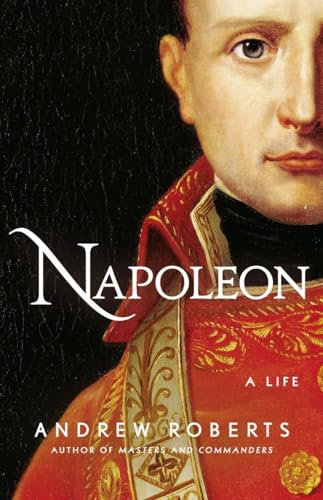
Napoleon
by Andrew Roberts
"A Life"
Popularity
4.85 / 5
* A book's popularity is determined by how it compares to all other books on this website.
Where to buy?
Buy from Amazon* If you buy this book through the link above, we may receive a small commission at no extra cost to you.
Napoleon by Andrew Roberts
Details
War:
Napoleonic Wars
Perspective:
Commanders
True Story:
Yes
Biography:
Yes
Region:
Europe
Published Date:
2014
ISBN13:
9780670025329
Summary
Andrew Roberts' biography presents a comprehensive examination of Napoleon Bonaparte's life, from his Corsican origins to his final exile. Drawing on newly accessible archives and Napoleon's personal correspondence, Roberts portrays the French emperor as a military genius, political reformer, and complex leader who transformed Europe. The book challenges previous interpretations by highlighting Napoleon's administrative achievements, including the Napoleonic Code, while providing balanced analysis of his military campaigns and ultimate downfall. Roberts combines scholarly research with engaging narrative to create an authoritative yet accessible portrait of one of history's most influential figures.
Review of Napoleon by Andrew Roberts
Andrew Roberts delivers a monumental biography with "Napoleon: A Life," offering readers an exhaustive yet remarkably engaging portrait of one of history's most controversial and influential figures. Drawing on previously untapped archives and personal letters, Roberts presents a comprehensive examination of Napoleon Bonaparte that challenges many long-held assumptions while providing fresh insights into the French emperor's extraordinary career.
The biography spans Napoleon's entire life, from his childhood in Corsica through his meteoric rise during the French Revolution, his unprecedented military conquests, and ultimately his exile and death on Saint Helena. Roberts demonstrates meticulous attention to chronological detail, ensuring readers can follow the complex web of military campaigns, political maneuvers, and personal relationships that defined Napoleon's existence. The narrative successfully balances the grand sweep of European history with intimate moments that reveal the man behind the legend.
One of the book's greatest strengths lies in its treatment of Napoleon's military genius. Roberts provides detailed analysis of key battles and campaigns, making complex strategic decisions accessible to general readers while offering sufficient depth to satisfy military history enthusiasts. The author examines not only Napoleon's victories but also his failures, providing balanced assessments of controversial campaigns such as the invasion of Russia and the Peninsula War. Rather than simply cataloging battles, Roberts explores Napoleon's innovative tactical approaches and his ability to inspire fierce loyalty among his troops.
The biography also gives substantial attention to Napoleon's role as a civil administrator and legal reformer. Roberts thoroughly examines the Napoleonic Code and its lasting impact on legal systems worldwide, as well as Napoleon's efforts to modernize French infrastructure, education, and government institutions. This broader perspective prevents the biography from becoming merely a military history and instead presents Napoleon as a complex figure whose influence extended far beyond the battlefield.
Roberts takes a notably sympathetic view of his subject, actively challenging what he considers the unfair characterization of Napoleon perpetuated by British propaganda and subsequent historians. While this approach provides a valuable counterbalance to more critical accounts, readers seeking an entirely neutral assessment may find certain sections reflect the author's evident admiration for Napoleon's achievements. The biography does not shy away from Napoleon's authoritarian tendencies, his reintroduction of slavery in French colonies, or his responsibility for the deaths of hundreds of thousands, but these darker aspects sometimes receive less emphasis than his accomplishments.
The personal dimension of Napoleon's life receives thorough treatment throughout the work. Roberts explores Napoleon's relationships with family members, particularly his siblings whom he placed on various European thrones, and his complicated marriages to Josephine de Beauharnais and Marie Louise of Austria. These sections humanize the historical figure, revealing Napoleon's capacity for both deep affection and cold political calculation. The portrayal of his final years in exile on Saint Helena proves particularly poignant, showing a fallen emperor reflecting on his legacy while enduring petty humiliations from his British captors.
At over 800 pages, the biography represents a significant commitment for readers, but Roberts maintains narrative momentum throughout. The prose remains accessible despite the wealth of detail, and the author's evident enthusiasm for his subject proves contagious. The extensive use of primary sources, including Napoleon's own correspondence, lends authenticity and immediacy to the narrative. Roberts cites approximately 60,000 letters written by Napoleon, providing direct access to the emperor's thoughts and motivations.
The book benefits from Roberts's broader knowledge of the period and his previous works on European history. He effectively contextualizes Napoleon's actions within the tumultuous era of the French Revolution and the subsequent European conflicts. The biography also traces Napoleon's lasting influence on military strategy, legal systems, and political thought, demonstrating why his legacy remains relevant more than two centuries after his death.
"Napoleon: A Life" stands as a significant contribution to Napoleonic scholarship and biography more broadly. While readers seeking a more critical assessment might want to supplement this work with alternative perspectives, Roberts has produced a thoroughly researched, compellingly written, and comprehensive account of an extraordinary life. The biography succeeds both as a scholarly work and as an accessible narrative for general readers interested in understanding one of history's most fascinating and consequential figures.