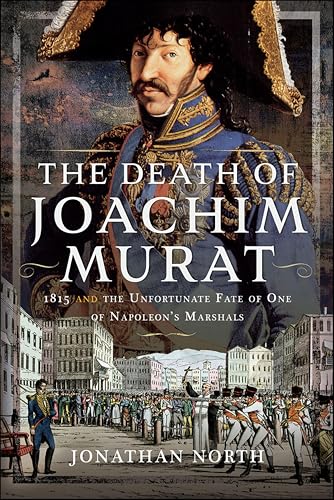
The Death of Joachim Murat
by Jonathan North
"1815 and the Unfortunate Fate of One of Napoleon's Marshals"
Popularity
4.47 / 5
* A book's popularity is determined by how it compares to all other books on this website.
Where to buy?
Buy from Amazon* If you buy this book through the link above, we may receive a small commission at no extra cost to you.
The Death of Joachim Murat by Jonathan North
Details
War:
Napoleonic Wars
Perspective:
Commanders
True Story:
Yes
Biography:
Yes
Region:
Europe
Page Count:
292
Published Date:
2025
ISBN13:
9781399058421
Summary
This book chronicles the final days of Joachim Murat, one of Napoleon's most flamboyant marshals and former King of Naples. Jonathan North examines Murat's ill-fated attempt to reclaim his throne in 1815 after Napoleon's defeat at Waterloo. The narrative follows Murat's desperate landing in Calabria, his capture, and subsequent execution by firing squad. North provides detailed analysis of the political and military circumstances that led to Murat's downfall, offering insight into the chaotic post-Napoleonic period and the fate of those who remained loyal to the fallen emperor.
Review of The Death of Joachim Murat by Jonathan North
Jonathan North's "The Death of Joachim Murat 1815 and the Unfortunate Fate of One of Napoleon's Marshals" offers a focused examination of the final months in the life of one of the Napoleonic era's most flamboyant military figures. The book narrows its scope to the period following Napoleon's final defeat at Waterloo, chronicling Murat's desperate attempt to reclaim his lost Kingdom of Naples and the tragic consequences that followed.
Murat stands out among Napoleon's marshals as perhaps the most colorful and contradictory character. A brilliant cavalry commander known for his daring charges and personal bravery on the battlefield, he was also a man of remarkable vanity who designed his own elaborate uniforms adorned with gold braid, feathers, and jewels. North's work captures this complexity while maintaining focus on the final act of Murat's dramatic life.
The narrative begins with Murat's precarious position after Napoleon's return from Elba and the subsequent Hundred Days campaign. Having lost his throne as King of Naples following his earlier betrayal of Napoleon in 1814, Murat found himself a man without a country when the emperor fell for the second time. North details how Murat, refusing to accept his diminished circumstances, hatched an ill-conceived plan to invade southern Italy and reclaim his kingdom through popular uprising.
The book excels in its depiction of Murat's final campaign in October 1815. North draws upon contemporary accounts and archival sources to reconstruct the marshal's landing at Pizzo in Calabria with a small force of supporters. The author portrays the venture as doomed from the outset, undermined by poor planning, insufficient resources, and a fatal misreading of the political situation in Italy. The expected popular support never materialized, and Murat's small band was quickly overwhelmed by Bourbon forces loyal to the restored King Ferdinand.
North provides careful attention to the legal and political dimensions of Murat's capture and subsequent trial. The author examines the questionable legitimacy of the military tribunal that condemned him and the speed with which the sentence was carried out. Within days of his capture, Murat faced a firing squad in the castle of Pizzo on October 13, 1815. The book reproduces accounts of Murat's final moments, including his famous command to the firing squad and his courage in facing death.
The work situates Murat's fate within the broader context of the post-Napoleonic settlement. North explores how Murat's execution served the political purposes of the restored Bourbon monarchy in Naples, which sought to eliminate any potential rallying point for Napoleonic sympathizers in Italy. The author also addresses the reactions across Europe to Murat's death, including the relative silence from the Allied powers who had defeated Napoleon.
One of the book's strengths lies in its analysis of Murat's psychology during this final period. North examines the marshal's apparent inability to grasp the reality of his situation, his continued belief in his own star despite overwhelming evidence to the contrary, and his tragic miscalculation of both his own abilities and the political climate of restoration Europe. The portrait that emerges is of a man trapped by his own legend, unable to reconcile his past glory with his present circumstances.
The book also considers Murat's legacy and his place among Napoleon's marshals. While acknowledging his undeniable talents as a cavalry commander, North places his final adventure within the pattern of impulsive decision-making and political naivety that had marked his career. The author draws comparisons with the fates of other Napoleonic figures in the aftermath of Waterloo, noting how Murat's death contrasted with the more cautious approaches adopted by other former imperial officers.
North writes with clarity and maintains a brisk pace throughout the narrative. The book avoids excessive military detail while providing enough context for readers unfamiliar with the Napoleonic period to follow the story. The author's treatment remains balanced, neither romanticizing Murat's final adventure nor dismissing it as mere folly.
For readers interested in the Napoleonic era, particularly the often-overlooked aftermath of Waterloo, this book provides valuable insight into one of the period's most dramatic episodes. The work serves as both a biographical study of a fascinating historical figure and an examination of how the victorious powers dealt with the remnants of Napoleon's empire. North's focused approach results in a compact but comprehensive account of Joachim Murat's final, fatal gamble.