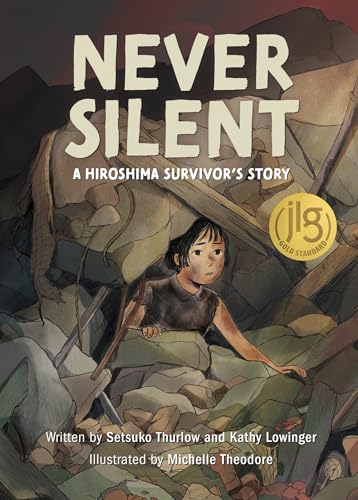
Never Silent
by Setsuko Thurlow
"A Hiroshima Survivor's Story"
Popularity
4.83 / 5
* A book's popularity is determined by how it compares to all other books on this website.
Where to buy?
Buy from Amazon* If you buy this book through the link above, we may receive a small commission at no extra cost to you.
Never Silent by Setsuko Thurlow
Details
War:
World War II
Perspective:
Civilian
True Story:
Yes
Biography:
Yes
Region:
Asia
Published Date:
2025
ISBN13:
9781773219851
Summary
Never Silent is the memoir of Setsuko Thurlow, a survivor of the atomic bombing of Hiroshima on August 6, 1945. The book chronicles her experience as a thirteen-year-old schoolgirl who witnessed the devastation firsthand and lost many family members and classmates. Thurlow recounts her journey from survivor to lifelong activist, dedicating decades to nuclear disarmament and peace advocacy. Her testimony has been instrumental in raising global awareness about the humanitarian consequences of nuclear weapons, culminating in her acceptance speech for the 2017 Nobel Peace Prize on behalf of the International Campaign to Abolish Nuclear Weapons.
Review of Never Silent by Setsuko Thurlow
Setsuko Thurlow's "Never Silent" stands as a profound testament to survival, resilience, and the moral imperative to bear witness to humanity's darkest moments. As one of the few remaining survivors of the atomic bombing of Hiroshima on August 6, 1945, Thurlow offers readers an unflinching account of her experiences as a thirteen-year-old girl who lived through the destruction and its aftermath. This memoir transcends the boundaries of personal narrative to become an essential historical document and a powerful call for nuclear disarmament.
The book opens with Thurlow's childhood in Hiroshima, providing context for the vibrant city and community that existed before the bombing. These early chapters establish the normalcy of daily life in wartime Japan, making the subsequent devastation all the more harrowing. Thurlow was a student mobilized for war work at the time of the attack, positioned in a building close enough to ground zero to witness the blinding flash and feel the crushing force of the blast wave, yet far enough to survive when so many others perished instantly.
Thurlow's descriptions of the immediate aftermath of the bombing are some of the most compelling and difficult passages in the memoir. The accounts of the injured and dying, the desperate search for family members, and the incomprehensible scale of destruction provide readers with visceral understanding that statistics alone cannot convey. Her recollections of classmates calling out for help, trapped beneath rubble, and her inability to save them, represent trauma that would shape the remainder of her life and fuel her decades-long activism.
Beyond the immediate horror of August 6, Thurlow chronicles the long-term effects of radiation exposure on survivors, known as hibakusha. The delayed deaths, mysterious illnesses, and social stigma faced by survivors add layers of tragedy to an already devastating event. Thurlow herself lost family members both immediately and in the weeks and months that followed, as radiation sickness claimed lives even among those who initially appeared to have survived relatively unscathed.
The memoir traces Thurlow's journey from survivor to activist, documenting her eventual immigration to the United States and her decision to break the silence many hibakusha maintained about their experiences. Despite facing hostility and indifference in various quarters, Thurlow committed herself to educating others about nuclear weapons and advocating for their elimination. Her work with the International Campaign to Abolish Nuclear Weapons, which received the Nobel Peace Prize in 2017, represents the culmination of a lifetime dedicated to preventing future nuclear catastrophes.
Thurlow's narrative voice combines emotional honesty with remarkable clarity. She neither sensationalizes her experiences nor minimizes their impact. The prose remains accessible while tackling complex subjects, including the geopolitical context of nuclear weapons, the medical consequences of radiation exposure, and the ethical dimensions of warfare. This balance makes the book valuable for general readers while maintaining the gravitas the subject matter demands.
The memoir also addresses challenging questions about memory, trauma, and the responsibility of survivors to tell their stories. Thurlow reflects on the psychological burden of serving as a witness to history, the weight of representing those who did not survive, and the toll that repeatedly recounting traumatic experiences takes on survivors. These reflections add depth to what could have been simply a chronological account of events.
One of the book's significant contributions lies in its humanization of historical abstractions. When discussions of nuclear weapons often focus on strategic considerations and political theory, Thurlow grounds the conversation in human suffering and moral clarity. The faces, names, and stories of individual victims prevent readers from maintaining emotional distance from the subject matter. This approach proves particularly relevant in contemporary discussions about nuclear proliferation and deterrence theory.
"Never Silent" also serves as an important corrective to narratives that frame the Hiroshima bombing solely through military or political lenses. While Thurlow acknowledges the historical context of World War II, her account centers the experiences of civilians who had no role in military decision-making yet bore the consequences of those decisions. This perspective challenges readers to consider the human cost of warfare and the ethical implications of weapons that cannot discriminate between combatants and civilians.
The book represents more than a historical account or personal memoir. It functions as a warning, a plea, and a challenge to current and future generations. Thurlow's dedication to speaking out, despite the personal cost, demonstrates the power of individual testimony in shaping public consciousness and influencing policy. Her story illustrates how survivors can transform their trauma into purpose, turning unbearable experiences into fuel for positive change. "Never Silent" deserves recognition as an essential contribution to peace literature and an invaluable primary source for understanding one of history's most consequential events.


