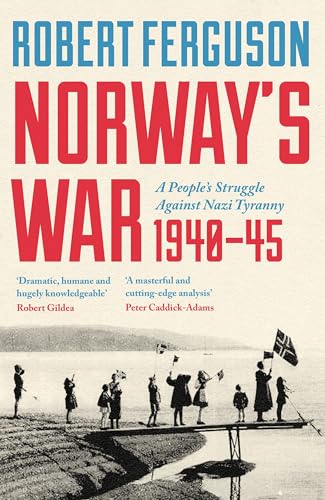
Norway's War
by Robert Ferguson
"A People's Struggle Against Nazi Tyranny, 1940-45"
Popularity
0 / 5
* A book's popularity is determined by how it compares to all other books on this website.
Where to buy?
Buy from Amazon* If you buy this book through the link above, we may receive a small commission at no extra cost to you.
Norway's War by Robert Ferguson
Details
War:
World War II
Perspective:
Civilian
True Story:
Yes
Biography:
Yes
Region:
Europe
Published Date:
2025
ISBN13:
9781801104821
Summary
Norway's War by Robert Ferguson chronicles Norway's resistance during the Nazi occupation from 1940 to 1945. The book examines how ordinary Norwegians opposed German tyranny through acts of defiance, sabotage, and organized resistance movements. Ferguson explores the experiences of civilians, resistance fighters, and collaborators, detailing the psychological and physical toll of occupation. The narrative covers key events including the initial invasion, the persecution of Norwegian Jews, and various resistance operations. Drawing on personal accounts and historical records, the book provides a comprehensive look at how a small nation maintained its spirit and fought back against overwhelming military force.
Review of Norway's War by Robert Ferguson
Robert Ferguson's "Norway's War: A People's Struggle Against Nazi Tyranny, 1940-45" offers a comprehensive examination of Norway's experience during World War II, moving beyond military chronicles to illuminate the complex social, political, and moral dimensions of life under occupation. Ferguson, known for his previous works on Scandinavian history and culture, brings both scholarly rigor and narrative accessibility to this account of a nation thrust into conflict.
The book opens with the shocking German invasion of April 1940, when Nazi forces violated Norwegian neutrality in a swift and calculated assault. Ferguson details the two-month campaign that followed, examining both the military responses and the difficult decisions faced by Norway's government and King Haakon VII. The narrative captures the confusion and chaos of those initial weeks, when Norwegian forces, supported by British and French troops, attempted to resist the German advance before ultimately being overwhelmed by superior numbers and tactical advantages.
What distinguishes this work from purely military histories is Ferguson's attention to the human dimension of occupation. The book explores how ordinary Norwegians navigated the compromises and dangers of daily life under Nazi rule. Ferguson examines the emergence of resistance movements, from small acts of civil disobedience to organized sabotage operations. The account includes coverage of significant resistance actions, such as the heavy water sabotage operations at Vemork, which aimed to prevent Nazi Germany from developing nuclear weapons capabilities.
Ferguson does not shy away from uncomfortable truths about collaboration and moral ambiguity during the occupation years. The book discusses Vidkun Quisling, whose name became synonymous with treachery, and the Norwegian Nazi party he led. The author examines how Quisling's collaboration with German authorities created a puppet government that attempted to legitimize Nazi rule, though it never gained widespread support among the Norwegian population. Ferguson's treatment of collaboration is nuanced, recognizing that survival under occupation often required difficult choices that existed in gray areas between resistance and complicity.
The book also addresses the fate of Norwegian Jews during the Holocaust. Ferguson documents how approximately half of Norway's small Jewish population was deported to death camps, primarily to Auschwitz, in 1942. The narrative acknowledges both the failures to protect this vulnerable population and the efforts of many Norwegians who risked their lives to help Jews escape to neutral Sweden. This section of the book serves as a sobering reminder of how the Holocaust extended throughout occupied Europe.
Ferguson devotes considerable attention to the role of culture and identity in sustaining Norwegian resistance. The book explores how symbols, literature, and shared cultural values became tools of defiance. Teachers who refused to join Nazi-controlled professional organizations, clergy who resisted pressure to support the occupation regime, and journalists who published underground newspapers all contributed to maintaining Norwegian identity and morale during the occupation years.
The narrative extends beyond Norway's borders to examine the government-in-exile in London and the Norwegian forces that continued fighting alongside the Allies. Ferguson discusses the diplomatic challenges faced by exiled leaders and the importance of maintaining international recognition of Norwegian sovereignty. The book also covers the Norwegian merchant fleet, which played a significant role in Allied supply lines throughout the war.
As the war progressed toward its conclusion, Ferguson documents the increasing boldness of resistance activities and the growing strain on German occupying forces. The book covers the liberation in May 1945 and the complex process of rebuilding Norwegian society. Questions of justice, reconciliation, and accountability arose as Norwegians confronted collaborators and began the difficult work of healing a divided nation.
Ferguson's writing balances historical detail with readability, making the book accessible to general readers while maintaining the depth expected by those familiar with World War II history. The author draws on a range of sources, including personal accounts, official records, and previous scholarship, to construct a multifaceted portrait of Norway during these years. The book succeeds in presenting Norwegian experiences within the broader context of World War II while honoring the specific character of Norway's struggle.
"Norway's War" stands as a valuable contribution to understanding how smaller nations experienced World War II, moving beyond the dominant narratives centered on major powers. Ferguson's work reminds readers that the war's impact was deeply personal for millions who faced occupation, resistance, and survival in their own communities. The book serves both as historical documentation and as a tribute to those who maintained their humanity and principles during one of history's darkest periods.


