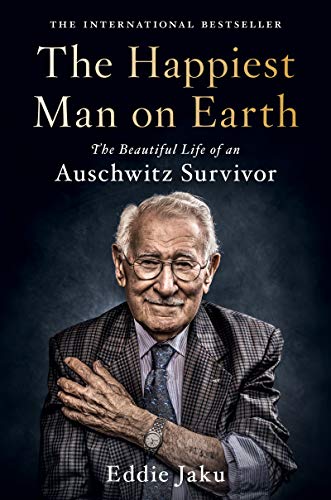
The Happiest Man on Earth
by Eddie Jaku
"The Beautiful Life of an Auschwitz Survivor"
Popularity
4.98 / 5
* A book's popularity is determined by how it compares to all other books on this website.
Where to buy?
Buy from Amazon* If you buy this book through the link above, we may receive a small commission at no extra cost to you.
The Happiest Man on Earth by Eddie Jaku
Details
War:
World War II
Perspective:
Prisoners of War
True Story:
Yes
Biography:
Yes
Region:
Europe
Page Count:
208
Published Date:
2021
ISBN13:
9780063097681
Summary
Eddie Jaku's memoir recounts his experiences as a Jewish Holocaust survivor who endured Auschwitz and other concentration camps during World War II. Despite suffering unimaginable trauma and loss, including the deaths of family members, Jaku chose to focus on gratitude, kindness, and friendship rather than bitterness. Written when he was 100 years old, the book shares his philosophy on finding happiness and meaning in life after surviving one of history's darkest periods. It serves as both a historical testimony and an inspirational guide about resilience, forgiveness, and choosing joy.
Review of The Happiest Man on Earth by Eddie Jaku
Eddie Jaku's memoir stands as a remarkable testament to the resilience of the human spirit in the face of unimaginable horror. Published in 2020 when Jaku was 100 years old, this autobiography chronicles his experiences as a Jewish teenager in Nazi Germany, his survival of Auschwitz and other concentration camps, and his decision to embrace happiness and gratitude in the decades that followed. The book offers readers an intimate portrait of a man who chose to define himself not by his suffering, but by his capacity for joy and human connection.
Born Abraham Jakubowicz in Leipzig, Germany in 1920, Jaku grew up in a family that considered itself thoroughly German. His early life was marked by privilege and promise until the Nazi rise to power shattered his world. The memoir details how his identity was violently stripped away, beginning with Kristallnacht in 1938 when he was beaten and his family's business destroyed. These opening chapters establish the cruel irony at the heart of his story: a young man who loved Germany and considered himself German was told he did not belong.
The narrative follows Jaku through multiple concentration camps, including Buchenwald and Auschwitz, where he was tattooed with the number that would mark him for life. His accounts of camp life are vivid and unflinching, describing the daily struggle for survival, the constant threat of death, and the small acts of humanity that occasionally pierced through the darkness. What distinguishes this memoir from other Holocaust testimonies is not the horror it contains, but the philosophical framework Jaku brings to his memories. He does not dwell on hatred or bitterness, though he certainly acknowledges the evil he witnessed and endured.
One of the most poignant threads running through the book is Jaku's relationship with his family. He describes the pain of being separated from his parents, who were murdered in the camps, and his reunion with Flore, the woman who would become his wife. Their love story, which began before the war and survived years of separation and uncertainty, provides an emotional anchor to the narrative. Jaku credits Flore with giving him reason to survive and later helping him build a new life in Australia, where they emigrated after the war.
The post-war sections of the memoir explore how Jaku rebuilt his existence from nothing. He and Flore settled in Sydney, where he established a successful business and raised a family. The transformation from broken survivor to thriving immigrant entrepreneur is presented not as a miraculous recovery but as a deliberate choice. Jaku made a conscious decision to focus on gratitude, friendship, and the small pleasures of daily life. This philosophy, which he developed over decades, forms the core message of the book.
Jaku's writing style, shaped with the assistance of his family, is straightforward and accessible. The prose is simple but never simplistic, conveying complex emotions and experiences without elaborate literary flourishes. This directness serves the material well, allowing the power of his story to speak for itself. The book moves chronologically, making it easy to follow while building emotional momentum toward his central thesis about choosing happiness.
In his later years, Jaku became a prominent Holocaust educator, speaking to thousands of students and community groups about his experiences. The memoir reflects this educational mission, as he repeatedly emphasizes the importance of remembering the past while not being consumed by it. His message is neither naive optimism nor denial of suffering, but rather a hard-won wisdom about where to direct one's attention and energy.
The title itself encapsulates Jaku's approach to life. Calling himself the happiest man on earth might seem incongruous given his history, but he explains that happiness is a choice made possible by surviving when so many did not. He views each day as a gift and each friendship as precious. This perspective, forged in the camps where he learned the value of a crust of bread or a kind word, carried him through a century of life.
The book has resonated with readers worldwide, becoming an international bestseller and introducing Jaku's story to a new generation. It serves multiple purposes: as historical testimony, as philosophical reflection, and as inspiration. The memoir does not minimize the Holocaust or suggest that positive thinking can overcome systemic evil, but it does demonstrate that individuals can choose how they respond to trauma and what legacy they leave behind. Eddie Jaku's decision to share his story in his final years has ensured that his message of hope, friendship, and the possibility of joy after darkness will endure beyond his lifetime.


![The Tattooist of Auschwitz [Movie-Tie-In]](https://m.media-amazon.com/images/I/51oBZ7tuzeL._SL500_.jpg)


