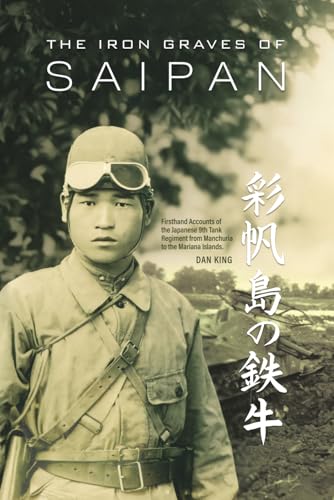
The Iron Graves of Saipan
by Dan King
"Firsthand Accounts of the Japanese 9th Tank Regiment from Manchuria to the Mariana Islands"
Popularity
4.87 / 5
* A book's popularity is determined by how it compares to all other books on this website.
Where to buy?
Buy from Amazon* If you buy this book through the link above, we may receive a small commission at no extra cost to you.
The Iron Graves of Saipan by Dan King
Details
War:
World War II
Perspective:
Tanks
True Story:
Yes
Biography:
No
Region:
Pacific
Published Date:
2025
ISBN13:
9798264300752
Summary
The Iron Graves of Saipan presents firsthand accounts from Japanese soldiers of the 9th Tank Regiment during World War II. Author Dan King chronicles the regiment's journey from Manchuria to their final stand in the Mariana Islands during the Battle of Saipan in 1944. The book offers rare perspectives from Japanese tankers, documenting their experiences, tactics, and ultimate fate in one of the Pacific War's bloodiest campaigns. Through personal testimonies and historical research, it provides insight into a lesser-known aspect of the Pacific theater from the Japanese military perspective.
Review of The Iron Graves of Saipan by Dan King
Dan King's "The Iron Graves of Saipan" presents a meticulously researched examination of the Japanese 9th Tank Regiment, tracing its journey from the plains of Manchuria to its final stand in the Mariana Islands during World War II. This work distinguishes itself through its reliance on firsthand accounts from Japanese tank crewmen, offering a perspective rarely explored in English-language military histories of the Pacific War.
The book chronicles the regiment's formation and early operations in Manchuria, where Japanese armored forces developed tactics and doctrine that would later prove inadequate against American firepower in the Pacific theater. King draws extensively from Japanese veterans' testimonies, providing detailed accounts of training regimens, tank crew dynamics, and the logistical challenges faced by Japanese armored units operating far from their industrial base. These personal narratives reveal the human dimension of soldiers who found themselves serving in increasingly obsolete equipment as the war progressed.
A significant portion of the narrative focuses on the regiment's deployment to Saipan in 1944, where it would face overwhelming American material superiority during Operation Forager. The accounts detail the mounting sense of desperation among Japanese forces as they confronted not only superior American tanks and anti-tank weapons but also devastating naval gunfire and air support. King's presentation of these firsthand testimonies illuminates the tactical and strategic difficulties inherent in Japanese defensive doctrine, which often relied on aggressive counterattacks that played into American strengths.
The title's reference to "iron graves" proves tragically literal, as King documents how Japanese tanks became death traps for their crews during the Battle of Saipan. The firsthand accounts describe the terror of being trapped inside thin-skinned vehicles subjected to American flamethrowers, high-explosive rounds, and close-assault tactics. These narratives provide sobering insights into the brutal nature of armored warfare in the Pacific, where Japanese crews often faced the choice between burning alive or attempting escape under withering fire.
King's research methodology deserves particular recognition. The author has clearly invested considerable effort in locating and translating primary source materials from Japanese veterans and military records. This commitment to authentic voices sets the work apart from many Western accounts that rely primarily on American sources. The testimonies reveal not only tactical details but also the psychological strain experienced by tank crews who understood the obsolescence of their equipment yet remained committed to their mission.
The book also addresses the broader context of Japanese armored doctrine and its limitations in the Pacific theater. While Japanese tanks had proven adequate against Chinese forces in Manchuria, they were fundamentally outmatched by American M4 Shermans and supporting arms in the island campaigns. The accounts from 9th Tank Regiment veterans illustrate this technological gap through specific engagements, describing how their Type 95 Ha-Go and Type 97 Chi-Ha tanks struggled to penetrate American armor while remaining vulnerable to nearly every weapon in the American arsenal.
One of the work's strengths lies in its treatment of the regiment's final actions on Saipan. Rather than presenting a sanitized or heroic narrative, King allows the veterans' voices to convey the chaos, confusion, and ultimate futility of the Japanese defense. The accounts describe the progressive destruction of the tank regiment through a series of costly engagements, culminating in the desperate final days of the battle when remaining crews fought as infantry or conducted suicide attacks with whatever resources remained.
The book provides valuable context for understanding the Japanese military experience during the Pacific War's latter stages. The transition from offensive operations in Manchuria to desperate defensive stands on isolated islands represented a fundamental shift that Japanese forces struggled to manage effectively. The 9th Tank Regiment's experience encapsulates this larger strategic failure, as units trained for mobile warfare found themselves confined to static defensive positions with diminishing supplies and no hope of reinforcement.
King's work makes an important contribution to Pacific War historiography by centering Japanese perspectives and experiences. The detailed accounts of tank operations, crew experiences, and the regiment's ultimate destruction on Saipan provide insights that complement existing American accounts of the battle. For readers interested in armored warfare, Japanese military history, or the Battle of Saipan specifically, this book offers valuable primary source material presented in accessible narrative form.
"The Iron Graves of Saipan" succeeds in documenting a overlooked aspect of Pacific War history through careful research and respect for its sources. The firsthand accounts preserved in this work provide future researchers and interested readers with authentic voices from an often-silenced perspective, making it a noteworthy addition to the literature on World War II in the Pacific.