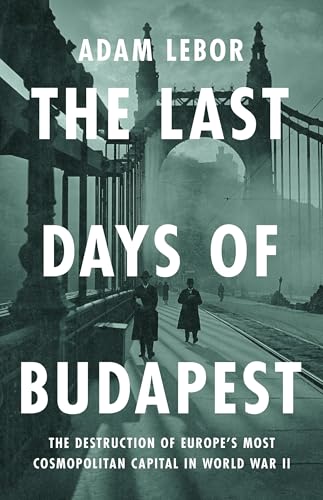
The Last Days of Budapest
by Adam LeBor
"The Destruction of Europe's Most Cosmopolitan Capital in World War II"
Popularity
4.89 / 5
* A book's popularity is determined by how it compares to all other books on this website.
Where to buy?
Buy from Amazon* If you buy this book through the link above, we may receive a small commission at no extra cost to you.
The Last Days of Budapest by Adam LeBor
Details
War:
World War II
Perspective:
Civilian
True Story:
Yes
Biography:
No
Region:
Europe
Page Count:
321
Published Date:
2025
ISBN13:
9781541700604
Summary
The Last Days of Budapest chronicles the final months of World War II in Hungary's capital, examining how one of Europe's most vibrant and culturally diverse cities was devastated by Nazi occupation and Soviet siege. Adam LeBor documents the systematic persecution of Budapest's Jewish population, the brutal urban warfare that destroyed much of the city, and the heroic efforts of diplomats like Raoul Wallenberg who saved thousands of lives. The book captures the human tragedy behind the political and military events that transformed this cosmopolitan metropolis into a battleground and marked the end of an era.
Review of The Last Days of Budapest by Adam LeBor
Adam LeBor's "The Last Days of Budapest" offers a compelling examination of one of World War II's most tragic urban catastrophes. The book chronicles the final months of the Hungarian capital as it descended from a vibrant, multicultural European metropolis into a scene of devastation, genocide, and military destruction between late 1944 and early 1945. LeBor, an experienced journalist and historian with expertise in Central European affairs, brings together multiple narrative threads to capture the complexity of Budapest's collapse during this dark period.
The strength of this work lies in its ability to weave together the experiences of various groups caught in Budapest's final wartime chapter. LeBor documents the plight of the city's Jewish population, which faced systematic persecution and murder even as Soviet forces approached. The Hungarian Arrow Cross Party, which came to power in October 1944, unleashed a campaign of terror against Jews that shocked even some German officials with its brutality. The author details how tens of thousands of Jews were forced on death marches toward Austria, while thousands more were shot along the banks of the Danube River, their bodies thrown into the freezing water.
The book also examines the efforts of diplomatic figures who worked to save lives during this period. LeBor gives considerable attention to Raoul Wallenberg, the Swedish diplomat whose protective passes and safe houses rescued thousands of Budapest Jews. The narrative includes the activities of other diplomats from neutral countries who established safe houses and issued protective documents, creating what became known as the "international ghetto" in Budapest. These accounts provide moments of moral courage against the backdrop of widespread atrocity and indifference.
LeBor's research draws on multiple sources, including survivor testimonies, diplomatic cables, military records, and contemporary accounts. This approach allows him to construct a detailed picture of daily life in the besieged city. The book describes how residents coped with shortages of food, water, and fuel during one of the coldest winters on record. The siege itself lasted more than fifty days, as German and Hungarian forces attempted to defend the city against the advancing Red Army. The urban combat resulted in widespread destruction of historic buildings, bridges, and entire neighborhoods.
The narrative does not shy away from examining the complex political situation that led to Budapest's fate. Hungary had been allied with Nazi Germany for much of the war, and Hungarian forces participated in military operations on the Eastern Front. However, as the war turned against the Axis powers, Hungarian leaders attempted unsuccessfully to negotiate a separate peace with the Allies. These efforts led to a German occupation of Hungary in March 1944 and the eventual installation of the Arrow Cross regime later that year. LeBor traces how these political maneuvers sealed Budapest's fate and intensified the suffering of its civilian population.
The author also explores the experiences of ordinary Hungarians who were neither perpetrators nor members of targeted groups. Many residents found themselves trapped between competing armies, facing danger from artillery, aerial bombardment, and street fighting. The book documents how some Hungarians risked their lives to hide Jewish neighbors, while others participated in or profited from persecution. This nuanced portrayal avoids simplistic characterizations and acknowledges the difficult moral terrain individuals navigated during this period.
One of the book's notable contributions is its attention to the aftermath of liberation. LeBor describes how the arrival of Soviet forces, while ending the immediate threat of Nazi genocide, brought new forms of violence and hardship. Soviet soldiers committed widespread acts of looting, assault, and rape. The Red Army's occupation marked the beginning of communist rule in Hungary, which would last for more than four decades. The book thus positions the siege not merely as an endpoint but as a transition between different forms of authoritarianism.
The writing maintains clarity throughout, making the complex sequence of events accessible without oversimplifying the historical record. LeBor's journalistic background serves him well in creating vivid scenes while maintaining factual precision. The book balances detailed descriptions of specific incidents with broader analysis of the political and military context. This approach helps readers understand both the individual human cost and the larger historical significance of Budapest's destruction.
"The Last Days of Budapest" serves as an important contribution to the literature on World War II's final months and the Holocaust in Hungary. The book illuminates a chapter of the war that has received less attention in English-language histories than events in Western Europe. For readers seeking to understand the full scope of the war's devastation and the particular tragedy that befell Budapest's Jewish community, LeBor's thoroughly researched account provides essential context and compelling narrative.


