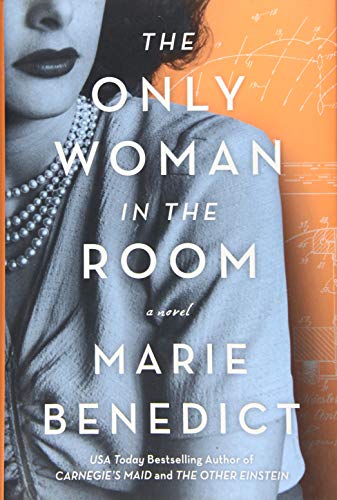
The Only Woman in the Room
by Marie Benedict
Popularity
4.81 / 5
* A book's popularity is determined by how it compares to all other books on this website.
Where to buy?
Buy from Amazon* If you buy this book through the link above, we may receive a small commission at no extra cost to you.
The Only Woman in the Room by Marie Benedict
Details
War:
World War II
Perspective:
Civilian
Biography:
No
Region:
Europe
Published Date:
2019
ISBN13:
9781492666868
Summary
The Only Woman in the Room is a historical fiction novel about Hedy Lamarr, the glamorous Hollywood actress who led a secret double life as an inventor. The story follows her escape from an oppressive marriage to an Austrian arms dealer in the 1930s to her rise as a film star in America. Beyond her beauty and fame, Lamarr applied her brilliant scientific mind to help the Allied war effort during World War II, developing a groundbreaking frequency-hopping technology that would later become foundational to modern wireless communications, including WiFi and Bluetooth.
Review of The Only Woman in the Room by Marie Benedict
Marie Benedict's "The Only Woman in the Room" brings to light the extraordinary life of Hedy Lamarr, a figure whose Hollywood glamour obscured one of the most remarkable scientific minds of the twentieth century. This biographical novel explores the dichotomy between Lamarr's public persona as a stunning actress and her private identity as an inventor whose contributions would eventually help shape modern wireless communication technology.
The narrative begins in 1930s Vienna, where Hedy Kiesler, as she was known before her Hollywood transformation, finds herself trapped in a marriage to Friedrich Mandl, an Austrian arms dealer with dangerous political connections. Benedict portrays this period with careful attention to the historical context, depicting how Lamarr's position as Mandl's wife provided her with unwitting access to sensitive military and technological discussions. These enforced attendances at business dinners and meetings, meant to showcase her as a beautiful accessory, instead became an unconventional education in weapons technology and military strategy.
The author's portrayal of Lamarr's escape from this oppressive marriage and her subsequent reinvention in Hollywood demonstrates the resilience and determination that characterized her entire life. Benedict captures the complexity of a woman who understood that her physical beauty opened doors but simultaneously became a prison of different expectations. The transition from European sophistication to Hollywood stardom is rendered with nuance, showing both the opportunities and limitations that came with her new life in America.
What distinguishes this novel is its focus on Lamarr's scientific achievements, particularly her development of frequency-hopping spread spectrum technology during World War Two. Working alongside composer George Antheil, Lamarr conceived of a communication system that would prevent the jamming of radio-controlled torpedoes by rapidly switching frequencies. Benedict presents this invention not as a sudden flash of genius but as the culmination of knowledge accumulated during those oppressive years in Vienna, combined with Lamarr's natural aptitude for mathematics and problem-solving.
The book does not shy away from the frustrations Lamarr faced in having her contributions taken seriously. Despite patenting the technology in 1942, the U.S. Navy initially dismissed the invention, and Lamarr was encouraged instead to use her celebrity status to sell war bonds. This rejection speaks to the broader historical tendency to undervalue women's intellectual contributions, particularly when those women were also recognized for their physical appearance. Benedict handles this aspect of the story with appropriate gravity, allowing the historical injustice to speak for itself without veering into didactic commentary.
The writing style is accessible and engaging, making complex technological concepts understandable without oversimplification. Benedict strikes a balance between biographical detail and narrative momentum, keeping the story moving while providing sufficient context for readers to appreciate the significance of Lamarr's achievements. The dialogue, while necessarily imagined in a biographical novel, feels period-appropriate and serves to reveal character rather than simply convey information.
The novel's structure effectively mirrors Lamarr's dual existence, moving between her public life in Hollywood and her private pursuits in invention. The contrast between glamorous film premieres and solitary hours spent at a drafting table emphasizes the compartmentalization required of someone living such divergent realities. Benedict's research is evident throughout, grounding the narrative in verifiable historical facts while filling in the emotional and psychological dimensions that primary sources cannot fully capture.
One of the book's strengths lies in its exploration of identity and self-determination. Lamarr's journey involves multiple reinventions, each undertaken as a means of survival or escape, yet each also representing a assertion of agency in circumstances that sought to define her solely through others' perceptions. The tension between how the world saw her and how she saw herself provides a compelling throughline that resonates beyond the specific historical moment.
The recognition that eventually came to Lamarr late in her life, when the significance of her frequency-hopping technology was finally acknowledged as foundational to modern WiFi, Bluetooth, and GPS technologies, provides a measure of vindication to the narrative. However, Benedict does not present this as a wholly satisfying resolution, acknowledging that posthumous recognition cannot compensate for decades of dismissal and obscurity regarding her scientific work.
"The Only Woman in the Room" succeeds as both an engaging biographical novel and an important recovery of a overlooked historical figure. Benedict's treatment of Hedy Lamarr presents a fully realized individual whose story challenges simplified narratives about beauty, intelligence, and the recognition of women's contributions to science and technology. The book serves as a reminder that history often overlooks those who do not fit convenient categories, and that the work of uncovering these stories remains vital and ongoing.


