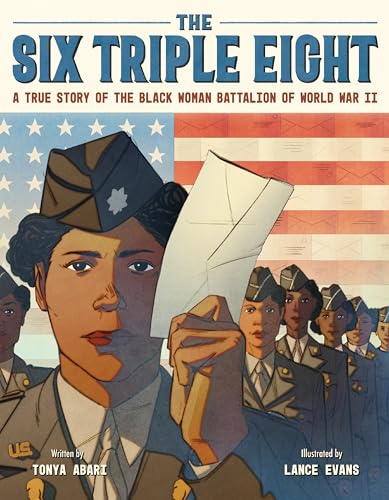
The Six Triple Eight
by Tonya Abari
"A True Story of the Black Woman Battalion of World War II"
Popularity
4.87 / 5
* A book's popularity is determined by how it compares to all other books on this website.
Where to buy?
Buy from Amazon* If you buy this book through the link above, we may receive a small commission at no extra cost to you.
The Six Triple Eight by Tonya Abari
Details
War:
World War II
Perspective:
Logistics
Military Unit:
US Army
True Story:
Yes
Biography:
Yes
Region:
Europe
Published Date:
2025
ISBN13:
9780063265769
Summary
The Six Triple Eight tells the remarkable true story of the 855th Central Postal Directory Battalion, the only all-Black women's unit to serve overseas during World War II. These pioneering women traveled to Europe in 1945 to tackle a massive backlog of undelivered mail that was devastating troop morale. Working around the clock in difficult conditions while facing both racism and sexism, they processed millions of pieces of mail with extraordinary efficiency. This book honors their vital but long-overlooked contribution to the war effort and celebrates their determination and resilience.
Review of The Six Triple Eight by Tonya Abari
Tonya Bolden's "The Six Triple Eight" brings to light one of the most overlooked chapters of World War II history: the story of the 855 Black women who formed the only all-Black Women's Army Corps battalion to serve overseas during the war. The 6888th Central Postal Directory Battalion, known as the Six Triple Eight, took on the monumental task of clearing a massive backlog of mail for American service members stationed in Europe, and Bolden's account serves as both historical record and tribute to these pioneering women.
The book opens with the context that made the formation of this unit both necessary and groundbreaking. As millions of American soldiers served overseas, mail became a crucial lifeline connecting them to loved ones back home. By 1945, warehouses in England and France were overflowing with undelivered packages and letters, some dating back years. Morale among troops was suffering, and the War Department needed a solution. The decision to deploy the Six Triple Eight represented a significant moment, as these women would face not only the challenges of their mission but also the double burden of racism and sexism in the military.
Bolden provides careful attention to the individual women who made up the battalion, ensuring they are not simply reduced to statistics or a collective entity. Through her research, she presents the backgrounds, motivations, and personal stories of various members, illustrating the diversity within the unit. These women came from different parts of the United States, brought varied educational backgrounds and life experiences, and shared a common determination to serve their country despite the discrimination they faced at home.
The operational achievement of the Six Triple Eight forms a central element of the narrative. Upon arrival in Birmingham, England, in February 1945, the battalion confronted warehouses filled with millions of pieces of mail in chaotic disarray. Letters had been improperly addressed, soldiers had been transferred or killed, and the existing system had completely broken down. Working in shifts around the clock in unheated, rat-infested buildings, these women devised and implemented an efficient tracking system. They processed an average of 65,000 pieces of mail per shift, completing in three months a task that had been estimated to take six months. Later, they continued their work in Rouen, France, and then in Paris.
The book does not shy away from the discrimination and obstacles these women encountered. Even while serving their country overseas, they faced segregation, unequal treatment, and prejudice from both military leadership and fellow American service members. Bolden documents how the battalion's commanding officer, Major Charity Adams, stood firm against attempts to undermine her authority and the dignity of her troops. The strength and professionalism these women maintained in the face of such treatment adds another dimension to their already remarkable story.
Bolden's writing style makes the historical material accessible without oversimplifying the complexities of the era. She incorporates period photographs, documents, and other primary sources that enhance the narrative and provide visual connection to the women and their work. The book successfully balances the larger historical significance of the battalion with the human stories of the individuals who served, making both the collective achievement and personal sacrifices clear.
The historical importance of the Six Triple Eight extends beyond their postal mission. These women proved that Black women could handle complex logistical operations, work under pressure, and excel in military service. Their success challenged prevailing stereotypes and contributed to the gradual integration of the armed forces. Despite their achievements, the battalion received little recognition for decades, a fact that Bolden addresses as part of the broader pattern of marginalization of Black women's contributions to American history.
One of the book's strengths lies in its ability to serve multiple audiences. Young readers can find inspiration in the courage and determination of these women, while adults and educators will appreciate the thorough research and historical detail. The narrative provides important context about World War II, the Women's Army Corps, and the state of race relations in 1940s America without becoming bogged down in excessive detail.
"The Six Triple Eight" fills a significant gap in World War II literature and African American history. By documenting the service and sacrifice of these remarkable women, Bolden ensures that their contributions are preserved and recognized. The book stands as both an engaging historical account and an important corrective to the incomplete narratives that have dominated discussions of the war for too long. For readers seeking to understand the full scope of American participation in World War II and the often-invisible contributions of Black women to the war effort, this book provides essential and compelling reading.


