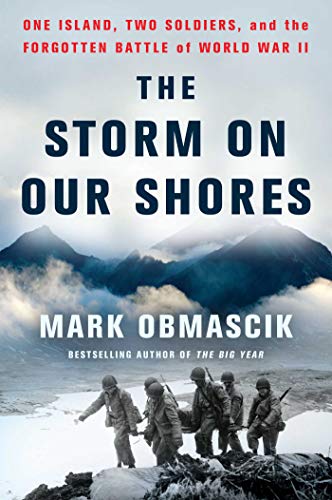
The Storm on Our Shores
by Mark Obmascik
"One Island, Two Soldiers, and the Forgotten Battle of World War II"
Popularity
4.44 / 5
* A book's popularity is determined by how it compares to all other books on this website.
Where to buy?
Buy from Amazon* If you buy this book through the link above, we may receive a small commission at no extra cost to you.
The Storm on Our Shores by Mark Obmascik
Details
War:
World War II
Perspective:
Commanders
True Story:
Yes
Biography:
Yes
Region:
Pacific
Page Count:
256
Published Date:
2019
ISBN13:
9781451678376
Summary
The Storm on Our Shores tells the true story of two soldiers on opposite sides of the Battle of Attu in Alaska's Aleutian Islands during World War II. Mark Obmascik chronicles the brutal 1943 conflict between American Army officer Dick Laird and Japanese medic Paul Nobuo Tatsuguchi on this remote, fog-shrouded battlefield. The book explores their parallel lives, the harsh conditions of warfare in the Aleutians, and the human cost of a largely forgotten campaign. Through these two men's experiences, Obmascik illuminates a overlooked chapter of the Pacific War.
Review of The Storm on Our Shores by Mark Obmascik
Mark Obmascik's "The Storm on Our Shores" delivers a gripping account of the Battle of Attu, one of World War II's most overlooked campaigns. This meticulously researched narrative focuses on two soldiers who fought on opposite sides of this brutal conflict in the Aleutian Islands: Dick Laird, an American army officer, and Paul Nobuo Tatsuguchi, a Japanese-American surgeon serving in the Imperial Japanese Army. Through their parallel stories, Obmascik illuminates a forgotten chapter of the war while exploring themes of loyalty, identity, and the complexities of wartime allegiances.
The Battle of Attu, fought in May 1943 on a remote Alaskan island, represents the only land battle fought on incorporated U.S. territory during World War II. Despite its historical significance, this campaign has largely faded from public memory, overshadowed by simultaneous operations in the Pacific and European theaters. Obmascik rescues this story from obscurity by anchoring his narrative in the personal experiences of two men whose lives intersected in the most unlikely and tragic of circumstances.
The book's central irony lies in the background of Paul Nobuo Tatsuguchi, a devout Seventh-day Adventist who had studied medicine in California before returning to Japan. Tatsuguchi had American friends, spoke fluent English, and harbored no hatred for Americans, yet found himself conscripted into the Japanese military and stationed on a desolate island thousands of miles from home. His diary, discovered after the battle, provides an intimate window into the desperate conditions faced by Japanese forces and serves as one of the book's most poignant primary sources.
Dick Laird's story offers the American perspective on this harrowing campaign. Obmascik traces Laird's journey from civilian life to the frozen, fog-shrouded battlefields of Attu, where American forces confronted not only a determined enemy but also some of the most unforgiving terrain and weather conditions imaginable. The Aleutian climate proved as dangerous as enemy fire, with soldiers battling hypothermia, trench foot, and the psychological toll of constant fog and isolation.
Obmascik excels at conveying the harsh realities of the Attu campaign. The island's treeless landscape, perpetual dampness, and bitter winds created a hellish environment for combat. American forces, many of whom had trained in desert conditions, found themselves woefully unprepared for Arctic warfare. The Japanese defenders, entrenched in the island's mountains and valleys, fought with characteristic determination despite dwindling supplies and no hope of reinforcement or evacuation.
The narrative builds toward the battle's climactic final days, when Japanese forces launched one of the largest banzai charges of the Pacific War. This desperate assault resulted in devastating casualties on both sides and effectively ended organized Japanese resistance on Attu. The author handles these brutal scenes with appropriate gravity, neither glorifying violence nor shying away from the battle's horrific human cost.
What distinguishes this book from conventional military histories is its focus on the human dimension of war. By centering the narrative on two individuals rather than grand strategy or tactical movements, Obmascik creates an emotionally resonant story that transcends the usual boundaries of war literature. The contrast between the two soldiers' backgrounds, particularly Tatsuguchi's American education and religious faith, underscores the arbitrary nature of wartime divisions and the personal tragedies that result from global conflict.
The research supporting this narrative is evident throughout. Obmascik draws on military records, personal correspondence, survivor interviews, and Tatsuguchi's diary to reconstruct events with careful attention to historical accuracy. The author visited Attu and consulted with veterans and their families, lending authenticity to his descriptions of both the island's geography and the battle's human drama.
The writing style remains accessible without sacrificing depth or nuance. Obmascik, an experienced journalist and author, demonstrates skill at pacing the narrative to maintain reader engagement while incorporating necessary historical context. The prose balances vivid scene-setting with clear exposition, making complex military operations understandable without overwhelming readers with tactical minutiae.
"The Storm on Our Shores" also serves as a meditation on memory and historical preservation. By rescuing the Battle of Attu from obscurity, Obmascik performs an important service for both American and Japanese readers. The book acknowledges the sacrifices made by soldiers on both sides while never losing sight of the larger moral context of World War II.
This work stands as both compelling narrative history and a thoughtful examination of war's human cost. Through meticulous research and skilled storytelling, Obmascik has created a fitting memorial to those who fought and died on a remote island that most Americans have never heard of, reminding readers that every battle, no matter how forgotten, consisted of individual human beings with stories worth remembering.


