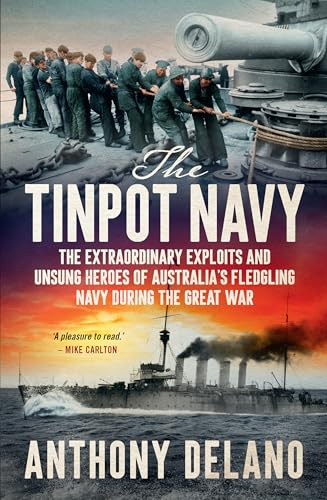
The Tinpot Navy
by Anthony Delano
"The extraordinary exploits and unsung heroes of Australia's fledgling navy during the Great War"
Popularity
3.26 / 5
* A book's popularity is determined by how it compares to all other books on this website.
Where to buy?
Buy from Amazon* If you buy this book through the link above, we may receive a small commission at no extra cost to you.
The Tinpot Navy by Anthony Delano
Details
War:
World War I
True Story:
Yes
Biography:
No
Region:
Australia/Oceania
Page Count:
370
Published Date:
2025
ISBN13:
9781761506017
Summary
The Tinpot Navy chronicles the remarkable story of Australia's newly formed Royal Australian Navy during World War I. Author Anthony Delano details the daring missions and overlooked contributions of Australian naval personnel who, despite having limited resources and minimal experience, played crucial roles in the war effort. The book highlights forgotten heroes and extraordinary exploits across various theaters of war, from the Pacific to the Mediterranean. Through meticulous research, Delano brings to light the bravery and ingenuity of these sailors who helped establish Australia's naval tradition during the nation's formative years.
Review of The Tinpot Navy by Anthony Delano
Anthony Delano's "The Tinpot Navy" offers a compelling examination of the Royal Australian Navy's formative years during World War I, a period when Australia's naval forces were still finding their footing on the global stage. The book sheds light on a chapter of military history that has often been overshadowed by the better-known land campaigns at Gallipoli and the Western Front, providing readers with a detailed account of the maritime contributions that helped shape the nation's identity.
The narrative centers on the early years of the Royal Australian Navy, which had only been established in 1911, just three years before the outbreak of the Great War. Delano traces the evolution of this fledgling force from its modest beginnings to its involvement in significant naval operations across multiple theaters of war. The author documents how Australian vessels and their crews participated in operations ranging from the hunt for German raiders in the Pacific to convoy escort duties in European waters, demonstrating the wide-reaching scope of Australia's naval commitment.
One of the book's strengths lies in its focus on the individual stories of sailors and officers who served in these early years. Delano brings to life the experiences of men who crewed destroyers, submarines, and other vessels, often in challenging conditions and far from home. These personal accounts provide a human dimension to the broader strategic narrative, illustrating the courage and resourcefulness required of those who served in what was, by contemporary standards, a relatively inexperienced naval force.
The author examines several key episodes in detail, including the Royal Australian Navy's involvement in the capture of German New Guinea early in the war and the loss of HMAS AE1, Australia's first submarine casualty. The book also covers the service of Australian ships in the North Sea and Mediterranean, where they operated alongside British and allied vessels in convoy protection and anti-submarine warfare. These accounts demonstrate that despite limited resources and experience, Australian naval personnel made meaningful contributions to the Allied war effort.
Delano's research draws on a range of primary sources, including naval records, personal letters, and official reports from the period. This documentation provides authenticity to the narrative and helps establish a clear picture of the operational challenges faced by the early Royal Australian Navy. The author presents the material in an accessible manner, making complex naval operations understandable to readers without specialist knowledge while maintaining sufficient detail to satisfy those with a deeper interest in naval history.
The title "Tinpot Navy" itself reflects the contemporary attitudes and challenges faced by the Australian naval forces. The term captures both the dismissive views held by some observers and the determination of those who served to prove the value and capability of their service. Delano explores this dynamic throughout the book, showing how the Royal Australian Navy gradually earned respect through operational success and the professionalism of its personnel.
The book also addresses the broader context of Australia's naval development, including the political decisions that shaped the force's structure and the relationship between the Australian and British navies during this period. These elements provide important background for understanding the constraints and opportunities that influenced naval operations. The author explains how Australia's geographic position and strategic interests drove certain operational priorities while alliance commitments shaped others.
Delano's writing maintains a steady pace throughout, balancing technical naval details with narrative momentum. The book avoids becoming bogged down in excessive technical specifications while still providing enough detail about vessels, weapons, and tactics to give readers a solid understanding of naval warfare during the period. This balance makes the work accessible to general readers while offering substance for military history enthusiasts.
The book serves as both a historical record and a tribute to those who served in Australia's navy during its earliest operational period. By documenting these experiences and achievements, Delano has created a valuable resource for understanding an important but often overlooked aspect of Australia's military heritage. The work contributes to a more complete picture of the nation's involvement in World War I and the development of its defense capabilities.
"The Tinpot Navy" fills a significant gap in Australian military historiography by giving proper attention to naval personnel whose service has received less recognition than their counterparts in the army. The book demonstrates that the maritime dimension of Australia's war effort was both substantial and worthy of detailed examination, offering readers insight into a critical period in the nation's naval history.


