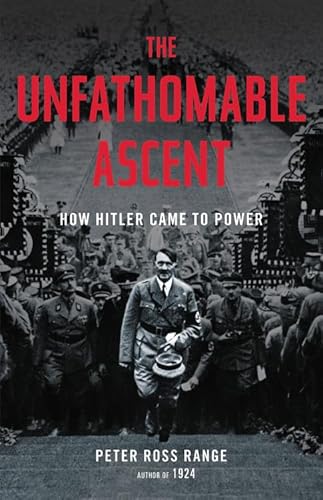
The Unfathomable Ascent
by Peter Ross Range
"How Hitler Came to Power"
Popularity
4.71 / 5
* A book's popularity is determined by how it compares to all other books on this website.
Where to buy?
Buy from Amazon* If you buy this book through the link above, we may receive a small commission at no extra cost to you.
The Unfathomable Ascent by Peter Ross Range
Details
Biography:
No
Published Date:
2020
ISBN13:
9780316435123
Summary
The Unfathomable Ascent chronicles Adolf Hitler's political rise in Germany during the 1920s and early 1930s. Peter Ross Range examines how Hitler transformed from a failed coup leader imprisoned after the 1923 Beer Hall Putsch into Germany's chancellor by 1933. The book analyzes the political maneuvering, propaganda tactics, and exploitation of economic turmoil and social unrest that enabled Hitler's ascent. Range explores how democratic institutions failed to prevent an extremist's climb to power, offering insights into the fragility of democracy when faced with determined authoritarianism and societal crisis.
Review of The Unfathomable Ascent by Peter Ross Range
Peter Ross Range's "The Unfathomable Ascent: How Hitler Came to Power" examines one of the most consequential and troubling questions in modern history: how did a failed artist and fringe political agitator rise to become chancellor of Germany and subsequently establish one of the twentieth century's most destructive regimes? Rather than retelling the full arc of Hitler's life or the atrocities of the Nazi era, Range narrows his focus to the critical period of ascent itself, tracing the political maneuvering, social conditions, and personal transformations that allowed Hitler to move from the margins of Weimar-era politics to the center of German power.
Range, a journalist and historian with prior work on Hitler's early years, brings a narrative-driven approach to this material. The book benefits from his background in reportage, as he writes with clarity and momentum rather than burying the reader in academic analysis. This makes the book accessible to general readers while still offering substantive historical detail for those already familiar with the period. The prose moves briskly through complex political developments, including the fractious coalition politics of the Weimar Republic, the economic devastation of hyperinflation and later the Great Depression, and the backroom negotiations among conservative elites who believed they could control Hitler once he held power.
One of the book's central strengths is its attention to the role played by individuals who are often relegated to footnotes in broader histories of Nazism. Figures such as Franz von Papen, Kurt von Schleicher, and President Paul von Hindenburg receive careful treatment, as Range demonstrates how their miscalculations and political self-interest created the conditions for Hitler's appointment as chancellor in January 1933. This is perhaps the most valuable contribution of the book: it resists the temptation to present Hitler's rise as an inevitable or purely ideological triumph, and instead frames it as the product of contingent decisions, institutional failures, and a political establishment that underestimated the man it sought to use for its own purposes.
Range also explores the cultural and psychological climate of post-World War I Germany, where resentment over the Treaty of Versailles, economic instability, and a widespread yearning for strong leadership created fertile ground for extremist movements. The book does not shy away from detailing the propaganda techniques, the cult of personality cultivated around Hitler, and the paramilitary violence of the SA that intimidated opposition and normalized political brutality. These elements are presented not as abstract historical forces but as concrete, documented strategies that had measurable effects on public opinion and political outcomes.
The pacing of the book is one of its more notable features. Range structures the narrative almost like a countdown, building tension toward the pivotal moment of Hitler's appointment, even though readers know the outcome in advance. This structure works well for maintaining engagement, though it occasionally means that broader context, such as comparative political movements elsewhere in Europe, receives less attention than some readers might want. The book is deliberately focused rather than comprehensive, and this is both its strength and its limitation. Those seeking a sweeping account of interwar European politics will need to look elsewhere, but those interested specifically in the German case will find a tightly argued and well-researched account.
Range draws on a wide range of primary sources, including diaries, letters, and contemporary newspaper accounts, lending the narrative a sense of immediacy. The book avoids melodrama, choosing instead to let the documented facts speak for themselves, which is particularly effective given the gravity of the subject matter. The author's restraint in interpretation, paired with his clear prose, allows readers to draw their own conclusions about the warning signs embedded in this history.
"The Unfathomable Ascent" is ultimately a sobering study of how democratic institutions can be exploited and dismantled through legal and semi-legal means, rather than through outright revolution. It serves as both a historical account and an implicit cautionary tale about the fragility of political systems when elites prioritize short-term advantage over long-term stability. For readers interested in the mechanics of political collapse and the specific sequence of events that enabled Hitler's rise, this book offers a well-researched, clearly written, and historically grounded account worth serious attention.