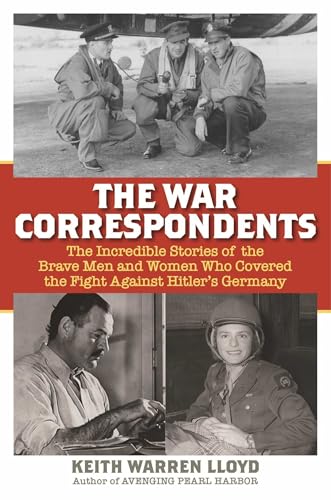
The War Correspondents
by Keith Warren Lloyd
"The Incredible Stories of the Brave Men and Women Who Covered the Fight Against Hitler's Germany"
Popularity
4.93 / 5
* A book's popularity is determined by how it compares to all other books on this website.
Where to buy?
Buy from Amazon* If you buy this book through the link above, we may receive a small commission at no extra cost to you.
The War Correspondents by Keith Warren Lloyd
Details
War:
World War II
Perspective:
War Correspondents
True Story:
Yes
Biography:
No
Region:
Europe
Page Count:
369
Published Date:
2025
ISBN13:
9781493088140
Summary
The War Correspondents chronicles the experiences of journalists who reported from the frontlines during World War II. Keith Warren Lloyd presents the stories of courageous reporters who risked their lives to document the Allied fight against Nazi Germany. The book highlights the dangers these correspondents faced, from combat zones to censorship challenges, while capturing pivotal moments of the war. Through their accounts, readers gain insight into both the brutal realities of warfare and the vital role journalism played in keeping the public informed during one of history's most significant conflicts.
Review of The War Correspondents by Keith Warren Lloyd
Keith Warren Lloyd's "The War Correspondents: The Incredible Stories of the Brave Men and Women Who Covered the Fight Against Hitler's Germany" takes on a subject that has long deserved sustained attention: the journalists, photographers, and broadcasters who risked their lives to document the Second World War's European theater. Rather than retelling the familiar military narrative of the war, Lloyd shifts the focus to the individuals who stood behind typewriters, cameras, and microphones in the midst of combat, air raids, and liberation efforts, bringing their personal courage and professional dedication into sharp relief.
The book's structure follows a roughly chronological arc, tracing the war from its early years through the Allied victory in Europe. Along the way, Lloyd introduces readers to a wide range of correspondents, some well known and others largely forgotten by general audiences. Figures such as Ernie Pyle, whose plainspoken dispatches captured the daily experiences of ordinary soldiers, and Martha Gellhorn, one of the few women to report from the front lines despite official restrictions on female correspondents, receive thoughtful treatment. Lloyd also highlights lesser-known names, giving space to photographers and radio reporters whose work shaped public understanding of the war but whose personal stories have often been overshadowed by more famous contemporaries.
One of the book's strengths lies in its attention to the practical and bureaucratic obstacles these correspondents faced. Lloyd details the censorship rules imposed by military authorities, the logistical challenges of transmitting reports from combat zones, and the constant negotiation between journalistic independence and wartime security concerns. This context helps readers appreciate not only the physical dangers correspondents endured, but also the professional constraints under which they operated. The tension between the desire to report accurately and the need to maintain troop morale and operational secrecy emerges as a recurring theme throughout the narrative.
Lloyd's prose is clear and accessible, avoiding dense academic language while still conveying a sense of historical rigor. The author draws on a range of primary sources, including correspondents' own writings, letters, and published dispatches, to reconstruct both the events they covered and their personal reactions to what they witnessed. This approach lends authenticity to the book and allows readers to hear, in part, the voices of the correspondents themselves rather than relying solely on secondhand summary.
The book does well in illustrating the diversity of experiences among war correspondents. Some worked for major newspapers and wire services, while others broadcast live reports for radio audiences back home, a relatively new and influential medium during this period. Lloyd notes how radio reporting, in particular, brought the immediacy of war into American living rooms in ways print journalism could not replicate. The inclusion of photographers alongside writers broadens the scope of the book, acknowledging the visual record of the war as an equally important form of correspondence.
While the book covers a substantial roster of individuals, the pacing occasionally suffers from the sheer number of figures introduced. Readers seeking deep, sustained biographical treatment of any single correspondent may find the book's broader survey approach leaves some stories feeling abbreviated. However, this breadth also serves the book's larger purpose: demonstrating that the coverage of the war against Nazi Germany was a collective undertaking involving many individuals working under extraordinary pressure, rather than the achievement of a few celebrated names.
Lloyd's work ultimately succeeds in honoring the memory of those who brought the war home to audiences through print, photography, and broadcast. The book serves as both a tribute and a historical record, filling a gap in popular understanding of how information about the war reached the public and at what personal cost. For readers interested in military history, journalism history, or the broader human stories behind major historical events, this book offers a valuable and well-researched account. It stands as a worthwhile addition to the literature on World War II, shedding light on contributors whose work shaped public memory of the conflict but whose personal sacrifices have often gone unrecognized. Lloyd's careful research and accessible writing make this an informative read for anyone curious about the intersection of journalism and one of history's most consequential conflicts.


