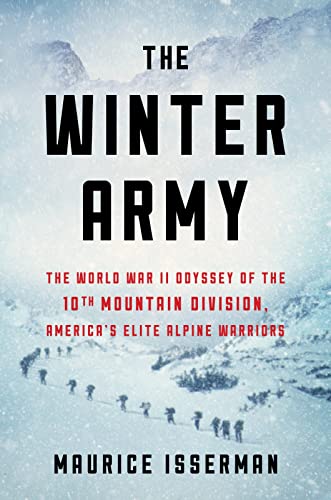
The Winter Army
by Maurice Isserman
"The World War II Odyssey of the 10th Mountain Division, America's Elite Alpine Warriors"
Popularity
4.68 / 5
* A book's popularity is determined by how it compares to all other books on this website.
Where to buy?
Buy from Amazon* If you buy this book through the link above, we may receive a small commission at no extra cost to you.
The Winter Army by Maurice Isserman
Details
War:
World War II
Perspective:
Infantry
Military Unit:
US Army
True Story:
Yes
Biography:
Yes
Region:
Europe
Page Count:
341
Published Date:
2019
ISBN13:
9781328871435
Summary
The Winter Army chronicles the remarkable story of the 10th Mountain Division, an elite U.S. Army unit trained in skiing, mountaineering, and winter warfare during World War II. Maurice Isserman details how this specialized force of athletes, outdoorsmen, and adventurers trained in Colorado's Rocky Mountains before fighting crucial battles in Italy's Apennine Mountains. The book explores their rigorous preparation, combat experiences, and lasting impact on American skiing and outdoor recreation. It highlights how these soldiers combined athletic prowess with military discipline to overcome challenging alpine terrain and enemy positions during the Italian Campaign.
Review of The Winter Army by Maurice Isserman
Maurice Isserman's "The Winter Army" stands as a comprehensive and thoroughly researched chronicle of the 10th Mountain Division, one of World War II's most distinctive American military units. This meticulously documented history traces the division's journey from its unconventional origins through its crucial role in the Italian campaign, offering readers an engaging account of soldiers who trained to fight in some of the war's most challenging terrain.
The narrative begins with the formation of this unique unit, born from the vision of Charles Minot Dole, a civilian skier who recognized the need for specialized mountain troops after witnessing European alpine warfare. Isserman details how the division attracted an unusual collection of recruits: accomplished skiers, mountaineers, and outdoorsmen who brought expertise rarely found in conventional military units. These volunteers came from ski resorts, college campuses, and climbing communities across America, transforming the ranks into what some called the most educated division in the U.S. Army.
The author devotes considerable attention to the division's rigorous training at Camp Hale, Colorado, situated at 9,200 feet elevation in the Rocky Mountains. The training regimen pushed these soldiers to master not only standard infantry skills but also specialized techniques in skiing, rock climbing, and cold-weather survival. Isserman captures the brutal physical demands of preparation in subzero temperatures and thin mountain air, where men learned to move swiftly on skis while carrying full combat loads and to navigate treacherous alpine terrain that would have stopped conventional forces.
The heart of the book focuses on the division's combat service in the Italian Apennines during the final months of the war in Europe. Isserman provides detailed accounts of the 10th Mountain Division's assault on Riva Ridge and Mount Belvedere in February 1945, operations that required soldiers to scale steep, defended heights under fire. These battles demonstrated both the value of the division's specialized training and the terrible cost of mountain warfare. The narrative does not shy away from the casualties and hardships faced by these soldiers as they fought through heavily fortified German positions in the rugged Italian mountains.
One of the book's strengths lies in Isserman's ability to balance tactical military history with personal stories of the men who served. The account draws on letters, diaries, and postwar interviews to illustrate the human dimension of this specialized warfare. These individual perspectives help readers understand what it meant to fight in conditions where frostbite could be as dangerous as enemy fire, and where every advance up a mountain slope required both physical stamina and technical skill.
Isserman also examines the division's legacy beyond the battlefield. Many veterans of the 10th Mountain Division went on to play pivotal roles in developing the American ski industry after the war, founding ski resorts and promoting winter sports across the country. This postwar influence adds an interesting dimension to the story, showing how military service shaped an entire recreational industry in the United States.
The research underpinning this work is extensive, drawing on archival materials, official military records, and a wide range of personal accounts. Isserman's background as a historian is evident in the careful documentation and balanced assessment of events. The book neither romanticizes nor diminishes the achievements of the 10th Mountain Division, instead presenting a measured evaluation of their contributions to the Allied victory in Italy.
The writing remains accessible throughout, making complex military operations understandable without oversimplifying the challenges these soldiers faced. Isserman successfully conveys the distinctive character of the division while placing its story within the broader context of World War II's Italian campaign. The pacing keeps the narrative moving forward, even during sections dealing with training and preparation that might otherwise become tedious.
"The Winter Army" serves as both an important military history and a tribute to an exceptional group of soldiers. The book fills a significant gap in World War II literature by giving proper attention to a division whose specialized nature and late-war service sometimes left it overlooked in broader histories of the conflict. For readers interested in World War II, military history, or the intersection of outdoor skills and warfare, Isserman's work offers a thorough and engaging account of America's elite alpine warriors and their remarkable wartime odyssey.


