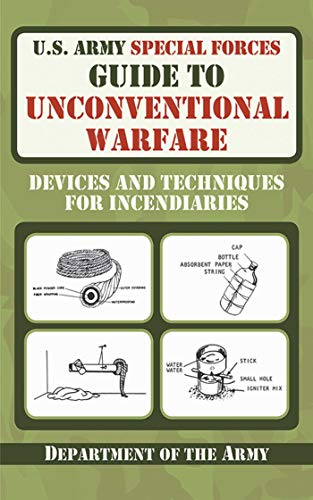
U.S. Army Special Forces Guide to Unconventional Warfare
by U.S. Department of the Army
"Devices and Techniques for Incendiaries"
Popularity
4.67 / 5
* A book's popularity is determined by how it compares to all other books on this website.
Where to buy?
Buy from Amazon* If you buy this book through the link above, we may receive a small commission at no extra cost to you.
U.S. Army Special Forces Guide to Unconventional Warfare by U.S. Department of the Army
Details
Perspective:
Special Forces
Biography:
No
Page Count:
116
Published Date:
2011
ISBN13:
9781626367586
Summary
This military field manual provides detailed technical information on improvised incendiary devices and their tactical applications in unconventional warfare scenarios. Originally developed for U.S. Army Special Forces personnel, it covers the construction, deployment, and effects of various incendiary materials and delivery methods. The guide includes practical instructions on creating fire-starting devices from available materials, understanding combustion principles, and employing incendiaries for military objectives. It serves as a technical reference for special operations forces operating in environments where conventional resources may be limited.
Review of U.S. Army Special Forces Guide to Unconventional Warfare by U.S. Department of the Army
The "U.S. Army Special Forces Guide to Unconventional Warfare: Devices and Techniques for Incendiaries" is part of a broader series of reprinted military field manuals originally produced by the United States Department of the Army. These manuals were developed to train Special Forces personnel in specialized skills related to unconventional warfare, and this particular volume focuses on incendiary devices and their applications. Reprinted for civilian audiences, the book offers a glimpse into the technical training materials once reserved for military use, presenting information in the same straightforward, instructional format found in official Army field manuals.
The content is organized in a manner consistent with military training documents, emphasizing clarity and practical application over narrative style. Readers can expect detailed explanations of incendiary materials, their compositions, and the principles governing their use in various operational contexts. The manual reflects the Army's historical approach to teaching technical subjects: methodical, direct, and focused on functional knowledge rather than theoretical discussion. This structure makes the book more of a reference document than a conventional read-through text, and it is best approached with that expectation in mind.
One of the more notable aspects of this book is its origin as an official government publication. Because it was originally created for military training purposes, the language is technical and assumes a baseline familiarity with basic chemistry, materials science, or military logistics. This is not a guide written for general audiences seeking light reading; rather, it serves a niche audience interested in military history, unconventional warfare doctrine, or the technical evolution of incendiary technology used by Special Forces units.
From a historical perspective, the manual provides insight into how the U.S. Army approached training in unconventional warfare during the period in which it was produced. Unconventional warfare, as a military discipline, encompasses a range of tactics including guerrilla operations, sabotage, and psychological operations, and this manual represents one component of that broader training framework. Its focus on incendiary devices highlights the practical, hands-on nature of Special Forces training, where soldiers were expected to understand not just theory but also the mechanics of implementing various techniques in the field.
Readers interested in military history will likely find value in seeing how such training materials were structured and disseminated. The manual's format—dense with technical detail and procedural explanation—offers an authentic representation of period military documentation, distinct from more narrative-driven histories or analyses. For those studying the evolution of Special Forces doctrine, or simply curious about the kinds of specialized knowledge imparted to elite military units, this book serves as a primary source rather than a secondary interpretation.
It is worth noting that the reprint format means the content is presented largely as it appeared in its original military context, without significant editorial commentary or contextualization for general readers. This can be both a strength and a limitation. On one hand, it preserves the authenticity and technical rigor of the original document. On the other hand, readers unfamiliar with military terminology or the historical context of unconventional warfare training may find some sections challenging to fully appreciate without additional background reading.
Overall, this manual is not intended for casual reading but rather serves as a specialized resource for those with a specific interest in military history, unconventional warfare tactics, or the technical aspects of incendiary devices as taught to Special Forces personnel. Its value lies in its authenticity as an official training document, offering readers a direct look into the kind of technical instruction once provided exclusively to military specialists. Those approaching the book with realistic expectations—understanding it as a historical and technical reference rather than a narrative work—will likely find it informative and useful for research or educational purposes.
In summary, the "U.S. Army Special Forces Guide to Unconventional Warfare: Devices and Techniques for Incendiaries" stands as a niche but historically significant document. It reflects the practical, technical training methods employed by the U.S. Army for Special Forces units, providing insight into an area of military instruction not commonly accessible to the public. While it may not appeal to general readers seeking engaging prose, it holds clear value for military historians, researchers, and enthusiasts interested in the technical dimensions of unconventional warfare training.