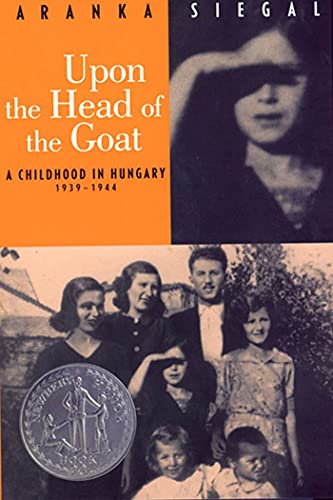
Upon the Head of the Goat
by Aranka Siegal
"A Childhood in Hungary 1939-1944"
Popularity
4.77 / 5
* A book's popularity is determined by how it compares to all other books on this website.
Where to buy?
Buy from Amazon* If you buy this book through the link above, we may receive a small commission at no extra cost to you.
Upon the Head of the Goat by Aranka Siegal
Details
War:
World War II
Perspective:
Civilian
True Story:
Yes
Biography:
No
Region:
Europe
Page Count:
224
Published Date:
2003
ISBN13:
9780374480790
Summary
Upon the Head of the Goat is a memoir chronicling Aranka Siegal's childhood in Hungary during the rise of Nazi persecution from 1939 to 1944. The narrative follows nine-year-old Piri and her family as they experience increasing anti-Semitic restrictions and the gradual erosion of their peaceful life. Living in the countryside, Piri initially remains sheltered from the war's harsh realities, but as conditions deteriorate, her family faces mounting dangers. The book provides a young person's perspective on the Holocaust's early years, culminating with their deportation to the Berehovo ghetto in 1944.
Review of Upon the Head of the Goat by Aranka Siegal
Aranka Siegal's memoir "Upon the Head of the Goat: A Childhood in Hungary, 1939-1944" offers a deeply personal account of a Jewish family's experience during the darkening years leading up to and including the Holocaust. The book chronicles the author's childhood from ages nine to thirteen, a period that begins with relative normalcy and ends with deportation to Auschwitz. Through the eyes of young Piri, as she was known then, readers witness the gradual erosion of security and the tightening grip of antisemitic persecution in rural Hungary.
The narrative opens in 1939 when Piri travels from her home in Komjaty to visit her grandmother in Beregszász. This journey marks the beginning of a five-year period during which the certainties of childhood give way to confusion, fear, and ultimately tragedy. Siegal's strength as a memoirist lies in her ability to recreate the perspective of her younger self while providing enough context for readers to understand the broader historical forces at work. The child's viewpoint serves as an effective lens through which to examine how ordinary people experienced extraordinary circumstances.
The title itself carries profound symbolism rooted in Jewish tradition. The phrase "upon the head of the goat" refers to an ancient practice of placing sins upon a scapegoat, and this metaphor resonates throughout the narrative as innocent people become targets of hatred and violence. Siegal weaves this biblical imagery into her personal story, connecting her family's suffering to a longer history of persecution while maintaining the intimate focus on individual lives and relationships.
One of the memoir's most compelling aspects is its portrayal of family dynamics under increasing pressure. Piri's mother emerges as a central figure, struggling to maintain normalcy and protect her children while facing mounting restrictions and dangers. The relationships between siblings, the extended family connections, and the bonds within the Jewish community all become more precious as external threats intensify. Siegal captures the small moments of joy, the attempts to preserve tradition, and the desperate efforts to shield children from harsh realities even as those realities become inescapable.
The chronological structure allows readers to experience the gradual nature of the persecution. Rather than presenting the Holocaust as a sudden catastrophe, Siegal demonstrates how rights were stripped away incrementally, how communities were isolated step by step, and how hope persisted even as circumstances worsened. This approach provides valuable insight into why families did not simply flee and why the full horror of what was coming remained unimaginable to those living through it.
The setting of rural Hungary adds geographical specificity to Holocaust literature, which often focuses on Poland or Germany. Siegal's depiction of village life, the relationships between Jewish and non-Jewish neighbors, and the particular timeline of Hungarian Jewish persecution contributes important historical detail. Hungary's complicated position during World War Two, its alliance with Nazi Germany, and the relatively late deportation of its Jewish population all play roles in the narrative.
Siegal's prose remains accessible and straightforward, appropriate for both young adult and adult readers. The book was recognized as a Newbery Honor Book, an acknowledgment of its literary merit and its value in introducing younger readers to Holocaust history through personal narrative. However, the memoir does not shy away from the harsh realities of the period, including hunger, humiliation, and the constant threat of violence.
The memoir ends with deportation, leaving readers at the threshold of the concentration camp experience. This stopping point was deliberate, as Siegal continued her story in a subsequent memoir. The decision to end where she does creates a narrative that focuses specifically on the years of increasing oppression rather than the camp experience itself, though the looming shadow of what comes next haunts the final pages.
"Upon the Head of the Goat" serves as both historical document and literary achievement. It personalizes statistics and dates, transforming abstract historical knowledge into lived experience. For readers seeking to understand the Holocaust through individual stories, Siegal's memoir provides an invaluable perspective. The book stands as a testament to memory, to the importance of bearing witness, and to the resilience of those who survived to tell their stories. Through clear prose and careful attention to detail, Siegal has created a work that educates, moves, and ultimately honors those who did not survive to share their own accounts.


