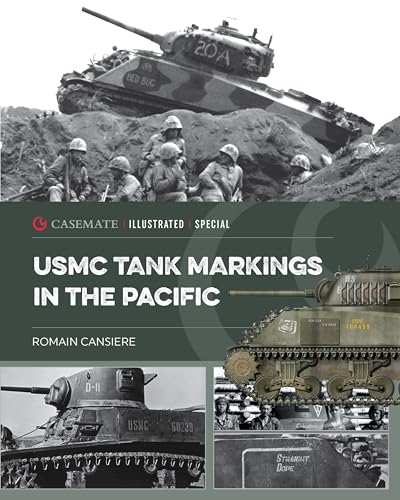
USMC Tank Markings in the Pacific
by Romain Cansiere
Popularity
4.53 / 5
* A book's popularity is determined by how it compares to all other books on this website.
Where to buy?
Buy from Amazon* If you buy this book through the link above, we may receive a small commission at no extra cost to you.
USMC Tank Markings in the Pacific by Romain Cansiere
Details
War:
World War II
Perspective:
Tanks
Military Unit:
US Marine Corps
True Story:
Yes
Biography:
No
Region:
Pacific
Published Date:
2025
ISBN13:
9781636245867
Summary
This specialized reference book documents the identification markings, numbers, and insignia used on United States Marine Corps tanks during Pacific theater operations in World War II. Cansiere provides detailed information about the various marking systems, unit designations, and tactical numbers applied to Marine tanks throughout the island-hopping campaigns. The book serves as an essential resource for military historians, modelers, and enthusiasts seeking accurate information about USMC armored vehicle markings. It includes visual documentation and technical details that help readers understand how Marine tank units identified their vehicles during combat operations against Japanese forces.
Review of USMC Tank Markings in the Pacific by Romain Cansiere
Romain Cansiere's work on United States Marine Corps tank markings in the Pacific theater represents a specialized reference that fills a notable gap in military modeling and historical documentation. This publication focuses specifically on the visual identification systems, tactical markings, and unit insignia applied to Marine Corps armor during World War II operations across the Pacific campaigns. For researchers, historians, and scale modelers seeking accurate information about this particular aspect of Marine Corps armored warfare, the book offers a concentrated examination of a topic that has historically received limited dedicated attention in broader military history publications.
The Pacific theater presented unique challenges for American armored units, and the Marine Corps employed tanks in various island-hopping campaigns where armor played supporting roles in assaults against fortified Japanese positions. Understanding the marking systems used on these vehicles provides insight into unit organization, tactical operations, and the visual culture of Marine Corps armored forces during this period. Cansiere's focus on this narrow subject allows for detailed treatment that would be impossible in more general works covering Pacific War armor or Marine Corps operations broadly.
The book's value lies primarily in its reference utility. Visual documentation of tank markings serves multiple audiences, from military historians tracking specific units through campaigns to hobbyists attempting to accurately recreate historical vehicles in scale model form. The level of detail provided regarding marking variations, color applications, and unit-specific identifiers makes this a practical resource for anyone requiring precise information about the appearance of Marine Corps tanks during their Pacific service. Such focused documentation preserves details that might otherwise be lost as primary sources age and become less accessible.
One strength of specialized reference works like this is their contribution to the larger body of military historical knowledge. While casual readers might find the subject matter too narrow, those engaged in serious research or detailed modeling projects will appreciate having a dedicated resource that consolidates information otherwise scattered across unit histories, after-action reports, period photographs, and veteran accounts. The book represents the kind of foundational reference that enables more accurate historical representation in museums, films, commemorative projects, and educational materials.
The Pacific campaigns saw Marine Corps tank battalions employed from Guadalcanal through Okinawa, with vehicles marking evolving as operational experience accumulated and as units adapted to specific tactical situations. Documenting these variations requires careful analysis of photographic evidence and official records. Works focused on such technical details contribute to preserving an accurate historical record, ensuring that future representations of these vehicles reflect actual wartime practice rather than assumptions or generalizations.
For scale modelers, accuracy in marking application separates merely competent work from historically faithful recreations. Knowing the correct placement of tactical numbers, unit insignia, and identification markings specific to particular campaigns or time periods allows modelers to represent specific vehicles rather than generic examples. This level of specificity enhances the historical value of model work and contributes to broader educational efforts when such models are displayed in historical contexts.
The specialized nature of this publication means it will appeal primarily to dedicated enthusiasts rather than general military history readers. Those seeking broad narratives of Pacific War combat or comprehensive overviews of Marine Corps operations will find other sources more suitable. However, within its defined scope, the book serves its intended purpose as a technical reference. The niche it occupies is important precisely because mainstream military histories typically lack space for such detailed technical coverage.
Publications like this also serve preservation purposes, documenting details that might otherwise fade from collective memory as generations pass. Photographic evidence from World War II, while extensive, requires interpretation and analysis to extract specific technical information. Consolidated references that synthesize this information provide lasting value to future researchers who may no longer have access to veterans who served with these units or to period documentation that deteriorates over time.
The book represents the type of specialized research that supports broader historical understanding. While tank markings might seem a minor detail in the context of major military campaigns, such specifics contribute to comprehensive historical knowledge. Understanding how units identified their equipment, how marking practices evolved, and how visual identification systems functioned in combat environments adds depth to appreciation of military operations and organizational culture.
For its intended audience of researchers, historians, and serious military modeling enthusiasts, this focused examination of Marine Corps tank markings in the Pacific provides concentrated information on a specific subject. The value of such specialized references lies not in broad appeal but in thorough coverage of narrowly defined topics, making information accessible that would otherwise require extensive primary research to compile.