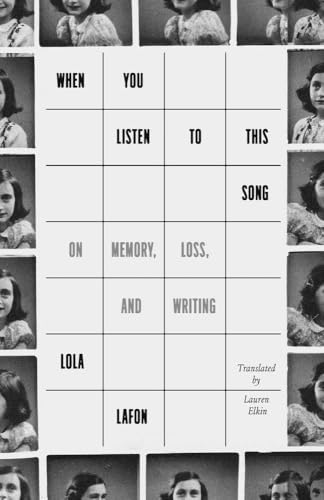
When You Listen to This Song
by Lola Lafon
"On Memory, Loss, and Writing"
Popularity
4.65 / 5
* A book's popularity is determined by how it compares to all other books on this website.
Where to buy?
Buy from Amazon* If you buy this book through the link above, we may receive a small commission at no extra cost to you.
When You Listen to This Song by Lola Lafon
Details
Perspective:
Researcher
True Story:
Yes
Biography:
Yes
Page Count:
174
Published Date:
2025
ISBN13:
9780300275889
Review of When You Listen to This Song by Lola Lafon
Lola Lafon's "When You Listen to This Song" presents a meditation on the intricate relationships between memory, loss, and the act of writing itself. The French author, known for her previous works exploring themes of identity and historical trauma, brings her characteristic introspection to this examination of how personal and collective memories shape narrative.
The book operates at the intersection of memoir and essay, though it resists easy categorization. Lafon uses music as a gateway into memory, exploring how particular songs can unlock entire worlds of experience and emotion. This approach allows her to investigate not just what is remembered, but how memory functions as a creative and sometimes unreliable force. The title itself suggests the participatory nature of remembering, inviting consideration of how sensory experiences trigger recollection.
Lafon's treatment of loss moves beyond conventional grief narratives. Rather than focusing solely on absence, she examines how loss transforms over time and how it becomes embedded in language and storytelling. The writing process itself becomes a subject of inquiry, with Lafon reflecting on the challenges and responsibilities inherent in translating memory into written form. This meta-textual dimension adds depth to the work, as readers observe the author grappling with the very tools she employs.
The structure reflects the fragmentary nature of memory itself. Rather than following a linear trajectory, the text moves between moments and reflections, creating a mosaic effect. This technique mirrors how memories surface unbidden, often in response to unexpected triggers. The non-linear approach requires attentive reading but rewards patience with moments of genuine insight into how human consciousness processes experience.
Lafon's prose style maintains clarity while embracing complexity. She avoids the trap of sentimentality without sacrificing emotional resonance. The writing demonstrates restraint, allowing observations to stand without excessive elaboration. This economy of language proves particularly effective when addressing difficult subjects, where overwrought prose might diminish impact.
The treatment of writing as both subject and method creates interesting layers within the text. Lafon considers what gets preserved through writing and what inevitably slips away. She acknowledges the impossibility of capturing experience in its entirety while simultaneously demonstrating the value of the attempt. This tension between aspiration and limitation runs throughout the work.
Memory emerges as both personal and political in Lafon's handling. Individual recollections exist within broader historical and social contexts, and the author examines how collective memories inform personal ones. This awareness of memory's social dimensions prevents the work from becoming purely introspective, connecting private experience to shared human concerns.
The role of music throughout the book serves multiple functions. Songs act as temporal markers, anchoring memories to specific moments. They also demonstrate how art can encode emotion and experience in ways that transcend language. Lafon's exploration of musical memory reveals how deeply intertwined aesthetic experience and personal history become over time.
Questions of authenticity and reliability surface repeatedly. Lafon does not claim perfect recall or objective truth. Instead, she acknowledges memory's mutability and the ways writing itself can alter what is remembered. This honesty about the limitations of both memory and language strengthens rather than undermines the work's authority.
The book's engagement with loss extends to considering what writing can and cannot accomplish in the face of absence. Lafon examines whether words can preserve what has been lost or whether they merely create new artifacts that stand in place of irretrievable experiences. This philosophical dimension elevates the work beyond simple memoir.
Readers seeking conventional narrative satisfaction may find the book's reflective nature challenging. The emphasis on process and questioning over resolution requires a different kind of engagement. However, those willing to meet the text on its own terms will find a thoughtful exploration of fundamental human experiences.
"When You Listen to This Song" demonstrates Lafon's skill at blending personal reflection with broader artistic and philosophical concerns. The book does not offer easy answers or neat conclusions about memory, loss, or writing. Instead, it models a way of thinking about these subjects that honors their complexity while remaining accessible to readers without specialized knowledge. The result is a work that invites contemplation about how lives are remembered and recorded.