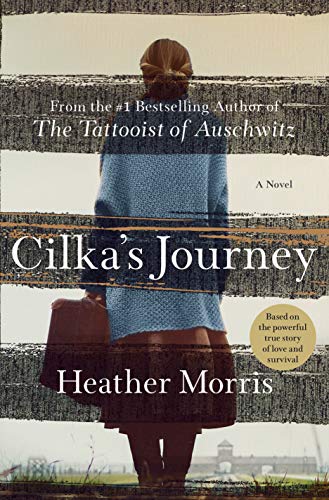
Cilka's Journey
by Heather Morris
"A Novel"
Popularity
4.63 / 5
* A book's popularity is determined by how it compares to all other books on this website.
Where to buy?
Buy from Amazon* If you buy this book through the link above, we may receive a small commission at no extra cost to you.
Cilka's Journey by Heather Morris
Details
War:
World War II
Perspective:
Prisoners of War
True Story:
Yes
Biography:
No
Region:
Europe
Page Count:
352
Published Date:
2019
ISBN13:
9781250265708
Summary
Cilka's Journey follows Cilka Klein, a young woman who survived Auschwitz only to be wrongly accused of collaboration and sent to a Siberian gulag. Based on a real person's story, the novel chronicles her sixteen-year imprisonment in one of Stalin's brutal work camps. Despite unimaginable hardship and trauma, Cilka draws on her inner strength and nursing skills to help fellow prisoners. The book explores themes of survival, resilience, and the enduring human spirit in the face of injustice. It is a sequel to The Tattooist of Auschwitz, continuing Cilka's harrowing yet inspiring story.
Review of Cilka's Journey by Heather Morris
Heather Morris delivers a powerful and harrowing continuation of historical fiction with "Cilka's Journey," a novel that traces the extraordinary life of Cilka Klein, a minor character from Morris's bestselling debut "The Tattooist of Auschwitz." This standalone sequel explores one woman's fight for survival through some of the darkest chapters of twentieth-century history, offering readers an unflinching look at resilience in the face of unspeakable adversity.
The novel picks up where Cilka's story in Auschwitz ends, but rather than finding freedom at the war's conclusion, she faces a new nightmare. Accused of collaboration with the Nazis, Cilka is sentenced to fifteen years in a Siberian gulag. This twist of fate forms the cruel irony at the heart of the narrative: a young woman who survived the horrors of a concentration camp must now endure the brutality of a Soviet labor camp. Morris constructs her story around this central injustice, examining how trauma compounds and how the human spirit continues to seek light even in the bleakest circumstances.
Morris employs a straightforward narrative style that allows the weight of historical events to speak for themselves. The prose remains accessible and clear, never obscuring the gravity of Cilka's experiences behind literary flourishes. This approach serves the story well, as the material itself carries sufficient emotional impact without requiring embellishment. The author moves chronologically through Cilka's time in the gulag, documenting her daily struggles, small victories, and the relationships that sustain her through years of forced labor.
The supporting characters Morris creates help illuminate different aspects of survival and human connection in extreme circumstances. Fellow prisoners become sources of strength, companionship, and sometimes danger. The author explores how hierarchies form even among the oppressed, and how small acts of kindness take on profound significance when everything has been stripped away. These relationships provide emotional anchors throughout the narrative, preventing the relentless hardship from becoming monotonous or overwhelming for readers.
One of the novel's strengths lies in its exploration of how past trauma intersects with present suffering. Cilka carries her experiences from Auschwitz into the gulag, and Morris examines how these memories shape her responses to new threats and opportunities. The psychological complexity of surviving multiple forms of imprisonment adds depth to what could have been a simple tale of endurance. Instead, readers encounter a protagonist whose survival strategies evolve, whose trust must be carefully rationed, and whose hope flickers but never entirely extinguishes.
Morris also addresses the particular vulnerabilities faced by women in these brutal environments. The novel does not shy away from difficult subjects, including sexual violence and exploitation, though it handles these topics with sensitivity rather than gratuitousness. These elements form part of the historical reality Morris seeks to represent, and their inclusion adds to the book's unflinching honesty about the conditions prisoners, particularly women, faced in Soviet labor camps.
The setting of the Siberian gulag receives detailed attention, with Morris painting a vivid picture of the harsh landscape, the inadequate shelter, the backbreaking labor, and the constant threat of cold and starvation. The physical environment becomes almost a character itself, an implacable force that prisoners must navigate alongside human cruelty and institutional indifference. Weather, illness, and exhaustion form constant threats, and the author effectively conveys the grinding nature of daily existence in such conditions.
Morris based her novel on the life of a real person, though she has noted that many elements are fictionalized due to limited historical documentation. This blend of fact and fiction raises questions about representation and responsibility when writing about real individuals who experienced such suffering. The author has been transparent about the creative liberties taken, acknowledging the challenge of filling gaps in the historical record while honoring the essence of a real person's experience.
The pacing maintains steady momentum throughout, though the repetitive nature of camp life means some sections cover similar ground. This repetition arguably serves a purpose, allowing readers to feel the monotony and endurance required to survive years of imprisonment. However, some may find certain portions of the narrative less dynamic than others. The novel builds toward Cilka's eventual release and attempts to rebuild a life after unimaginable trauma, providing a conclusion that acknowledges both survival and its costs.
"Cilka's Journey" stands as a testament to an often-overlooked aspect of World War II's aftermath: the fate of concentration camp survivors who faced continued persecution rather than liberation. Morris brings attention to this historical injustice while crafting a narrative about human resilience, the power of small kindnesses, and the possibility of finding meaning even in suffering. The novel succeeds in making readers confront uncomfortable historical truths while maintaining focus on one woman's remarkable determination to survive and maintain her humanity against all odds.


![The Tattooist of Auschwitz [Movie-Tie-In]](https://m.media-amazon.com/images/I/51oBZ7tuzeL._SL500_.jpg)