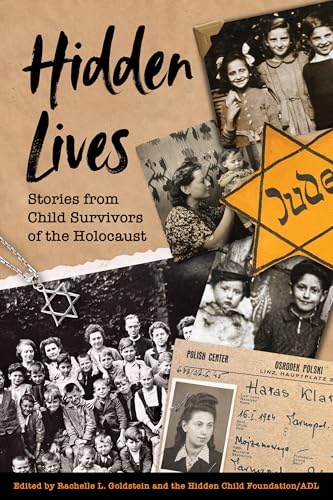
Hidden Lives
by Rachelle L. Goldstein
"Stories from Child Survivors of the Holocaust"
Popularity
4.39 / 5
* A book's popularity is determined by how it compares to all other books on this website.
Where to buy?
Buy from Amazon* If you buy this book through the link above, we may receive a small commission at no extra cost to you.
Hidden Lives by Rachelle L. Goldstein
Details
War:
World War II
Perspective:
Civilian
True Story:
Yes
Biography:
Yes
Region:
Europe
Published Date:
2025
ISBN13:
9781772604429
Summary
Hidden Lives presents firsthand accounts from individuals who survived the Holocaust as children. Through personal testimonies, the book documents the experiences of young survivors who endured persecution, hiding, separation from families, and life in concentration camps during World War II. These narratives reveal how children coped with trauma, loss, and fear while navigating an incomprehensible world of violence and hatred. The collection preserves their memories and perspectives, offering insights into resilience, survival, and the long-lasting impact of genocide on its youngest victims. Their stories serve as important historical documentation and powerful reminders of this dark period.
Review of Hidden Lives by Rachelle L. Goldstein
"Hidden Lives: Stories from Child Survivors of the Holocaust" by Rachelle L. Goldstein is a collection that brings together the testimonies of individuals who experienced the Holocaust as children. The book focuses on a period of history often examined through the lens of adult experience, and instead centers the perspective of young people who were forced to navigate persecution, hiding, displacement, and loss at an age when their understanding of the world was still forming. This approach gives the collection a distinct and valuable place among Holocaust literature.
The structure of the book relies on personal narrative, allowing each survivor's account to stand largely on its own. This format respects the individuality of each story while also allowing patterns to emerge across the collection as a whole. Readers encounter accounts of children who were hidden in convents, farmhouses, and with sympathetic families; children who assumed false identities; and children who were separated from parents and siblings, sometimes permanently. The diversity of experience underscores an important truth about the Holocaust: even within a shared historical catastrophe, individual circumstances varied enormously, shaped by geography, family resources, community relationships, and chance.
Goldstein's approach as an author and compiler appears to prioritize the voices of the survivors themselves. Rather than imposing heavy interpretive frameworks, the book allows firsthand recollection to carry the emotional and historical weight of the material. This choice makes the collection accessible to readers who may not have extensive background in Holocaust history, while still offering substance for those with deeper familiarity with the subject. The prose throughout maintains a measured tone, avoiding sensationalism even when describing events of extreme hardship.
One of the more striking aspects of the book is its attention to the psychological dimension of childhood survival. Many of the accounts describe not only the physical dangers faced by these children but also the confusion, fear, and forced maturity that came with hiding one's identity, suppressing memories of family, or adapting to unfamiliar and often hostile environments. These reflections offer insight into how trauma experienced in youth can shape memory and identity well into adulthood. This focus adds a layer of depth to the collection, moving beyond a simple recounting of events to a more nuanced exploration of survival's lasting effects.
The book also serves an important documentary function. As the number of living Holocaust survivors continues to decline, collections like this one preserve firsthand testimony that might otherwise be lost. For students, educators, and general readers interested in twentieth-century history, the book offers primary source material that complicates and enriches historical understanding. It reminds readers that history is composed not only of large-scale events and statistics but also of individual lives, each shaped by specific choices, encounters, and losses.
Stylistically, the writing throughout the collection tends to be direct and unembellished, which suits the subject matter. The restraint in language allows the events described to speak for themselves, without unnecessary dramatization. This is a difficult balance to strike when writing about atrocity, and the book generally succeeds in presenting painful material with dignity and clarity.
Some readers may wish for more extensive historical context surrounding each individual account, such as additional information about the specific regions, dates, or circumstances involved. Given the format of a testimony-based collection, though, this is a common limitation rather than a significant flaw. The strength of the book lies in its commitment to personal voice rather than exhaustive historical framing.
Overall, "Hidden Lives: Stories from Child Survivors of the Holocaust" makes a meaningful contribution to Holocaust literature by centering an often underrepresented perspective. Rachelle L. Goldstein's work provides a platform for survivors to share experiences that were shaped by childhood innocence colliding with extraordinary danger. The collection is suitable for readers of many backgrounds, from those studying the Holocaust academically to general readers seeking a deeper understanding of its human impact. It stands as both a historical resource and a testament to resilience, offering an important reminder of the diverse ways in which individuals endured one of history's darkest periods.