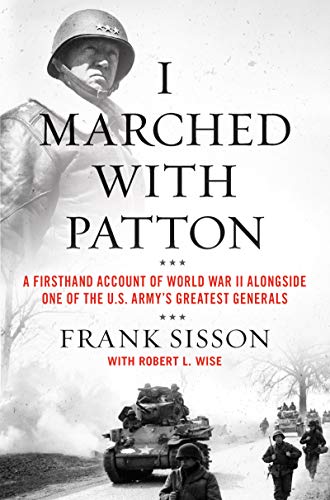
I Marched with Patton
by Frank Sisson
"A Firsthand Account of World War II Alongside One of the U. S. Army's Greatest Generals"
Popularity
4.56 / 5
* A book's popularity is determined by how it compares to all other books on this website.
Where to buy?
Buy from Amazon* If you buy this book through the link above, we may receive a small commission at no extra cost to you.
I Marched with Patton by Frank Sisson
Details
War:
World War II
Perspective:
Infantry
Military Unit:
US Army
True Story:
Yes
Biography:
Yes
Region:
Europe
Page Count:
304
Published Date:
2020
ISBN13:
9780063019478
Summary
Frank Sisson's memoir recounts his experiences as a soldier serving under General George S. Patton during World War II. The book provides a firsthand perspective of the European Theater, following Sisson through major campaigns including the Battle of the Bulge and the advance into Germany. Sisson offers intimate observations of Patton's leadership style and military tactics while describing the daily realities of combat. The narrative combines personal anecdotes with historical context, giving readers an authentic ground-level view of the war and what it was like to serve under one of America's most legendary military commanders.
Review of I Marched with Patton by Frank Sisson
"I Marched with Patton" presents a firsthand account of World War II as experienced by Frank Sisson, a soldier who served under General George S. Patton, one of the most famous and controversial commanders in United States military history. The book offers readers a ground-level perspective on the campaigns that defined the war in Europe, moving away from the broad strategic overviews found in traditional histories and instead focusing on the day-to-day realities faced by the men who served under Patton's command.
Patton remains one of the most recognizable figures of World War II, known for his aggressive tactics, flamboyant personality, and unwavering confidence in the face of adversity. His leadership of the Third Army during the push across France and into Germany, along with his pivotal role in relieving the besieged town of Bastogne during the Battle of the Bulge, cemented his reputation as a general willing to take bold risks to achieve victory. Sisson's account provides a valuable counterpoint to the many biographies and historical analyses of Patton by offering the perspective of an ordinary soldier who witnessed these events unfold in real time.
The strength of this memoir lies in its immediacy. Rather than analyzing troop movements from a distance, Sisson describes the physical and emotional toll of combat, the exhaustion of extended marches, and the uncertainty that accompanied nearly every operation. These details help humanize a period of history often reduced to dates, statistics, and generalship. Readers gain insight into the logistics of supply lines, the challenges of communication in the field, and the camaraderie that developed among soldiers under extreme pressure. Such firsthand testimony carries a weight that secondary sources cannot replicate, since it reflects lived experience rather than retrospective interpretation.
Sisson's writing style is direct and unembellished, which suits the subject matter well. There is no attempt to dramatize events beyond what actually occurred, and the narrative avoids excessive editorializing. This restraint allows the events themselves to carry the emotional and historical significance, rather than relying on rhetorical flourishes. For readers interested in military history, particularly the European theater of World War II, this straightforward approach will likely be appreciated, as it lends the account a sense of authenticity and credibility.
The book also serves as a useful primary source for those studying the broader context of the war. While Patton's own writings and the numerous biographies written about him provide valuable insight into his strategic thinking and personality, Sisson's memoir fills a different role. It documents the experience of the soldiers who executed those strategies, often under harrowing conditions. This perspective is essential for a complete understanding of the war, since military success ultimately depended on the endurance and effectiveness of frontline troops, not solely on the decisions made by commanding officers.
At the same time, readers should approach the book with an understanding of its scope. As a personal account, it does not attempt to provide a comprehensive analysis of Patton's campaigns or a full assessment of his controversial legacy, which includes both his tactical brilliance and the criticism he faced for his conduct and public statements during the war. Instead, the memoir remains focused on Sisson's own experiences and observations, offering a narrower but deeply personal lens through which to view these historical events.
For readers seeking a change from the analytical tone of many war histories, "I Marched with Patton" offers something different: an intimate window into the experience of serving under one of the war's most demanding leaders. It complements existing scholarship on Patton and the Third Army while standing on its own as a testament to the resilience and sacrifice of the soldiers who fought in some of the most significant battles of the twentieth century. Those with an interest in World War II history, particularly accounts told from the perspective of enlisted personnel, will find this memoir a worthwhile addition to their reading, offering both historical value and a personal glimpse into a defining chapter of American military history.