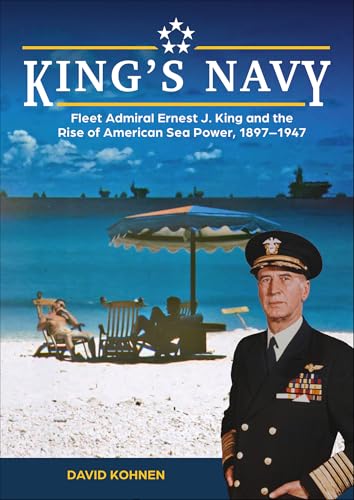
King's Navy
by David Kohnen
"Fleet Admiral Ernest J. King and the Rise of American Sea Power, 1897–1947"
Popularity
4.63 / 5
* A book's popularity is determined by how it compares to all other books on this website.
Where to buy?
Buy from Amazon* If you buy this book through the link above, we may receive a small commission at no extra cost to you.
King's Navy by David Kohnen
Details
War:
World War II
Perspective:
Commanders
Military Unit:
US Navy
True Story:
Yes
Biography:
Yes
Region:
Pacific
Page Count:
939
Published Date:
2024
ISBN13:
9781507303962
Summary
This biography chronicles Admiral Ernest J. King's five-decade naval career and his pivotal role in transforming the United States Navy into a dominant global force. The book examines King's professional development from the late 19th century through World War II, where he served as Commander in Chief of the U.S. Fleet and Chief of Naval Operations. Author David Kohnen explores how King's strategic vision, leadership, and often controversial personality shaped American naval power during its most critical period of expansion and modernization, ultimately establishing the foundation for postwar American maritime supremacy.
Review of King's Navy by David Kohnen
David Kohnen's comprehensive examination of Fleet Admiral Ernest J. King presents a meticulously researched portrait of one of America's most consequential naval leaders. Spanning five decades from 1897 to 1947, this biography traces King's journey from his early days at the Naval Academy through his pivotal role as Commander in Chief of the United States Fleet during World War II. Kohnen, drawing on extensive archival materials and King's own papers, offers readers an opportunity to understand both the man and the institutional transformation of American naval power during a critical period in world history.
Ernest J. King remains a somewhat paradoxical figure in American military history. Known for his demanding leadership style and uncompromising dedication to naval excellence, King earned a reputation as both brilliant and difficult. Kohnen does not shy away from these contradictions but instead uses them to illuminate the complex personality that shaped American naval strategy during its most challenging period. The biography examines how King's early career experiences, including his service in the Spanish-American War era and his subsequent assignments across various naval disciplines, forged his understanding of sea power and its role in national security.
The book thoroughly documents King's professional development through the interwar years, a period often overlooked in naval histories but crucial to understanding the preparedness of the United States Navy when war came in 1941. Kohnen details King's involvement in naval aviation, submarines, and surface warfare, demonstrating how this unusually broad experience across multiple domains gave King a comprehensive understanding of naval capabilities. This multifaceted expertise would prove invaluable when King assumed leadership of the entire fleet, as he could speak authoritatively about every aspect of naval operations.
Kohnen's treatment of King's wartime leadership provides substantial insight into the strategic decisions that shaped the Allied victory in World War II. As both Commander in Chief of the United States Fleet and Chief of Naval Operations, King wielded unprecedented authority over American naval forces. The biography examines his often contentious relationships with other Allied leaders, including his well-documented clashes with British leadership over strategic priorities. These conflicts, far from being merely personal, reflected fundamental disagreements about how to prosecute the war and allocate limited resources between the European and Pacific theaters.
The author pays particular attention to King's advocacy for the Pacific War, arguing persuasively that King's insistence on maintaining pressure against Japan, even while Europe remained the stated priority, proved strategically sound. Kohnen shows how King navigated the complex political and military landscape of coalition warfare, balancing the demands of alliance politics with his assessment of American strategic interests. This aspect of the biography offers valuable lessons about joint and combined operations that remain relevant to contemporary military planning.
One of the biography's strengths lies in its examination of King's role in building the institutional structures that would govern American naval power for decades. Kohnen explores how King's organizational reforms, training initiatives, and strategic vision helped create a modern navy capable of projecting power globally. The biography details King's efforts to professionalize the officer corps, modernize naval education, and integrate new technologies into fleet operations. These contributions extended far beyond the immediate demands of wartime and helped establish the foundations for American naval dominance in the postwar era.
The book also addresses King's relationships with civilian leadership, particularly President Franklin Roosevelt and Secretary of the Navy Frank Knox. Kohnen illustrates how King managed the delicate balance between military advice and civilian control, maintaining his professional independence while respecting constitutional authority. These interactions reveal much about civil-military relations during a period when the stakes of such relationships could not have been higher.
Kohnen's research is evident throughout the work, with detailed citations and references to primary sources that support his narrative. The biography benefits from access to previously underutilized materials that shed new light on King's decision-making processes and personal correspondence. This scholarly foundation gives the work credibility while remaining accessible to general readers interested in naval history and World War II.
The book succeeds in placing King's career within the broader context of American naval development and the nation's emergence as a global superpower. By examining the full arc of King's fifty-year association with the Navy, Kohnen demonstrates how individual leadership intersected with institutional evolution and geopolitical transformation. The result is a biography that serves both as a character study and as a history of American sea power during a decisive period. Readers seeking to understand how the United States Navy became the preeminent naval force of the twentieth century will find this biography an essential resource.


