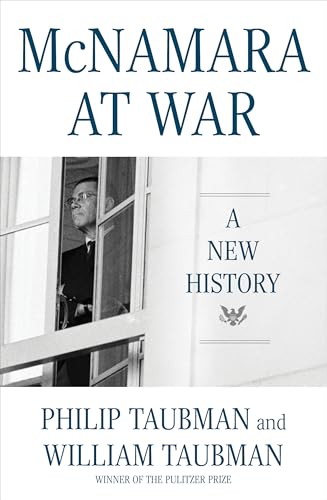
McNamara at War
by Philip Taubman
"A New History"
Popularity
4.95 / 5
* A book's popularity is determined by how it compares to all other books on this website.
Where to buy?
Buy from Amazon* If you buy this book through the link above, we may receive a small commission at no extra cost to you.
McNamara at War by Philip Taubman
Details
War:
Vietnam War
Perspective:
Commanders
True Story:
Yes
Biography:
Yes
Region:
North America
Published Date:
2025
ISBN13:
9781324007166
Summary
McNamara at War by Philip Taubman examines Robert McNamara's role as Secretary of Defense during the Kennedy and Johnson administrations. The book provides a detailed look at McNamara's influence on major Cold War events, particularly the Vietnam War, Cuban Missile Crisis, and nuclear strategy. Taubman draws on extensive archival research and interviews to reassess McNamara's legacy, exploring his analytical approach to defense policy, his evolution from confident technocrat to doubter of the Vietnam War, and the lasting impact of his decisions on American military and foreign policy.
Review of McNamara at War by Philip Taubman
Philip Taubman's biographical examination of Robert McNamara offers a comprehensive reassessment of one of the most consequential and controversial figures in twentieth-century American politics. Drawing on extensive research and previously untapped sources, Taubman presents a nuanced portrait of the former Secretary of Defense whose decisions shaped the course of the Vietnam War and left an indelible mark on American military and foreign policy.
McNamara served as Secretary of Defense under Presidents Kennedy and Johnson from 1961 to 1968, a period that encompassed the Cuban Missile Crisis, the escalation of American involvement in Vietnam, and profound transformations in defense strategy and nuclear policy. Taubman, a veteran journalist and author with deep expertise in Cold War history, brings both analytical rigor and narrative skill to this complex subject. His approach balances careful historical documentation with an accessible writing style that makes the material engaging for general readers while maintaining scholarly credibility.
The book explores McNamara's background as a systems analyst and his meteoric rise through the corporate ranks at Ford Motor Company, where he became the first president from outside the Ford family. This business experience profoundly influenced his approach to managing the Pentagon, where he introduced quantitative analysis and data-driven decision-making processes that revolutionized defense management. Taubman examines how McNamara's faith in rationality and measurable metrics both strengthened certain aspects of defense planning and contributed to tragic miscalculations in Vietnam.
Central to Taubman's narrative is the question of McNamara's evolving understanding of the Vietnam War. The book traces how McNamara privately harbored growing doubts about the war's conduct and ultimate success even as he publicly defended administration policy. This tension between private misgivings and public loyalty became one of the defining aspects of McNamara's tenure and later reputation. Taubman navigates this complex terrain with careful attention to documentary evidence, including internal memos and communications that reveal the depth of McNamara's concerns.
The author also addresses McNamara's role during the Cuban Missile Crisis, widely regarded as his finest hour in government service. Taubman shows how McNamara's analytical approach and willingness to consider multiple options contributed to the peaceful resolution of what remains the most dangerous confrontation of the nuclear age. This section of the book demonstrates McNamara's capacity for clear thinking under extreme pressure and his understanding of the catastrophic risks inherent in nuclear brinkmanship.
Taubman does not shy away from examining the criticisms that have followed McNamara throughout his career and beyond. The book confronts questions about McNamara's responsibility for the escalation of the Vietnam War, the controversial tactics employed in the conflict, and whether he adequately confronted his own errors in judgment. At the same time, Taubman resists simplistic judgments, presenting McNamara as a figure of genuine complexity whose motivations and actions cannot be reduced to caricature.
The research underlying this biography reflects impressive depth and breadth. Taubman consulted archives, government documents, and personal papers while also conducting interviews with individuals who worked alongside McNamara. This combination of sources allows for a richly detailed account that moves beyond surface-level observations to examine the institutional contexts and personal relationships that shaped McNamara's decisions.
One of the book's strengths lies in its contextualization of McNamara within the broader Cold War landscape. Taubman effectively conveys the pressures, assumptions, and strategic calculations that defined American foreign policy during this era. The book illuminates how McNamara operated within systems and structures that both enabled and constrained his choices, providing readers with a more sophisticated understanding of high-level decision-making during a pivotal period in American history.
The narrative also touches on McNamara's later years, including his service as president of the World Bank and his eventual public acknowledgment of errors regarding Vietnam. These later chapters add important dimension to the overall portrait, showing a man grappling with the consequences and moral weight of his decisions. Taubman handles this material with appropriate sensitivity while maintaining his analytical approach.
This work represents a significant contribution to the literature on the Vietnam War era and Cold War leadership. Taubman succeeds in producing a biography that serves both as a detailed examination of one individual's career and as a window into the larger forces that shaped American policy during a transformative period. The book will appeal to readers interested in political history, military affairs, and the complexities of leadership under extraordinary circumstances.