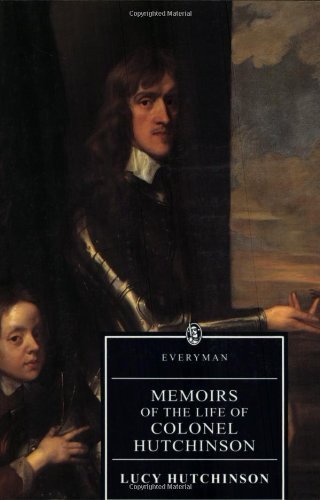
Memoirs of the Life of Colonel Hutchinson
by Lucy Hutchinson
"With a Fragment of Autobiography"
Popularity
3.82 / 5
* A book's popularity is determined by how it compares to all other books on this website.
Where to buy?
Buy from Amazon* If you buy this book through the link above, we may receive a small commission at no extra cost to you.
Memoirs of the Life of Colonel Hutchinson by Lucy Hutchinson
Details
War:
English Civil War
Perspective:
Commanders
True Story:
Yes
Biography:
Yes
Region:
Europe
Page Count:
399
Published Date:
1995
ISBN13:
9780460874915
Review of Memoirs of the Life of Colonel Hutchinson by Lucy Hutchinson
Lucy Hutchinson's "Memoirs of the Life of Colonel Hutchinson" stands as one of the most remarkable pieces of biographical writing to emerge from the English Civil War period. Composed in the years following her husband's death, this work offers a deeply personal and historically significant account of Colonel John Hutchinson, a parliamentarian officer and regicide who governed Nottingham Castle during the conflict between Royalist and Parliamentary forces. What sets this memoir apart from other historical accounts of the era is the intimate perspective of a wife writing about her husband, blending personal devotion with careful historical documentation.
The memoir was written primarily for the Hutchinson children, intended to preserve the memory and reputation of a man who had signed King Charles I's death warrant and consequently faced significant political risk during the Restoration period. This context shapes much of the narrative's purpose and tone. Lucy Hutchinson writes with evident care to defend her husband's actions and character, presenting him as a principled man motivated by conscience rather than ambition or cruelty. Readers encounter a portrait of Colonel Hutchinson as both a devoted family man and a serious military and political figure navigating one of England's most turbulent periods.
The accompanying fragment of autobiography adds another valuable dimension to this edition. Lucy Hutchinson's own reflections on her upbringing, education, and early life provide insight into the intellectual and social world of educated women in seventeenth-century England. Her account reveals a woman of considerable learning and independent thought, qualities that inform the sophistication and clarity found throughout the main memoir. This autobiographical fragment, though brief, helps contextualize the perspective and capabilities of the narrator whose voice dominates the larger work.
From a historical standpoint, the memoir serves as an invaluable primary source for understanding the English Civil War from a parliamentarian viewpoint. Lucy Hutchinson's detailed descriptions of military engagements, political maneuvering, and the day-to-day realities of governing a contested territory like Nottingham Castle provide texture and detail that complement more formal historical records of the period. Her position as an eyewitness to many events, combined with her access to her husband's own accounts and correspondence, lends considerable authority to her narrative.
The prose style reflects the literary conventions of seventeenth-century writing, which may present some challenges for modern readers unfamiliar with period language and sentence structures. However, the emotional authenticity and narrative skill evident throughout the work compensate for these stylistic demands. Lucy Hutchinson demonstrates a keen ability to construct compelling scenes and character portraits, particularly in her descriptions of her husband's moral struggles and decision-making processes during moments of political crisis.
Beyond its historical value, the memoir offers insight into the nature of marriage and partnership during this period. The relationship between Lucy and John Hutchinson, as portrayed in these pages, suggests a marriage built on mutual respect, shared political convictions, and intellectual companionship. This dimension of the work adds depth to its historical significance, illustrating how personal relationships intersected with the broader political and religious conflicts of the era.
The work also documents the aftermath of the Restoration and the precarious position of former parliamentarians and regicides under the restored monarchy. Colonel Hutchinson's eventual imprisonment and death, as recounted by his wife, provide a sobering conclusion to the narrative and underscore the personal costs borne by those who had participated in the revolutionary events of the 1640s and 1650s.
This memoir remains essential reading for anyone interested in seventeenth-century English history, the Civil War period specifically, or the experiences of women writers during this era. Lucy Hutchinson's achievement in preserving her husband's memory while also revealing her own considerable literary and intellectual gifts makes this work a significant contribution to both historical scholarship and English literature. The combination of personal memoir and historical documentation creates a multifaceted text that rewards careful reading and continues to offer valuable perspectives on a pivotal period in English history.


