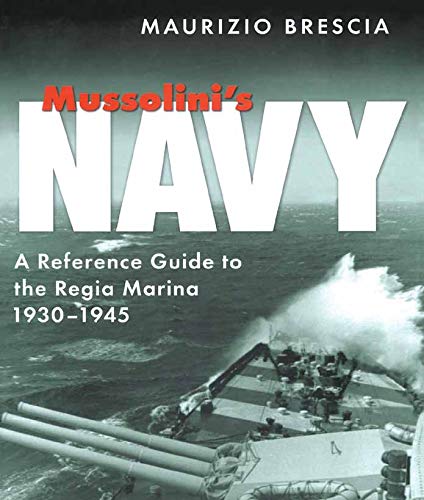
Mussolini's Navy
by Maurizio Brescia
"A Reference Guide to the Regia Marina 1930-1945"
Popularity
4.74 / 5
* A book's popularity is determined by how it compares to all other books on this website.
Where to buy?
Buy from Amazon* If you buy this book through the link above, we may receive a small commission at no extra cost to you.
Mussolini's Navy by Maurizio Brescia
Details
War:
World War II
Military Unit:
Kriegsmarine
True Story:
Yes
Biography:
No
Region:
Europe
Published Date:
2025
ISBN13:
9781036150259
Review of Mussolini's Navy by Maurizio Brescia
Maurizio Brescia's "Mussolini's Navy: A Reference Guide to the Regia Marina 1930-1945" is a technical and visual survey of the Italian fleet during one of the most dramatic periods in its history. Published by Naval Institute Press, the book positions itself as a reference work rather than a narrative history, and it succeeds admirably in that role. For readers interested in naval architecture, ship design, and the specific characteristics of Italian warships from the interwar period through the Second World War, this volume offers a wealth of carefully organized information.
The book's structure follows a logical progression through the various classes of vessels that made up the Regia Marina. Battleships, cruisers, destroyers, torpedo boats, submarines, and smaller craft each receive dedicated attention, with technical specifications, construction histories, and armament details laid out in a clear and accessible format. Brescia, an established authority on Italian naval matters, brings a deep familiarity with primary sources and archival material that lends the work considerable authority. The level of detail extends beyond mere statistics to include design philosophy, the industrial context of Italian shipbuilding, and the strategic thinking that shaped fleet composition during the Fascist era.
One of the standout features of this reference guide is its visual component. The book is generously illustrated with photographs, many of which are not widely reproduced elsewhere, along with technical drawings and diagrams that help readers visualize the vessels being discussed. For those with an interest in naval modeling or ship design, these illustrations alone justify the book's place on a shelf. The quality of reproduction is generally high, allowing readers to appreciate details of superstructure, armament placement, and hull configuration that might otherwise be difficult to discern from written description alone.
The historical context provided throughout the book is measured and informative without veering into speculation or unsupported claims. Brescia situates the development of the Regia Marina within the broader currents of interwar naval treaties, particularly the Washington and London naval agreements, which shaped tonnage limits and influenced design choices across all major navies of the period. The book also addresses the operational realities faced by Italian ships during the Second World War, including engagements in the Mediterranean theater, without dwelling excessively on tactical narrative. This restraint keeps the focus squarely on the ships themselves rather than diverting into a full campaign history, which is appropriate given the book's stated purpose as a reference guide.
Readers should approach this volume with realistic expectations. It is not intended as a chronological history of Italian naval operations during the war, nor does it offer extensive biographical detail on commanders or political figures. Those seeking a narrative account of specific battles, such as Taranto or Cape Matapan, will find only passing references here rather than in-depth analysis. Instead, the book excels as a technical companion, the kind of resource one might keep close at hand while reading a more narrative-driven history, using it to check specifications or clarify the appearance of a particular class of vessel.
The organization of the material makes it easy to locate specific information quickly, a hallmark of a well-designed reference work. Cross-referencing between related ship classes and consistent presentation of technical data throughout the book contribute to its usability. This is clearly a volume meant to be consulted repeatedly rather than read cover to cover in a single sitting, though enthusiasts of naval history may well find themselves doing exactly that given the quality of the content.
Overall, "Mussolini's Navy" fills a valuable niche for anyone with a serious interest in the Regia Marina during its most consequential period. Brescia's expertise shines through in the precision of the technical details and the thoughtfulness of the historical framing. While it may not appeal to casual readers looking for dramatic storytelling, it will be an essential addition to the libraries of naval historians, modelers, and researchers who require accurate, well-organized information about Italian warships of the era. The book stands as a testament to careful scholarship and a genuine passion for naval history, offering lasting value as a reference tool long after a first reading.