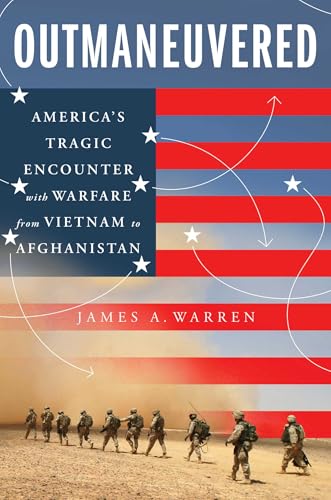
Outmaneuvered
by James A. Warren
"America's Tragic Encounter with Warfare from Vietnam to Afghanistan"
Popularity
4.51 / 5
* A book's popularity is determined by how it compares to all other books on this website.
Where to buy?
Buy from Amazon* If you buy this book through the link above, we may receive a small commission at no extra cost to you.
Outmaneuvered by James A. Warren
Details
War:
Vietnam War
Perspective:
Commanders
Military Unit:
US Army
True Story:
Yes
Biography:
Yes
Region:
Asia
Page Count:
336
Published Date:
2025
ISBN13:
9781668004555
Review of Outmaneuvered by James A. Warren
James A. Warren's "Outmaneuvered: America's Tragic Encounter with Warfare from Vietnam to Afghanistan" offers a sweeping examination of how the United States military has repeatedly struggled to adapt its strategic thinking to the realities of irregular and unconventional warfare. Warren, a historian with a long-standing interest in American military affairs, traces a pattern of institutional failure that spans decades and multiple conflicts, arguing that the Pentagon has consistently misunderstood the nature of the wars it has been asked to fight.
The book's central thesis is that American military leadership, shaped by a doctrine built around large-scale conventional battles against nation-states, has been fundamentally unprepared for the asymmetric, politically complex conflicts that have defined the post-World War II era. Warren begins with Vietnam, laying out how the overwhelming firepower and technological superiority of American forces failed to translate into strategic success against a determined insurgency that understood the political dimensions of the conflict far better than its opponent. From there, the narrative moves through subsequent decades, ultimately arriving at the wars in Iraq and Afghanistan, where similar patterns of misjudgment and institutional resistance to change reemerge.
One of the strengths of this book lies in its ability to draw connections across seemingly disparate conflicts separated by decades and vastly different geopolitical contexts. Warren is not simply cataloging military failures; he is building a case that these failures share common roots in how the American defense establishment conceives of warfare itself. The emphasis on technological dominance, decisive battles, and clear metrics of victory, he argues, has repeatedly blinded military planners to the political and cultural dimensions that determine success or failure in counterinsurgency and nation-building efforts.
Warren's prose is accessible without sacrificing depth, making the book suitable for readers who may not have extensive background knowledge of military history or strategic theory. He avoids excessive jargon, choosing instead to explain complex concepts in terms that a general audience can follow. This is particularly valuable given the scope of the material, which spans multiple wars, several presidential administrations, and evolving military doctrines over more than half a century.
The historical research underpinning the book appears thorough, drawing on a range of primary and secondary sources to support its arguments. Warren does not merely rely on hindsight to criticize past decisions; he attempts to reconstruct the thinking of military and political leaders at the time, which lends credibility to his analysis. This approach helps readers understand not just what went wrong, but why intelligent, experienced professionals repeatedly made similar strategic miscalculations across different conflicts and generations.
That said, the book's ambitious scope occasionally becomes its own challenge. Covering multiple wars across many decades in a single volume necessarily means that some conflicts receive more detailed treatment than others. Readers seeking an exhaustive account of any single war, such as Vietnam or Afghanistan, may find themselves wanting more depth than this comparative study can provide. The book works best when read as a broad argument about institutional patterns rather than as a definitive history of any one conflict.
Warren's critique of American military culture is pointed but measured. He does not dismiss the courage or competence of individual soldiers and officers, nor does he suggest that failures were the result of incompetence alone. Instead, he points to systemic and cultural factors within the defense establishment that have made adaptation difficult, even when individual leaders recognized the need for change. This nuanced approach avoids the trap of oversimplified blame while still delivering a clear and consistent argument.
For readers interested in military history, foreign policy, or the broader question of how nations learn or fail to learn from past conflicts, "Outmaneuvered" offers a thought-provoking and well-researched perspective. It is particularly relevant for anyone seeking to understand the strategic challenges that continue to shape American involvement in conflicts around the world. While the book covers well-trodden historical ground in places, its comparative framework and emphasis on institutional patterns provide a valuable lens through which to view decades of American military engagement. Warren has produced a work that is both accessible to general readers and substantive enough to reward those with deeper interest in the subject matter.
