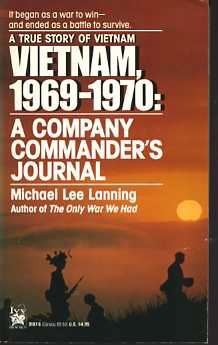
Vietnam, 1969-1970
by Michael Lee Lanning
"A Company Commander's Journal"
Popularity
4.66 / 5
* A book's popularity is determined by how it compares to all other books on this website.
Where to buy?
Buy from Amazon* If you buy this book through the link above, we may receive a small commission at no extra cost to you.
Vietnam, 1969-1970 by Michael Lee Lanning
Details
War:
Vietnam War
Perspective:
Commanders
Military Unit:
US Army
True Story:
Yes
Biography:
No
Region:
Asia
Page Count:
311
Published Date:
1988
ISBN13:
9780804101875
Summary
Vietnam 1969 1970 is a firsthand account by Michael Lee Lanning detailing his experiences as a company commander during the Vietnam War. Written in journal format, the book offers a candid, day to day perspective on the realities of combat leadership, the challenges of commanding troops in the field, and the broader struggles faced by soldiers during this period of the conflict. It provides readers with an intimate look at military decision making, the physical and emotional toll of war, and the complexities of leading men in a difficult and often unclear conflict environment.
Review of Vietnam, 1969-1970 by Michael Lee Lanning
Michael Lee Lanning's "Vietnam, 1969-1970: A Company Commander's Journal" stands as one of the more candid and immediate accounts to emerge from the Vietnam War, distinguished by the fact that it was drawn directly from the journal entries Lanning kept while serving as a company commander in the field. Unlike memoirs written decades after the fact and filtered through the haze of memory, this book retains the rawness and specificity of events recorded close to when they happened, lending it a documentary quality that many war narratives lack.
Lanning served with the 199th Light Infantry Brigade, and his book chronicles his experiences leading a company of soldiers through the dense terrain and constant uncertainty of the war in Vietnam. The narrative does not attempt to romanticize combat or present a sweeping political analysis of the conflict. Instead, it focuses tightly on the day-to-day realities faced by a junior officer responsible for the lives of the men under his command. This includes the physical hardships of jungle warfare, the psychological toll of sustained danger, and the complex relationships between officers and enlisted soldiers operating under extreme stress.
One of the book's notable strengths is its unflinching honesty about the difficulties of command. Lanning does not shy away from describing moments of fear, uncertainty, and the weight of decisions that carried life-and-death consequences. He writes about the strain of maintaining discipline and morale among troops who were often exhausted, frightened, and skeptical of the war's broader purpose. This candor gives readers insight into the human dimension of leadership in combat, a perspective that is sometimes lost in more detached historical accounts.
The journal format itself shapes the reading experience in a distinctive way. Entries are often terse and focused on immediate concerns: troop movements, enemy contact, logistical challenges, and the physical environment. This style conveys a sense of the fragmented, unpredictable nature of the war, where soldiers moved from moments of tedium to sudden danger without warning. Readers looking for a traditional narrative arc with clear beginning, middle, and end points may find the structure less conventional, but this fragmentation mirrors the actual experience of those who served, where long stretches of waiting were punctuated by brief, intense episodes of combat.
Lanning's background as a career military officer, and his later work as a military historian, lends credibility to his observations. He writes with the authority of someone who understood both the tactical and human dimensions of the war, and his later scholarly work on Vietnam-era topics suggests a lasting commitment to documenting this period of American military history accurately. This book can be read not only as a personal account but as a valuable primary source for understanding small-unit infantry operations during this specific phase of the war.
The book also captures the broader context of the Vietnam War during 1969 and 1970, a period marked by shifting American strategy and growing uncertainty about the war's direction at home. While Lanning's focus remains largely on his immediate surroundings and responsibilities, the backdrop of this transitional period in the conflict adds historical weight to his personal observations. Readers interested in military history will find value in the ground-level perspective it offers, complementing broader historical narratives with the specific, lived experience of a company commander.
Overall, "Vietnam, 1969-1970: A Company Commander's Journal" offers a direct, unembellished look at the realities of leading soldiers in combat during one of the most contentious periods of American military involvement overseas. Its value lies not in dramatic storytelling but in its authenticity and immediacy. For readers seeking to understand the practical and emotional challenges faced by junior officers in Vietnam, this book provides a clear and credible window into that experience. It stands as a useful contribution to the broader body of literature documenting the Vietnam War from a personal, ground-level vantage point, offering insight that complements more strategic or political accounts of the conflict.