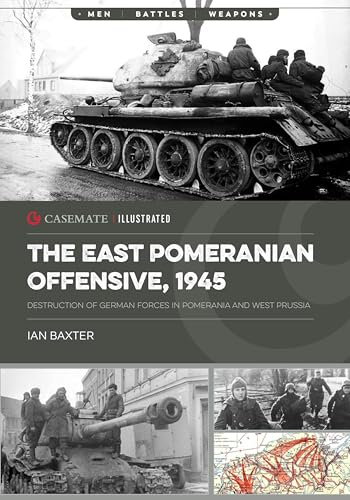
The East Pomeranian Offensive, 1945
by Ian Baxter
"Destruction of German forces in Pomerania and West Prussia"
Popularity
4.75 / 5
* A book's popularity is determined by how it compares to all other books on this website.
Where to buy?
Buy from Amazon* If you buy this book through the link above, we may receive a small commission at no extra cost to you.
The East Pomeranian Offensive, 1945 by Ian Baxter
Details
War:
World War II
Military Unit:
Red Army
True Story:
Yes
Biography:
No
Region:
Europe
Page Count:
129
Published Date:
2025
ISBN13:
9781636243894
Summary
The East Pomeranian Offensive, 1945 examines the Soviet military campaign that destroyed German forces in Pomerania and West Prussia during the final months of World War II. Ian Baxter documents this brutal winter offensive, which ran from February to April 1945, as Soviet armies pushed westward through these territories toward Berlin. The book combines historical narrative with extensive photographic documentation, detailing the combat operations, strategic objectives, and devastating impact on both military forces and civilian populations. It provides insight into this often overlooked phase of the war's Eastern Front conclusion.
Review of The East Pomeranian Offensive, 1945 by Ian Baxter
Ian Baxter's examination of the East Pomeranian Offensive represents a focused study of one of World War II's lesser-known yet strategically significant military campaigns. This volume directs attention to the Soviet operations conducted in early 1945 that resulted in the destruction of substantial German forces in the Pomeranian and West Prussian regions during the final months of the war in Europe.
The East Pomeranian Offensive, which took place between February and April 1945, constituted a critical phase of the Soviet advance toward Berlin. Baxter presents this campaign within its proper historical context, exploring how Soviet forces under Marshals Konstantin Rokossovsky and Georgy Zhukov executed operations designed to eliminate German defensive positions along the Baltic coast and secure the Soviet northern flank before the final assault on the German capital.
The author provides detailed coverage of the military situation facing both sides at the start of the offensive. German forces, consisting of remnants of Army Group Vistula under Heinrich Himmler's initially ineffective command, occupied defensive positions intended to protect the approaches to Berlin and maintain access to East Prussia. These formations, despite their depleted state after previous Soviet offensives, represented a significant threat to Soviet operational plans. Baxter outlines how the Germans attempted to establish defensive lines while simultaneously dealing with overwhelming Soviet numerical superiority and the challenges of conducting operations with diminishing resources.
The photographic content serves as a central feature of this work, consistent with Baxter's approach in his military history publications. The collection includes images documenting various aspects of the campaign, from destroyed German armor and defensive positions to scenes of urban warfare in Pomeranian cities. These visual materials provide tangible evidence of the intensity and destructive nature of the fighting that characterized this offensive. The photographs also illustrate the conditions faced by both attacking Soviet forces and defending German units during the harsh winter and early spring of 1945.
Baxter traces the progression of Soviet operations through multiple phases, examining how the Red Army systematically reduced German defensive positions. The narrative covers the isolation and destruction of German forces in key locations, including the siege of several fortified cities that the Germans had designated as strongholds. The author explains how Soviet forces employed combined arms tactics, utilizing artillery, armor, and infantry in coordinated assaults designed to break through German lines and encircle defending formations.
The work addresses the significant humanitarian dimensions of the campaign, including the massive displacement of civilian populations from East Prussia and Pomerania. As Soviet forces advanced, hundreds of thousands of German civilians fled westward, often under extremely difficult conditions. This aspect of the offensive had lasting demographic and political consequences for the region, as the territorial changes resulting from the war's outcome would permanently alter the area's character.
The author examines the military effectiveness of German defensive efforts during this period, noting both the determination of individual units and the overall impossibility of their strategic situation. By early 1945, German forces lacked the resources, reinforcements, and air support necessary to conduct effective defensive operations against the massive Soviet war machine. Baxter presents this reality without excessive editorializing, allowing the historical facts to convey the desperate circumstances facing German commanders and their troops.
The operational details provided throughout the text offer insight into the conduct of large-scale military operations during the war's final phase. The campaign demonstrated the Soviet military's ability to sustain offensive operations across multiple axes of advance while maintaining logistics over extended distances. The coordination between different Soviet fronts and the integration of various combat arms reflected the considerable operational experience gained through years of warfare on the Eastern Front.
This volume serves readers interested in the military operations that preceded the Battle of Berlin and those seeking to understand the complete picture of the war's final campaigns in Eastern Europe. The book's focus on a specific offensive provides detailed coverage that broader surveys of the period cannot accommodate. The combination of narrative text and photographic documentation creates a resource that appeals to military history enthusiasts and researchers examining the Eastern Front's concluding operations. Baxter's work contributes to the documentation of this important campaign, ensuring that the East Pomeranian Offensive receives appropriate attention within the larger historical record of World War II's European theater.


