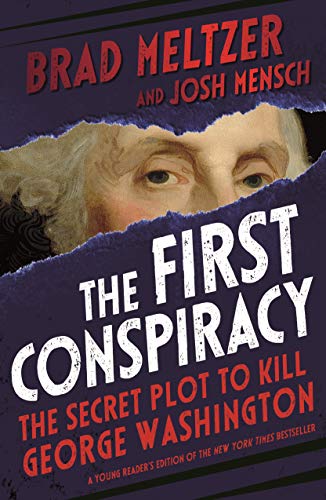
The First Conspiracy (Young Reader's Edition)
by Brad Meltzer
"The Secret Plot to Kill George Washington"
Popularity
4.56 / 5
* A book's popularity is determined by how it compares to all other books on this website.
Where to buy?
Buy from Amazon* If you buy this book through the link above, we may receive a small commission at no extra cost to you.
The First Conspiracy (Young Reader's Edition) by Brad Meltzer
Details
War:
American Revolutionary War
Perspective:
Spying
True Story:
Yes
Biography:
No
Region:
North America
Page Count:
368
Published Date:
2020
ISBN13:
9781250244833
Summary
The First Conspiracy reveals a little-known historical plot to assassinate George Washington during the early days of the Revolutionary War in 1776. Brad Meltzer uncovers a real conspiracy involving members of Washington's own guard who planned to kill or kidnap him in New York before the Declaration of Independence was signed. The book details how this treasonous scheme was discovered and thwarted, examining the subsequent investigation and trial. Meltzer combines historical research with compelling narrative to illuminate this dramatic moment when the fate of the Revolution and the nation hung in the balance.
Review of The First Conspiracy (Young Reader's Edition) by Brad Meltzer
"The First Conspiracy: The Secret Plot to Kill George Washington" by Brad Meltzer, co-written with Josh Mensch, explores a little-known episode from the early days of the American Revolution: a plot allegedly aimed at assassinating General George Washington in 1776. The book examines how, at a critical and fragile moment for the fledgling Continental Army, threats to Washington's life emerged from within the ranks meant to protect him, including members of his own personal guard.
Meltzer and Mensch structure the book around the investigation that uncovered the conspiracy, weaving together the perspectives of Washington, his soldiers, and the shadowy figures suspected of plotting against him. The narrative moves through the tense atmosphere of New York City in the months before the British invasion, when loyalty to the revolutionary cause was far from universal and Tory sympathizers actively worked to undermine the rebellion. The authors present this backdrop with enough detail to help readers understand why such a plot could plausibly take root, without overwhelming the story with excessive historical exposition.
One of the book's strengths lies in its accessibility. Meltzer, known primarily for his thriller novels, brings a narrative sensibility to historical nonfiction that makes the material engaging for readers who might not typically pick up a history book. The pacing is brisk, and the authors take care to explain the political and military context clearly, making the story approachable for those with only a general familiarity with the American Revolution. At the same time, the book does not sacrifice historical grounding for the sake of drama; sources and archival records are referenced throughout, and the authors are transparent about the limits of what can be definitively proven regarding the scope and intentions of the conspiracy.
The book also sheds light on the early development of American counterintelligence and internal security efforts, showing how Washington and his closest advisors began to grapple with the necessity of protecting the revolutionary leadership from infiltration and betrayal. This aspect of the story is particularly compelling, as it reveals the fragility of the American cause at a time when the outcome of the war was far from certain. The plot itself, involving individuals such as Thomas Hickey, a member of Washington's guard, is presented with attention to the legal proceedings that followed its discovery, including the resulting court-martial.
Where the book occasionally falls short is in its treatment of ambiguity. Because much of the historical record surrounding the conspiracy is incomplete, the authors sometimes must rely on inference to connect certain events or motivations. They generally handle this responsibly, distinguishing between established fact and reasonable speculation, but readers seeking a purely academic account may find themselves wanting more caveats or deeper engagement with primary source limitations. Those looking for a heavily footnoted scholarly work may be better served by more specialized historical texts, though the authors do include source notes for readers interested in further research.
Despite this, the book succeeds in its primary goal: illuminating an overlooked chapter of Revolutionary War history in a way that is both informative and readable. It offers a useful reminder that the American Revolution was shaped not only by battles and grand political decisions but also by internal threats, personal loyalties, and the constant uncertainty faced by its leaders. Washington emerges from the narrative not as a distant, mythologized figure, but as a man acutely aware of the dangers surrounding him, navigating both external and internal threats with caution and resolve.
Overall, "The First Conspiracy" is a well-paced and engaging work of narrative history that succeeds in bringing attention to a lesser-known event with real historical significance. It is particularly well-suited for readers interested in early American history who want an accessible entry point into a specific and dramatic episode, rather than a sweeping overview of the Revolutionary War. The collaboration between Meltzer's storytelling instincts and Mensch's research contributes to a book that is both entertaining and informative, making it a solid addition to popular historical nonfiction focused on the founding era of the United States.

