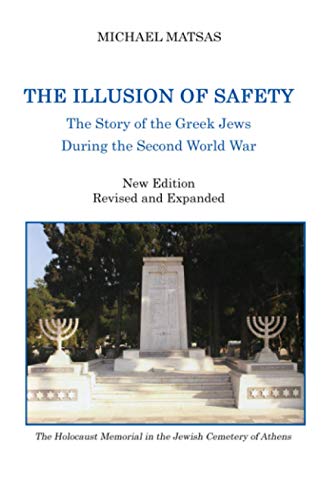
The Illusion of Safety
by Michael Matsas
"The Story of the Greek Jews During the Second World War"
Popularity
4.93 / 5
* A book's popularity is determined by how it compares to all other books on this website.
Where to buy?
Buy from Amazon* If you buy this book through the link above, we may receive a small commission at no extra cost to you.
The Illusion of Safety by Michael Matsas
Details
War:
World War II
Perspective:
Civilian
True Story:
Yes
Biography:
No
Region:
Europe
Published Date:
2021
ISBN13:
9780578877075
Review of The Illusion of Safety by Michael Matsas
Michael Matsas's "The Illusion of Safety: The Story of the Greek Jews During the Second World War" is a sobering and meticulously researched account of a community whose long history in the Balkans came to a devastating end under Nazi occupation. The book examines the fate of Greek Jewry, a population that had thrived for centuries in cities such as Thessaloniki, Athens, Ioannina, and Rhodes, and traces how the illusions of security many held before the war gave way to catastrophic loss during it.
The title itself captures the central theme of the book. Many Greek Jews, particularly in Thessaloniki, believed that their deep roots in the region, their contributions to local economies, and in some cases their assumptions about international protection would shield them from the worst horrors sweeping across Europe. Matsas methodically dismantles this false sense of security, showing how quickly circumstances changed once German forces occupied Greece in 1941 and began implementing anti-Jewish policies in cooperation with local collaborators.
One of the book's strengths lies in its attention to regional variation. Rather than treating Greek Jewry as a monolithic group, Matsas highlights the distinct experiences of different communities. Thessaloniki, home to one of the largest and most historically significant Sephardic Jewish populations in Europe, suffered near-total destruction, with the vast majority of its Jews deported to Auschwitz-Birkenau in 1943. In contrast, Athens and other areas under Italian occupation experienced a different trajectory, at least until Italy's surrender in 1943 shifted control to German forces and dramatically worsened conditions for Jews throughout the country.
Matsas also devotes attention to the role of Greek resistance networks, religious leaders, and ordinary citizens who risked their lives to shelter Jewish neighbors. These accounts of rescue and solidarity provide necessary context, illustrating that the story of Greek Jewry during the war is not solely one of victimization but also one that includes acts of courage amid extraordinary danger. The inclusion of these narratives helps present a more complete and nuanced picture of the period, avoiding a simplistic framing that might otherwise flatten the complexity of wartime Greece.
The book is grounded in historical research, drawing on testimonies, documentation, and existing scholarship to reconstruct the sequence of events with clarity. Matsas writes in a direct, unembellished style that suits the gravity of the subject matter. He avoids sensationalism, instead allowing the historical record to convey the scale of the tragedy. This restraint gives the book a quiet power, as the facts themselves are stark enough to leave a lasting impression on readers.
At the same time, the book does not shy away from addressing the broader historical and political context that shaped the fate of Greek Jews. Matsas discusses the occupation dynamics between German and Italian forces, the involvement of local collaborators, and the bureaucratic mechanisms of deportation that were implemented with chilling efficiency. This contextualization helps readers understand not just what happened, but how the machinery of persecution operated within a specific national and geopolitical framework.
For readers interested in Holocaust history, Mediterranean Jewish communities, or the broader history of wartime Greece, this book offers a valuable and detailed resource. It fills an important gap in English-language scholarship, as much of the existing literature on the Holocaust has traditionally focused on Central and Eastern Europe, leaving the experience of Sephardic and Romaniote Jewish communities in Greece less widely known. Matsas's work helps address this imbalance, bringing attention to a community whose destruction was nearly complete and whose history deserves wider recognition.
Overall, "The Illusion of Safety" is a valuable contribution to Holocaust historiography. It combines careful documentation with a clear narrative structure, making a painful chapter of history accessible without diminishing its complexity. The book serves as both a record of loss and a tribute to a community whose presence in Greece spanned centuries before being nearly erased within a few short years of occupation and war.