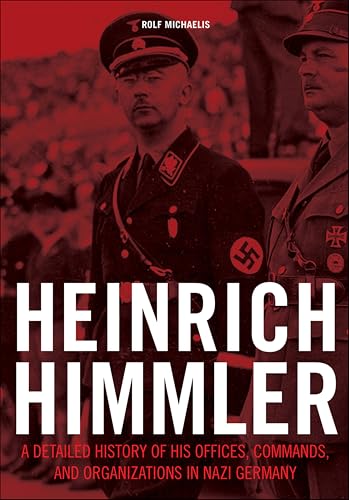
The Private Heinrich Himmler
by Katrin Himmler
"Letters of a Mass Murderer"
Popularity
4.65 / 5
* A book's popularity is determined by how it compares to all other books on this website.
Where to buy?
Buy from Amazon* If you buy this book through the link above, we may receive a small commission at no extra cost to you.
The Private Heinrich Himmler by Katrin Himmler
Details
War:
World War II
Perspective:
Commanders
Military Unit:
Waffen-SS
True Story:
Yes
Biography:
Yes
Region:
Europe
Page Count:
353
Published Date:
2016
ISBN13:
9781250064653
Summary
This book presents a collection of personal letters written by Heinrich Himmler, one of the most powerful figures in Nazi Germany and architect of the Holocaust. The correspondence reveals the stark contrast between his private life as a seemingly ordinary family man and his role as head of the SS, responsible for organizing mass murder. Through these letters, readers gain insight into the disturbing duality of a man who could express domestic concerns while simultaneously orchestrating genocide, offering a chilling glimpse into the banality of evil and the psychology of perpetrators.
Review of The Private Heinrich Himmler by Katrin Himmler
"The Private Heinrich Himmler: Letters of a Mass Murderer" presents a chilling and revealing collection of personal correspondence written by one of the most infamous architects of the Holocaust. Compiled and edited from letters exchanged primarily with his wife Margarete and, later, his mistress Hedwig Potthast, this volume offers a rare glimpse into the domestic and emotional life of a man responsible for orchestrating mass genocide as head of the SS. The juxtaposition between the banality of everyday concerns expressed in these letters and the horrific historical context in which Himmler operated creates a deeply unsettling reading experience.
What makes this collection particularly valuable to historians and general readers alike is its unflinching presentation of Himmler as a multidimensional figure rather than a one-dimensional villain. The letters reveal a man who worried about his health, discussed household matters, expressed affection for his family, and engaged in the mundane rhythms of daily life even as he was simultaneously directing one of history's greatest atrocities. This duality is not softened or explained away by the editors; rather, it is presented starkly, forcing readers to grapple with the disturbing reality that perpetrators of genocide can also inhabit ordinary domestic roles.
The correspondence spans a significant period, offering insight into Himmler's evolving relationships and his attempts to maintain a semblance of normal family life while his professional responsibilities grew increasingly monstrous. The letters to his wife Margarete, in particular, show a marriage that appears to have been practical rather than passionate, with correspondence often focused on logistics, finances, and their daughter Gudrun. The later letters to Hedwig Potthast reveal a different dynamic, suggesting a more emotionally invested relationship, though even these communications remain constrained by the formal conventions of the era and Himmler's own reserved personality.
Editorial commentary throughout the volume provides essential historical context, helping readers understand the timeline of events and Himmler's rising power within the Nazi hierarchy. This scholarly apparatus is crucial, as the letters themselves, taken purely at face value, might otherwise obscure the full scope of Himmler's crimes. The editors have clearly taken care to situate these personal writings within the broader historical narrative of the Third Reich, ensuring that readers understand the letters not as a rehabilitation of Himmler's character but as a disturbing complement to the historical record of his actions.
The book's structure allows for a chronological progression that mirrors Himmler's own trajectory from a relatively obscure figure to one of the most powerful and feared men in Nazi Germany. This progression is particularly effective in demonstrating how the language and content of his letters shifted over time, even as certain personal preoccupations remained constant. The mundane details—discussions of gifts, health remedies, and family visits—stand in stark contrast to the historical knowledge readers bring to the text regarding the concentration camps, mass executions, and systematic persecution that Himmler was simultaneously overseeing.
This collection serves an important function in Holocaust studies and the broader historiography of Nazi Germany by humanizing, in the most uncomfortable sense of that word, one of history's most notorious perpetrators. Rather than allowing readers to dismiss Himmler as an inhuman monster disconnected from ordinary experience, the letters compel a more complex understanding of how ordinary domestic sentiments coexisted with extraordinary evil. This approach aligns with broader scholarly efforts to understand the psychology of perpetrators of genocide, moving beyond simple demonization toward a more nuanced, if deeply troubling, comprehension of how individuals can compartmentalize their personal and professional lives.
Readers approaching this book should be prepared for an emotionally challenging experience. The banality documented within these pages does not provide easy answers or comfortable narratives. Instead, it presents primary source material that requires careful, critical engagement. For those interested in Holocaust history, the psychology of perpetrators, or the personal dimensions of historical figures who committed atrocities, this collection offers invaluable, if disquieting, insight. It stands as an important contribution to understanding not just Himmler as an individual, but the broader phenomenon of how ordinary human relationships and concerns persisted alongside unprecedented crimes against humanity.