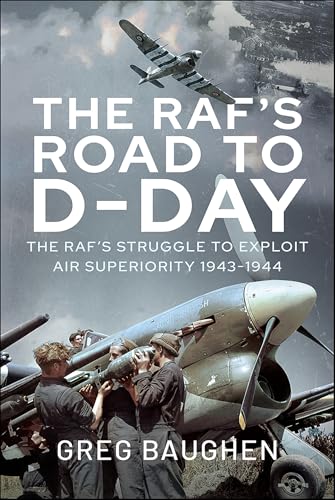
The RAF's Road to D-Day
by Greg Baughen
"The Struggle to Exploit Air Superiority, 1943–1944"
Popularity
4.32 / 5
* A book's popularity is determined by how it compares to all other books on this website.
Where to buy?
Buy from Amazon* If you buy this book through the link above, we may receive a small commission at no extra cost to you.
The RAF's Road to D-Day by Greg Baughen
Details
War:
World War II
Perspective:
Bombers
Military Unit:
Royal Air Force
True Story:
Yes
Biography:
No
Region:
Europe
Page Count:
413
Published Date:
2023
ISBN13:
9781399051828
Summary
This book examines the Royal Air Force's efforts to leverage air superiority in the lead-up to the D-Day invasion. Greg Baughen analyzes the strategic and tactical challenges the RAF faced during 1943-1944, exploring debates over bombing strategies, resource allocation, and coordination with Allied forces. The narrative reveals how the RAF worked to translate its dominance in the skies into effective support for the ground invasion, highlighting both successes and setbacks in developing doctrine and operations that would prove crucial to the Normandy landings.
Review of The RAF's Road to D-Day by Greg Baughen
Greg Baughen's "The RAF's Road to D-Day: The Struggle to Exploit Air Superiority, 1943-1944" offers a detailed examination of a critical but often overlooked period in the Allied air campaign during World War II. This work challenges conventional narratives about the Royal Air Force's effectiveness in the months leading up to the Normandy invasion, presenting a nuanced analysis of strategic decisions, operational challenges, and the complex relationship between air power doctrine and battlefield reality.
The book focuses on a pivotal transitional period when the RAF had achieved air superiority over Western Europe but struggled to translate this advantage into tangible support for the impending invasion. Baughen meticulously documents the debates, disagreements, and organizational tensions that characterized RAF operations during 1943 and early 1944. Rather than presenting a triumphalist account of inevitable Allied success, the author reveals a more complicated picture of military planning, where competing priorities, doctrinal rigidity, and inter-service rivalries often hindered effective coordination.
One of the book's central themes concerns the strategic bombing campaign and its relationship to Operation Overlord. Baughen examines how Bomber Command's focus on area bombing of German cities competed with the tactical need to disrupt enemy transportation networks and military installations in occupied France. The tension between Air Chief Marshal Arthur Harris's commitment to strategic bombing and the requirements of the invasion planners receives thorough treatment, illuminating the difficult choices facing Allied commanders as D-Day approached.
The author demonstrates considerable expertise in analyzing the technical and operational aspects of RAF operations during this period. The discussion of aircraft capabilities, targeting methodologies, and the evolution of tactical air support doctrine provides valuable context for understanding why certain approaches succeeded while others failed. Baughen pays particular attention to the development of the Transportation Plan, which aimed to cripple German rail networks in France, and the debates surrounding its implementation and effectiveness.
The research underpinning this work appears extensive, drawing on operational records, strategic assessments, and contemporary accounts to build a comprehensive picture of RAF activities. The author's treatment of the command structure and decision-making processes within the RAF and the broader Allied hierarchy adds depth to the narrative. By examining the personalities and perspectives of key figures involved in planning and executing air operations, Baughen helps readers understand not just what happened, but why particular choices were made.
The book does not shy away from examining failures and missed opportunities. Baughen's analysis reveals instances where doctrinal inflexibility, inadequate intelligence, or poor coordination resulted in less effective operations than might have been achieved. This critical approach strengthens the work's credibility, as it avoids the temptation to portray Allied air operations as uniformly successful or brilliantly conceived. Instead, readers encounter a realistic assessment that acknowledges both achievements and shortcomings.
The relationship between the RAF and other Allied air forces, particularly the United States Army Air Forces, receives appropriate attention. The coordination challenges inherent in managing a coalition air campaign emerge clearly from the narrative, demonstrating how national priorities and organizational cultures influenced operational planning. The author's treatment of these inter-Allied dynamics adds an important dimension to understanding the broader context of air operations in support of D-Day.
For readers interested in military aviation history or the preparation for the Normandy invasion, this book provides valuable insights that complement existing literature on the subject. The focus on the RAF's perspective and the specific challenges of the 1943-1944 period fills a gap in the historiography of the air war over Europe. While the level of detail may be substantial for general readers, those with a serious interest in the subject will find the thoroughness rewarding.
The writing maintains a scholarly tone throughout while remaining accessible to non-specialist readers who possess a basic familiarity with World War II history. Baughen presents complex operational and strategic matters clearly, though the density of information requires attentive reading. The book's structure supports its analytical approach, allowing the author to develop arguments systematically while maintaining narrative coherence across multiple operational theaters and organizational levels.
"The RAF's Road to D-Day" represents a significant contribution to understanding how air power was employed in support of the Allied invasion of France. By focusing on the difficult transition from achieving air superiority to exploiting it effectively for ground operations, Baughen illuminates a crucial but insufficiently examined aspect of the preparations for D-Day. The book will appeal particularly to military historians, aviation enthusiasts, and anyone seeking a deeper understanding of the complexities inherent in translating strategic advantage into operational success.