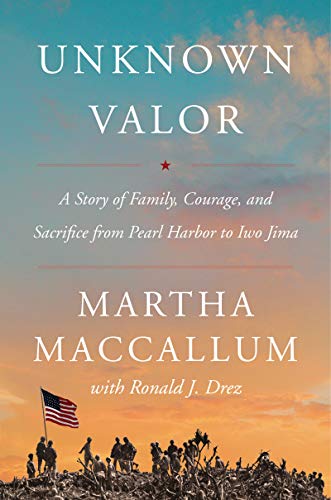
Unknown Valor
by Martha MacCallum
"A Story of Family, Courage, and Sacrifice from Pearl Harbor to Iwo Jima"
Popularity
4.93 / 5
* A book's popularity is determined by how it compares to all other books on this website.
Where to buy?
Buy from Amazon* If you buy this book through the link above, we may receive a small commission at no extra cost to you.
Unknown Valor by Martha MacCallum
Details
War:
World War II
Perspective:
Infantry
Military Unit:
US Marine Corps
True Story:
Yes
Biography:
Yes
Region:
Pacific
Page Count:
336
Published Date:
2020
ISBN13:
9780062853851
Summary
Unknown Valor tells the intertwined stories of twelve American men, including the author's uncle, who fought in the Pacific theater during World War II. Martha MacCallum traces their journeys from the attack on Pearl Harbor through the brutal Battle of Iwo Jima, highlighting the courage and sacrifice of these young Marines. The book combines personal family history with extensive research to bring to life the experiences of ordinary men thrust into extraordinary circumstances, offering readers an intimate look at one of the war's most iconic and costly battles.
Review of Unknown Valor by Martha MacCallum
Martha MacCallum's "Unknown Valor" tells the remarkable true story of a group of young Marines whose lives became forever intertwined through the crucible of World War II in the Pacific. The book focuses on Harry Gray, a young man from a working-class Massachusetts family, and his fellow servicemen who fought from the devastating attack on Pearl Harbor through the bloodiest battles of the Pacific campaign, culminating in the assault on Iwo Jima. MacCallum, a Fox News anchor, brings a journalist's eye for detail and a storyteller's heart to this meticulously researched account of ordinary Americans thrust into extraordinary circumstances.
The narrative begins with the peaceful prewar lives of these young men, establishing their backgrounds, families, and the world they knew before everything changed on December 7, 1941. This grounding in their civilian identities makes their transformation into Marines all the more poignant. MacCallum excels at portraying the human dimension of war, showing how these men were sons, brothers, and boyfriends before they became soldiers. The author draws heavily on letters, diaries, and family archives to reconstruct their experiences, giving readers intimate access to their thoughts and fears.
What distinguishes this book from other World War II Pacific theater accounts is its dual focus on both the combat experience and the home front. MacCallum skillfully weaves together battlefield narratives with the stories of the families left behind, particularly the mothers, wives, and sweethearts who endured years of uncertainty and dread. The parallel storytelling illuminates the total nature of the war effort and the profound sacrifice demanded not just of those in uniform but of entire families and communities. The anxiety of waiting for news, the careful parsing of censored letters, and the knock on the door that every military family feared are rendered with sensitivity and historical accuracy.
The book's treatment of the major Pacific battles is both accessible and informative. MacCallum provides sufficient strategic context to help readers understand the military objectives and tactical challenges without overwhelming them with excessive military minutiae. The accounts of Guadalcanal, Tarawa, Saipan, and ultimately Iwo Jima are harrowing and visceral, drawn from firsthand accounts and official records. The descriptions of combat conditions, the brutal environment, and the ferocity of Japanese resistance convey the reality of island warfare without sensationalizing the violence.
The Battle of Iwo Jima occupies a central place in the narrative, and MacCallum's treatment of this iconic engagement is thorough and moving. The book captures the strategic importance of the small volcanic island and the terrible cost of securing it. The stories of individual Marines fighting across the black sand beaches and up the slopes of Mount Suribachi bring human scale to a battle often reduced to statistics and the famous flag-raising photograph. MacCallum reminds readers that behind that celebrated image were thousands of individual acts of courage, along with tremendous loss.
One of the book's strengths lies in its exploration of the values and character that motivated these young men. MacCallum examines the sense of duty, patriotism, and commitment to comrades that sustained them through unimaginable hardship. The author also addresses the psychological toll of combat and the challenges faced by survivors in processing their experiences and losses. The post-war section of the book follows the veterans as they attempted to return to civilian life, carrying the weight of what they had witnessed and endured.
The research underpinning the narrative is extensive, incorporating military records, personal correspondence, oral histories, and interviews with surviving family members. MacCallum's access to the Gray family materials and other private archives provides fresh perspectives on well-documented events. The book includes photographs that help bring the individuals to life and connect readers to the real people behind the story.
"Unknown Valor" serves as both a tribute to a specific generation of Marines and a broader meditation on sacrifice, duty, and the human cost of war. MacCallum writes with respect for her subjects and clear admiration for their courage without veering into hagiography. The book acknowledges the complexity of war while honoring those who served. For readers interested in World War II history, personal military narratives, or the Pacific theater specifically, this work offers a compelling and accessible entry point. The focus on lesser-known individuals rather than famous military figures provides a valuable perspective on how ordinary Americans experienced and shaped history during one of the nation's most challenging periods.


