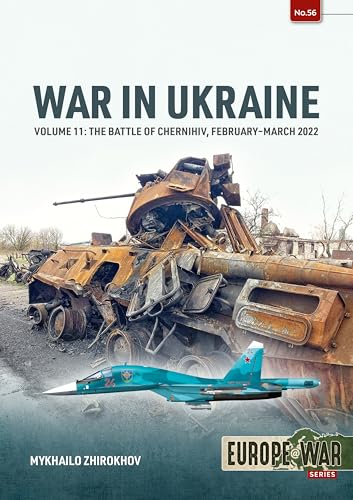
War in Ukraine Volume 11
by Mikhailo Zhirokhov
"The Battle of Chernihiv, February-March 2022"
Popularity
4.89 / 5
* A book's popularity is determined by how it compares to all other books on this website.
Where to buy?
Buy from Amazon* If you buy this book through the link above, we may receive a small commission at no extra cost to you.
War in Ukraine Volume 11 by Mikhailo Zhirokhov
Details
War:
Russo-Ukrainian War
Biography:
No
Region:
Europe
Published Date:
2025
ISBN13:
9781804519677
Summary
This book examines the Battle of Chernihiv during the early stages of Russia's 2022 invasion of Ukraine. Zhirokhov provides a detailed military analysis of the fighting that occurred in and around the northern Ukrainian city from February to March 2022, when Russian forces attempted to capture Chernihiv as part of their advance toward Kyiv. The volume documents the defensive operations by Ukrainian forces, tactical developments, and the eventual Russian withdrawal. It forms part of a larger series chronicling different aspects and battles of the war in Ukraine.
Review of War in Ukraine Volume 11 by Mikhailo Zhirokhov
Mikhailo Zhirokhov's "War in Ukraine, Volume 11: The Battle of Chernihiv, February-March 2022" delivers a detailed examination of one of the lesser-known yet strategically significant battles during the opening phase of Russia's full-scale invasion of Ukraine. As part of the ongoing War in Ukraine series, this volume focuses specifically on the defense of Chernihiv, a city that found itself in the path of Russian forces advancing from Belarus toward Kyiv during the early weeks of the conflict.
The book documents the military operations around Chernihiv, a regional center located approximately 150 kilometers north of the Ukrainian capital. The city's position made it a critical junction in the northern axis of the Russian offensive, as control of the area would have facilitated the encirclement of Kyiv and secured supply lines for advancing forces. Zhirokhov traces the course of combat operations from late February through March 2022, when Ukrainian defenders successfully prevented Russian forces from capturing the city despite weeks of intensive fighting and bombardment.
The narrative examines the tactical situation facing both sides during this period. Ukrainian forces, though outnumbered and facing a better-equipped adversary, managed to hold defensive positions within and around the city. The book details how local defenders utilized urban terrain to their advantage, establishing strongpoints and organizing resistance despite being partially encircled. Meanwhile, Russian forces attempted to bypass or overwhelm these defenses through various tactical maneuvers, leading to sustained combat operations across multiple fronts around the city.
One of the strengths of this volume lies in its attention to the operational details of the battle. Zhirokhov provides information about unit deployments, tactical decisions, and the evolution of fighting positions throughout the engagement. The author documents specific incidents and engagements that shaped the overall battle, offering readers insight into how the defense of Chernihiv unfolded over several weeks. This level of detail helps readers understand the complexity of urban and semi-urban warfare in a contemporary context.
The book also addresses the humanitarian situation that developed as the battle progressed. Chernihiv experienced significant bombardment during the period covered, with civilian infrastructure suffering extensive damage. The text documents how the city's population endured weeks under siege-like conditions, with limited access to supplies, utilities, and medical care. This dimension of the battle provides important context for understanding the full impact of the military operations on the city and its inhabitants.
Zhirokhov's work benefits from its position as part of a larger series dedicated to documenting the war in Ukraine. This allows the volume to maintain focus on Chernihiv specifically while connecting events there to the broader strategic picture of the northern offensive. Readers gain understanding of how the battle for Chernihiv related to simultaneous operations around Kyiv and other northern Ukrainian cities, and how the eventual failure to capture these objectives influenced the subsequent course of the war.
The documentation approach employed in this series aims to create a comprehensive record of military operations during the conflict. For the Battle of Chernihiv, this means assembling information about force dispositions, combat actions, and operational outcomes during a critical period. The book serves as a reference work for those seeking to understand this particular engagement within the larger context of the war's opening phase.
The withdrawal of Russian forces from the Chernihiv region in late March and early April 2022 marked the conclusion of this phase of fighting. The book examines the circumstances surrounding this withdrawal and its implications for both the immediate military situation and the longer-term course of operations. The successful defense of Chernihiv, alongside similar outcomes in other northern cities, contributed to the failure of the initial Russian campaign plan and necessitated a significant shift in operational focus.
This volume will appeal primarily to readers with a serious interest in contemporary military history, operational analysis, or the ongoing conflict in Ukraine. The detailed focus on a specific battle over a defined time period makes it particularly valuable for those seeking to understand the tactical and operational dimensions of modern warfare. While the specialized nature of the content may limit its appeal to general readers, those interested in military operations will find substantial material for study and analysis.
"War in Ukraine, Volume 11" contributes to the growing body of literature documenting the conflict in real-time or near-real-time. As with any work covering recent events, the book represents a snapshot of available information and understanding at the time of publication. Nevertheless, Zhirokhov's detailed treatment of the Battle of Chernihiv provides valuable documentation of an important defensive success during a critical period of the war, ensuring that this battle receives the historical attention it deserves within the broader narrative of the conflict.


