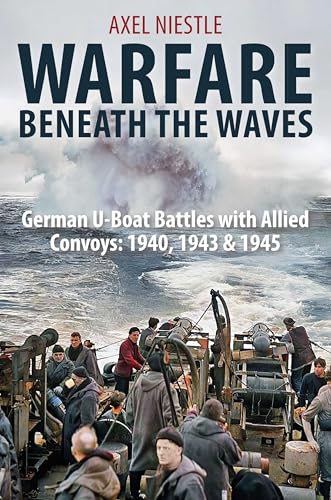
Warfare Beneath the Waves
by Axel Niestle
"German U-Boat Battles with Allied Convoys: 1940, 1943 And 1945"
Popularity
3.72 / 5
* A book's popularity is determined by how it compares to all other books on this website.
Where to buy?
Buy from Amazon* If you buy this book through the link above, we may receive a small commission at no extra cost to you.
Warfare Beneath the Waves by Axel Niestle
Details
War:
World War II
Perspective:
Submarines
Military Unit:
Kriegsmarine
True Story:
Yes
Biography:
No
Region:
Europe
Published Date:
2025
ISBN13:
9781805000730
Summary
This book examines three critical years of the Battle of the Atlantic through detailed analysis of German U-boat operations against Allied convoys. Niestlé focuses on specific convoy battles from 1940, 1943, and 1945, documenting the tactical evolution of submarine warfare throughout World War II. The work provides a German perspective on these engagements, exploring how U-boat strategies and effectiveness changed across different phases of the war, from early successes through the introduction of Allied countermeasures to the final desperate months of the conflict.
Review of Warfare Beneath the Waves by Axel Niestle
Axel Niestlé's "Warfare beneath the waves: German U-boat battles with allied convoys: 1940, 1943 & 1945" stands as a meticulously researched examination of three pivotal periods in the Battle of the Atlantic. This work distinguishes itself from conventional World War II naval histories through its granular focus on specific convoy operations during years that marked distinct phases of the undersea conflict. Rather than attempting a comprehensive overview of the entire U-boat campaign, Niestlé strategically selects representative battles that illuminate the evolving dynamics between German submarine forces and Allied merchant shipping.
The book's structure reflects a deliberate chronological approach, examining convoy battles from 1940 when German U-boats enjoyed their first period of significant success, through 1943 which witnessed both the climax and turning point of the campaign, and finally 1945 when the U-boat arm faced inevitable defeat despite technological innovations. This framework allows readers to observe how tactical approaches, technological capabilities, and strategic circumstances shifted dramatically across these five years of maritime warfare.
Niestlé brings considerable expertise to this subject matter, having spent decades researching German naval operations and U-boat warfare. His access to primary source materials, including war diaries, operational records, and official reports from both Axis and Allied archives, provides the foundation for detailed tactical reconstructions. The author's background in naval research enables him to parse technical details without overwhelming general readers, though the text does demand careful attention to understand the complexities of convoy routing, submarine tactics, and anti-submarine warfare measures.
The treatment of individual convoy battles demonstrates Niestlé's analytical methodology. Each engagement receives thorough documentation, tracking the movements of specific U-boats, identifying commanding officers, and establishing timelines for attacks and counterattacks. The author correlates German records with Allied after-action reports to create comprehensive accounts that acknowledge the fog of war while establishing factual narratives. This approach proves particularly valuable when examining discrepancies between what submarine commanders reported and what actually occurred, revealing how incomplete intelligence shaped decision-making on both sides.
One of the book's notable strengths lies in its balanced perspective. While focusing primarily on German submarine operations, Niestlé does not neglect the Allied response. The evolution of convoy escort tactics, the introduction of new detection technologies, improvements in depth charge deployment, and the critical role of air cover all receive appropriate attention. The text illustrates how the Battle of the Atlantic constituted a genuine battle of innovation, with both sides continuously adapting to counter new threats and exploit emerging vulnerabilities.
The 1943 section receives particular emphasis, reflecting that year's decisive importance in the Atlantic campaign. Niestlé examines how the combination of improved radar, enhanced escort group coordination, the closing of the mid-Atlantic air gap, and superior intelligence gathering transformed what had been a desperate struggle into an Allied victory. The statistical evidence presented demonstrates the dramatic reversal in U-boat effectiveness, with loss rates becoming unsustainable for the Kriegsmarine by mid-year.
Technical readers will appreciate the detailed information on submarine types, weaponry specifications, and operational capabilities. The book addresses how technical limitations constrained U-boat effectiveness, from battery endurance that restricted submerged operations to acoustic torpedo guidance systems that proved less reliable than hoped. Similarly, the discussion of Allied countermeasures provides insight into technological developments that included improved sonar, radar-equipped aircraft, and escort carriers that brought air power to previously vulnerable convoy routes.
The human dimension of submarine warfare, while not the primary focus, emerges through operational accounts. The extreme conditions faced by U-boat crews during extended patrols, the psychological strain of depth charge attacks, and the grim reality of merchant sailors facing torpedo strikes without warning all receive acknowledgment. These elements prevent the narrative from becoming purely statistical or technical, reminding readers that the convoy battles involved profound human costs.
Researchers and serious students of naval warfare will find substantial value in the appendices and documentation. The citation of sources enables verification and further investigation, while the operational details support deeper analysis of tactical decision-making. However, casual readers seeking dramatic narratives or personal memoirs may find the presentation too detailed and analytical for recreational reading.
"Warfare beneath the waves" serves as an important contribution to Battle of the Atlantic historiography by providing focused, evidence-based examinations of specific convoy engagements rather than attempting another sweeping overview. The book's value lies in its rigorous research methodology and detailed tactical reconstructions, making it a significant reference work for understanding how the longest continuous campaign of World War II unfolded at the operational level. Those seeking comprehensive understanding of U-boat warfare during these critical years will find Niestlé's work an essential resource.