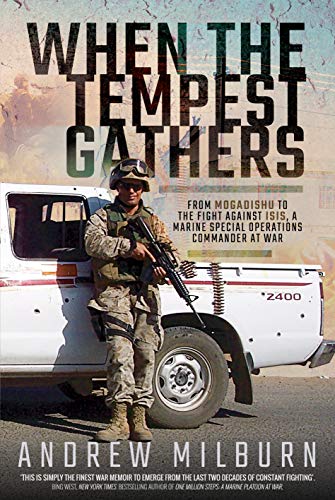
When the Tempest Gathers
by Andrew Milburn
"From Mogadishu to the Fight Against ISIS, a Marine Special Operations Commander at War"
Popularity
4.93 / 5
* A book's popularity is determined by how it compares to all other books on this website.
Where to buy?
Buy from Amazon* If you buy this book through the link above, we may receive a small commission at no extra cost to you.
When the Tempest Gathers by Andrew Milburn
Details
War:
War on Terror
Perspective:
Commanders
Military Unit:
US Marine Corps
True Story:
Yes
Biography:
Yes
Region:
Middle East
Published Date:
2020
ISBN13:
9781526750556
Review of When the Tempest Gathers by Andrew Milburn
Andrew Milburn's "When the Tempest Gathers" is a memoir that traces the arc of a career spent at the sharp end of American military engagements, from the chaos of Somalia in the early 1990s to the grinding campaign against the Islamic State decades later. Milburn, a retired Marine colonel who rose through the ranks of Marine Special Operations Command, offers a firsthand account that is less concerned with grand strategy than with the lived experience of command under pressure. The result is a book that reads with the immediacy of a field report while still allowing room for reflection on what two and a half decades of conflict have meant for the officers who fought them.
The narrative structure follows Milburn's progression from a young officer navigating the aftermath of the Black Hawk Down disaster in Mogadishu to a seasoned commander directing operations against ISIS in Iraq and Syria. This chronological sweep gives the book a natural momentum, and Milburn uses it to illustrate how the nature of American military intervention shifted over time. The early chapters, set against the backdrop of a United Nations peacekeeping mission gone wrong, capture the confusion and improvisation that often characterized operations in that era. By contrast, the later sections dealing with the fight against ISIS reveal a more deliberate, if still chaotic, approach to warfare shaped by lessons absorbed over years of counterinsurgency and counterterrorism operations.
What distinguishes this memoir from many others in the genre is Milburn's willingness to examine the institutional and personal costs of sustained conflict. He does not shy away from describing moments of doubt, frustration with bureaucratic decision-making, or the toll that repeated deployments take on those who serve. This candor lends the book a credibility that purely triumphalist war narratives often lack. Milburn writes as someone who has spent considerable time thinking about leadership under fire, and his observations on the subject feel earned rather than performative.
The prose itself is direct and unadorned, favoring clarity over literary flourish. Milburn's background as a career military officer shows through in his attention to operational detail, and readers with an interest in the mechanics of special operations will find much to appreciate here. At the same time, the book does not become bogged down in jargon or acronyms to the point of alienating a general audience. Milburn takes care to explain the context behind the operations he describes, which makes the book accessible even to those without a background in military affairs.
The sections on the campaign against ISIS are particularly strong, offering a ground-level perspective on a conflict that received extensive media coverage but relatively little firsthand testimony from the commanders directing it. Milburn's account of coordinating with Kurdish and Iraqi forces, navigating coalition politics, and making decisions with incomplete information adds texture to public understanding of a campaign often reduced to headlines about territorial gains and losses. These passages serve as a valuable complement to more detached journalistic or academic accounts of the fight against the Islamic State.
If the book has a shortcoming, it may be that the sheer breadth of Milburn's career occasionally results in episodes that feel compressed, as though there was more material than the format could comfortably hold. Readers seeking exhaustive detail on any single deployment may find themselves wanting more, though this is perhaps an inevitable consequence of covering such a long span of service in a single volume.
Overall, "When the Tempest Gathers" succeeds as both a personal memoir and a document of a particular period in American military history. It offers insight into how the character of warfare evolved from the 1990s through the 2010s, filtered through the experience of a man who was present for much of that transformation. For readers interested in military history, leadership, or the human dimension of modern warfare, Milburn's book provides a thoughtful and often unflinching account worth considering.