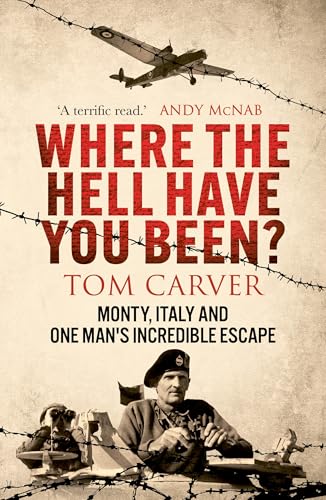
Where the Hell Have You Been?
by Tom Carver
"Monty, Italy and One Man's Incredible Escape"
Popularity
4.21 / 5
* A book's popularity is determined by how it compares to all other books on this website.
Where to buy?
Buy from Amazon* If you buy this book through the link above, we may receive a small commission at no extra cost to you.
Where the Hell Have You Been? by Tom Carver
Details
War:
World War II
Perspective:
Prisoners of War
Military Unit:
British Army
True Story:
Yes
Biography:
Yes
Region:
Europe
Published Date:
2025
ISBN13:
9781804193396
Summary
This gripping World War II memoir tells the story of the author's father, a British soldier who escaped from an Italian prisoner-of-war camp after Italy's surrender in 1943. The book follows his harrowing journey through enemy-occupied Italy as he evaded German forces while trying to rejoin Allied lines. Tom Carver interweaves his father's wartime experiences with the broader context of Field Marshal Montgomery's Italian campaign, creating both a personal family history and a compelling account of survival, courage, and the chaos of war in Italy.
Review of Where the Hell Have You Been? by Tom Carver
Tom Carver's "Where the Hell Have You Been?" presents a compelling exploration of personal history intertwined with one of World War Two's most critical periods. The book centers on the remarkable wartime experiences of Carver's father, who found himself caught behind enemy lines in Italy during the Allied advance. Through meticulous research and deeply personal storytelling, Carver reconstructs a narrative that had remained largely untold within his own family for decades.
The title itself poses the question that greeted Carver's father upon his eventual return to British lines after months of absence. This seemingly simple question masks the extraordinary circumstances that led to his prolonged disappearance and the complex journey that brought him back. The book operates on multiple levels, functioning simultaneously as a war memoir, a family history, and an investigation into the nature of memory and trauma.
Carver's approach to reconstructing his father's story demonstrates considerable historical rigor. Unable to rely solely on family recollections, the author traced his father's footsteps through Italy, consulting military records, interviewing survivors, and piecing together fragments of evidence that had scattered across decades. This investigative dimension adds depth to the narrative, as readers witness not only the historical events themselves but also the process of historical recovery.
The Italian campaign serves as a vivid backdrop for the personal drama at the book's core. The period following the Allied invasion of Italy in 1943 created chaotic conditions across the country, with German forces, Allied troops, Italian partisans, and civilians all navigating shifting battle lines and uncertain loyalties. Within this context, the experiences of individual soldiers who became separated from their units illuminate the human dimensions of military history often overshadowed by strategic accounts of the campaign.
Carver's father emerges as a figure whose wartime experiences profoundly shaped his postwar life in ways that remained difficult to articulate or share with his family. The author explores the silence that often surrounded the traumatic experiences of veterans, examining how this reticence affected family relationships across generations. This psychological dimension elevates the book beyond simple adventure narrative, engaging with broader questions about how individuals process and communicate extreme experiences.
The narrative benefits from Carver's journalistic background, evident in his clear prose and structured approach to storytelling. The writing maintains momentum while conveying complex historical circumstances and personal revelations. Descriptions of the Italian landscape and wartime conditions create atmospheric context without overwhelming the human story at the center of the account.
The relationship between Montgomery's campaigns in Italy and the individual soldier's experience provides another layer to the narrative. While military historians focus on strategic decisions and operational outcomes, Carver illuminates how these large-scale movements translated into lived reality for those on the ground. The contrast between official military history and personal experience runs throughout the book, highlighting disconnections between command decisions and frontline consequences.
One of the book's strengths lies in its treatment of the Italian civilians and partisans who played crucial roles in the survival and eventual return of Allied soldiers trapped behind German lines. These relationships, formed under extraordinary pressure, demonstrate the complex human networks that existed beneath the formal structure of military conflict. Carver gives appropriate weight to these Italian perspectives, acknowledging the risks taken by those who chose to assist Allied personnel at tremendous personal cost.
The author also grapples honestly with the limitations of his project. Gaps in the historical record, the unreliability of decades-old memories, and the challenge of verifying events from a chaotic period all present obstacles to definitive reconstruction. Rather than concealing these difficulties, Carver incorporates them into his narrative, creating a more nuanced and ultimately more credible account.
The book contributes to growing literature examining World War Two through personal and familial lenses rather than purely military or political frameworks. This approach has become increasingly important as the generation that experienced the war directly passes away, and subsequent generations seek to understand and preserve these stories. Carver's work demonstrates how individual narratives can illuminate broader historical truths while retaining their particular emotional power.
For readers interested in World War Two history, family memoir, or the Italian campaign specifically, this book offers substantial rewards. The combination of historical investigation and personal discovery creates a reading experience that satisfies both intellectual curiosity and emotional engagement. Carver has crafted a tribute to his father that also serves as a meaningful contribution to understanding the war's impact on individuals and families across generations.