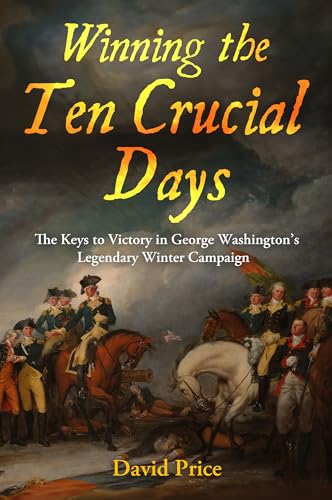
Winning the Ten Crucial Days
by David Price
"The Keys to Victory in George Washington's Legendary Winter Campaign"
Popularity
4.62 / 5
* A book's popularity is determined by how it compares to all other books on this website.
Where to buy?
Buy from Amazon* If you buy this book through the link above, we may receive a small commission at no extra cost to you.
Winning the Ten Crucial Days by David Price
Details
War:
American Revolutionary War
Perspective:
Commanders
Biography:
No
Region:
North America
Page Count:
217
Published Date:
2025
ISBN13:
9781955041348
Summary
This book examines George Washington's critical winter campaign of 1776-1777, focusing on the ten pivotal days that transformed the Revolutionary War. David Price analyzes the strategic decisions and military actions during this period, particularly the famous crossing of the Delaware River and the battles of Trenton and Princeton. The author explores how Washington's leadership and tactical choices during these crucial moments reversed American fortunes when the Continental Army faced potential collapse, ultimately reinvigorating the revolutionary cause and changing the war's trajectory.
Review of Winning the Ten Crucial Days by David Price
David Price's examination of George Washington's winter campaign of 1776-1777 offers readers a detailed analysis of one of the American Revolution's most critical periods. The book focuses on the ten days between Christmas 1776 and January 3, 1777, when Washington orchestrated a series of bold military operations that revitalized the Continental Army's prospects and reinvigorated the revolutionary cause at a moment when defeat seemed imminent.
The narrative centers on three crucial engagements: the crossing of the Delaware River and the Battle of Trenton on December 26, 1776, the subsequent Battle of Assunpink Creek on January 2, 1777, and the Battle of Princeton on January 3, 1777. Price methodically reconstructs these events, drawing on historical sources to illustrate how Washington transformed a demoralized and diminishing force into an effective fighting unit capable of achieving tactical victories against professional soldiers.
The book's strength lies in its detailed examination of the operational and strategic decisions that characterized this campaign. Price explores how Washington's leadership evolved during this period, demonstrating the general's growing confidence in employing unconventional tactics and his willingness to take calculated risks. The author analyzes the intelligence gathering, logistical planning, and coordination required to execute the Delaware crossing under challenging winter conditions, providing readers with an appreciation for the complexity of eighteenth-century military operations.
Price gives considerable attention to the broader context surrounding these ten days. The author outlines the dire circumstances facing the Continental Army in late 1776, including widespread desertions, expiring enlistments, and a series of military setbacks that had forced Washington's retreat across New Jersey. This context helps readers understand why these victories proved so significant, not merely as tactical successes but as psychological turning points that demonstrated the viability of continued resistance against British forces.
The treatment of the Trenton engagement provides insight into how surprise and timing could offset disadvantages in training and equipment. Price examines the decision to attack Hessian forces stationed in Trenton, the challenges of coordinating multiple columns in harsh weather, and the execution of the assault itself. The author also addresses the immediate aftermath, including Washington's decision to recross the Delaware with prisoners and captured supplies before British reinforcements could respond.
The analysis extends to the battles at Assunpink Creek and Princeton, which receive thorough examination as connected elements of a cohesive campaign rather than isolated events. Price illustrates how Washington's nighttime march around British forces positioned at Trenton demonstrated tactical flexibility and creative problem-solving. The subsequent engagement at Princeton, though smaller in scale than major battles elsewhere in the war, is presented as a significant achievement that further demonstrated the Continental Army's improving capabilities.
The book explores the contributions of various officers and soldiers who played roles in these operations, though Washington necessarily remains the central figure. Price discusses how the commander-in-chief's relationships with subordinates and his ability to maintain army cohesion under adverse conditions proved essential to the campaign's success. The author also acknowledges the challenges Washington faced in managing a force composed of militia and regular Continental troops with varying levels of experience and commitment.
Price addresses the campaign's impact on the broader trajectory of the Revolutionary War. The victories disrupted British plans for consolidating control over New Jersey and provided tangible evidence that the Continental Army could compete effectively against professional military forces under the right circumstances. The author examines how these successes influenced subsequent recruitment efforts, bolstered morale among supporters of independence, and affected British strategic calculations for continuing the conflict.
The narrative maintains focus on military operations and leadership decisions rather than delving extensively into political dimensions or providing exhaustive biographical background. This approach allows Price to maintain momentum while examining the campaign's military significance in detail. The book serves readers interested in Revolutionary War military history and those seeking to understand how leadership and tactical innovation can influence outcomes during critical moments.
Price's work contributes to the extensive literature on Washington's military career by concentrating on a brief but consequential period. The book demonstrates how focused examination of a limited timeframe can illuminate broader themes regarding leadership, resilience, and strategic thinking. Readers gain understanding of how these ten days represented a turning point that prevented the collapse of the revolutionary effort and established patterns of operation that would characterize Washington's subsequent command decisions throughout the war.