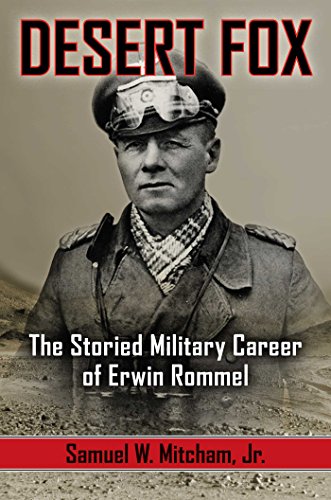
Desert Fox
by Samuel W. Mitcham
"The Storied Military Career of Erwin Rommel"
Popularity
4.71 / 5
* A book's popularity is determined by how it compares to all other books on this website.
Where to buy?
Buy from Amazon* If you buy this book through the link above, we may receive a small commission at no extra cost to you.
Desert Fox by Samuel W. Mitcham
Details
War:
World War II
Perspective:
Commanders
Military Unit:
Wehrmacht
True Story:
Yes
Biography:
Yes
Region:
Europe
Page Count:
450
Published Date:
2019
ISBN13:
9781621577218
Summary
This biography examines the military career of Erwin Rommel, the legendary German field marshal nicknamed the Desert Fox for his brilliant North African campaigns during World War II. Samuel Mitcham chronicles Rommel's rise through the ranks, his innovative tactical approaches, and his most famous battles including those in France and against British forces in Libya and Egypt. The book explores both his military genius and his complex relationship with Nazi leadership, providing a comprehensive look at one of history's most studied military commanders.
Review of Desert Fox by Samuel W. Mitcham
Samuel W. Mitcham's "Desert Fox: The Storied Military Career of Erwin Rommel" offers a focused examination of one of the twentieth century's most discussed military commanders. Rather than attempting a full biography that covers every aspect of Rommel's personal life, Mitcham concentrates on the professional trajectory that took Rommel from a junior officer in the First World War to the commander most associated with the North African campaign of the Second World War. This narrower scope allows the author to trace, in considerable detail, the tactical decisions and battlefield circumstances that shaped Rommel's reputation among both his contemporaries and later historians.
The book begins with Rommel's early service, including his experiences during the First World War, where he first demonstrated the aggressive and improvisational style that would later define his generalship. Mitcham uses this period to establish the foundations of Rommel's approach to warfare, showing how lessons learned as a young officer informed his later command decisions. This grounding in his formative years gives context to readers who may only be familiar with Rommel through his more famous exploits in the deserts of Libya and Egypt.
The heart of the book, unsurprisingly, deals with the North African campaign, where Rommel earned the nickname that gives the book its title. Mitcham walks through the major engagements of this theater, including the early German successes that pushed British forces back toward Egypt, as well as the eventual reversal of fortune that culminated in retreat and the loss of North Africa to Allied forces. The author pays close attention to the logistical challenges that plagued Axis operations throughout the campaign, an aspect often overshadowed by more dramatic accounts of tank battles and troop movements. This attention to supply lines, fuel shortages, and the broader strategic picture adds a layer of analysis that goes beyond simple hero worship or condemnation.
One of the strengths of Mitcham's approach is his willingness to present Rommel as a complex figure rather than a simple archetype. The book acknowledges the tactical brilliance that earned Rommel respect even from his adversaries, including figures within the British military establishment. At the same time, Mitcham does not shy away from discussing the strategic limitations that came with Rommel's style of command, including moments where his aggressive tendencies outpaced the logistical realities of his situation. This balance prevents the book from becoming either uncritical praise or reflexive dismissal, both of which have characterized some other treatments of Rommel over the decades.
The book also touches on Rommel's later years, including his role in the defense of Normandy and his eventual death, which followed his implication in the July 1944 plot against Hitler. These sections are handled with appropriate care, given the historical sensitivity surrounding Rommel's relationship with the Nazi regime and the circumstances of his demise. Mitcham presents the available facts without overstating certainty where historical record remains incomplete or debated among scholars.
Stylistically, the book is written in clear, accessible prose that should appeal to general readers interested in military history as well as those with more specialized knowledge of the Second World War. Mitcham avoids excessive jargon, making the tactical discussions understandable without requiring prior expertise in military terminology. The organization follows a chronological structure that is easy to follow, moving methodically through the various campaigns and engagements that defined Rommel's career.
Some readers may wish for a more expansive treatment of Rommel's personal life or his relationships with other key figures in the German military hierarchy, as the book's focus remains largely on operational and tactical matters. Those seeking psychological insight into Rommel as an individual, rather than as a military commander, may need to look elsewhere for that dimension of the story.
Overall, "Desert Fox" serves as a solid contribution to the literature on Rommel, offering a detailed and measured account of his military career. Mitcham's research and clear writing make this a worthwhile read for anyone interested in the North African campaign specifically or in the broader history of the Second World War's European and Mediterranean theaters. The book succeeds in presenting Rommel's achievements and shortcomings within the context of the historical record, avoiding both hagiography and unwarranted criticism.


