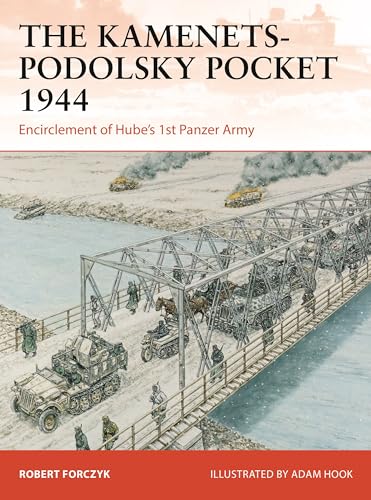
The Kamenets-Podolsky Pocket 1944
by Robert Forczyk
"Encirclement of Hube’s 1st Panzer Army"
Popularity
4.52 / 5
* A book's popularity is determined by how it compares to all other books on this website.
Where to buy?
Buy from Amazon* If you buy this book through the link above, we may receive a small commission at no extra cost to you.
The Kamenets-Podolsky Pocket 1944 by Robert Forczyk
Details
War:
World War II
Perspective:
Commanders
Military Unit:
Wehrmacht
True Story:
Yes
Biography:
No
Region:
Europe
Page Count:
196
Published Date:
2025
ISBN13:
9781472862273
Summary
This book examines the World War II Battle of Kamenets-Podolsky in March-April 1944, where Soviet forces encircled General Hans-Valentin Hube's First Panzer Army in western Ukraine. Forczyk analyzes the operational decisions on both sides as the Soviets attempted to trap and destroy the German force, while Hube executed a fighting withdrawal to break out of the pocket. The account covers the tactical maneuvers, command decisions, and combat operations during this critical Eastern Front engagement, which ultimately saw the Panzer Army escape despite being outnumbered.
Review of The Kamenets-Podolsky Pocket 1944 by Robert Forczyk
Robert Forczyk's examination of the Kamenets-Podolsky Pocket represents a detailed analysis of one of World War II's lesser-known Eastern Front operations. Published as part of Osprey Publishing's Campaign series, this work focuses on the March-April 1944 encirclement of the German 1st Panzer Army under General Hans-Valentin Hube in western Ukraine. The book fills a significant gap in English-language military history by documenting an engagement that, while overshadowed by Stalingrad and other famous encirclements, demonstrated both the resilience of German armored formations and the increasing operational sophistication of Soviet forces.
The narrative centers on the Soviet spring offensive of 1944, when multiple Ukrainian Front armies launched coordinated attacks designed to exploit the Wehrmacht's overextended positions following the failed defense of the Dnieper line. Forczyk traces how Marshal Georgy Zhukov's 1st Ukrainian Front and Marshal Ivan Konev's 2nd Ukrainian Front executed a double envelopment that trapped approximately 200,000 German troops in a pocket near the town of Kamenets-Podolsky. Unlike the catastrophic outcome at Stalingrad, however, Hube's army managed to fight its way westward in a mobile defense that preserved much of its combat strength.
The author's treatment of the operational planning on both sides provides valuable insight into the command decisions that shaped the battle. The book examines how Soviet commanders sought to replicate earlier encirclement successes while German leadership debated between Hitler's typical no-retreat orders and the tactical necessity of mobile warfare. Forczyk details the tensions between Army Group South headquarters and the embattled 1st Panzer Army, highlighting the command conflicts that characterized German military operations during this period of the war.
One of the work's strengths lies in its attention to the terrain and weather conditions that profoundly influenced operations. The spring rasputitsa, or mud season, transformed Ukrainian roads into impassable morasses, severely limiting mobility for both sides. Forczyk explains how these environmental factors affected logistics, tank operations, and the pace of the fighting. The author also discusses the challenges of maintaining supply lines in territory where infrastructure had been systematically destroyed during years of warfare and scorched-earth tactics.
The book benefits from Forczyk's background in armor warfare, as he provides technical assessments of the tanks and vehicles employed by both armies. Discussions of German Panthers and Tigers alongside Soviet T-34s and heavier tanks offer context for understanding the tactical engagements within the larger operational framework. The author examines how equipment reliability, fuel availability, and maintenance capabilities influenced the outcome as much as raw combat power.
Forczyk's analysis of the breakout operation itself constitutes the core of the narrative. The text describes how Hube organized his trapped forces into a mobile hedgehog formation that fought westward while maintaining defensive cohesion. The coordination between the encircled army and relieving German forces, particularly the II SS Panzer Corps, receives detailed coverage. The author explains the difficult decisions regarding which units to sacrifice as rear guards and how limited resources were allocated among competing priorities.
The book acknowledges the human cost of the operation without dwelling on graphic details. Casualty figures for both German and Soviet forces are presented alongside discussions of the fate of wounded soldiers, prisoners, and civilians caught in the combat zone. Forczyk notes the participation of various Soviet ethnic formations and the multinational character of German forces, which included Hungarian and Romanian units whose combat effectiveness varied considerably.
As befits the Osprey Campaign series format, the book includes maps, diagrams, and illustrations that support the text. The cartography proves essential for following the complex movements of multiple armies across an expansive front. Period photographs provide visual documentation of the forces, equipment, and terrain involved in the operation.
The strategic implications of the Kamenets-Podolsky operation receive appropriate attention in the author's assessment. While the 1st Panzer Army escaped destruction, the Soviet offensive achieved significant territorial gains and forced German forces farther west. The operation demonstrated that the Wehrmacht could no longer conduct the kind of successful defensive battles that had characterized earlier periods of the Eastern Front. Simultaneously, the escape of Hube's army showed that German forces retained considerable tactical skill even as strategic defeat became inevitable.
This volume serves military historians, enthusiasts of armored warfare, and readers interested in Eastern Front operations. The book assumes some familiarity with World War II military terminology and organization, though Forczyk provides sufficient context for general readers. The work stands as a solid contribution to understanding the complex military operations of 1944, offering a balanced examination of a significant but often overlooked chapter in the Eastern Front's final year.


