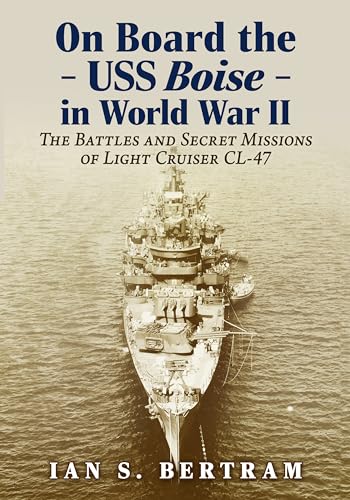
On Board the USS Boise in World War II
by Ian S. Bertram
"The Battles and Secret Missions of Light Cruiser CL-47"
Popularity
4.63 / 5
* A book's popularity is determined by how it compares to all other books on this website.
Where to buy?
Buy from Amazon* If you buy this book through the link above, we may receive a small commission at no extra cost to you.
On Board the USS Boise in World War II by Ian S. Bertram
Details
War:
World War II
Military Unit:
US Navy
True Story:
Yes
Biography:
No
Region:
Pacific
Page Count:
195
Published Date:
2025
ISBN13:
9781476658216
Review of On Board the USS Boise in World War II by Ian S. Bertram
Ian S. Bertram's "On Board the USS Boise in World War II: The Battles and Secret Missions of Light Cruiser CL-47" offers a detailed account of one of the more storied vessels to serve in the Pacific and Mediterranean theaters during the Second World War. The USS Boise earned a reputation early in the war for its role in the Battle of Cape Esperance, where it engaged Japanese naval forces in a night action that became something of a legend among naval historians. Bertram uses this reputation as a foundation, but the book extends well beyond that single engagement to cover the ship's full service history, from its commissioning through its various deployments across multiple theaters of the war.
The structure of the book follows a chronological approach, tracking the Boise from its early operations in the Pacific through its later service supporting Allied landings in the Mediterranean, including operations in Sicily and Italy. This breadth is one of the book's strengths, as it allows readers to see how a single ship's service could span such different geographic and strategic contexts. Bertram does not simply recount battle after battle; he also addresses the ship's involvement in less publicized missions, some of which involved intelligence-related or covert operations, giving the book its subtitle reference to "secret missions."
Bertram's writing style favors clarity over embellishment. He presents naval terminology and tactical maneuvers in a way that remains accessible to readers who may not have extensive background in naval history, while still providing enough technical detail to satisfy those with more specialized interest in ship classes, armament, and combat tactics of the era. The book benefits from what appears to be careful research into primary sources, including ship logs, after-action reports, and personal accounts from crew members, though the author is careful to present this material in a readable narrative form rather than as a dry recitation of facts.
One of the more valuable aspects of this work is its attention to the human element of naval warfare. Rather than focusing solely on strategic outcomes and tactical decisions, Bertram incorporates the perspectives of the sailors who served aboard the Boise, capturing something of what daily life was like for the crew during long deployments punctuated by moments of intense combat. This approach helps humanize what might otherwise be a straightforward chronicle of military engagements, and it adds depth to the reader's understanding of what serving on a light cruiser during this period actually entailed.
The book also does a commendable job of situating the Boise within the broader context of Allied naval strategy during the war. Readers gain insight into how light cruisers like the Boise fit into fleet operations, how they were used in conjunction with other vessel types, and how their roles evolved as the war progressed from the desperate early campaigns in the Pacific to the more coordinated Allied offensives in Europe. This contextual grounding makes the book useful not only as a study of one particular ship but as a window into the operational realities of naval warfare during this period more broadly.
Some readers may find certain sections more engaging than others, depending on their particular interests. Those drawn primarily to combat narratives will likely find the accounts of the Cape Esperance engagement and subsequent battles the most compelling material in the book. Readers with interest in logistics, intelligence operations, or the administrative aspects of naval service may find similar value in the chapters addressing the ship's less combat-focused missions. This variation in content, while occasionally uneven in pacing, ultimately serves to create a more complete picture of what wartime naval service actually involved.
Overall, "On Board the USS Boise in World War II" succeeds as a focused, well-researched history of a single vessel's wartime service. It will appeal most directly to readers with an existing interest in naval history, World War II Pacific and Mediterranean campaigns, or the specific operational history of American light cruisers. Bertram's careful attention to both the tactical and human dimensions of the Boise's service makes this a worthwhile addition to the broader literature on naval warfare during the Second World War.


