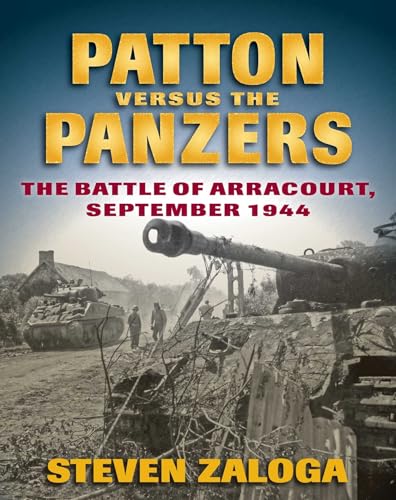
Patton versus the Panzers
by Steven Zaloga
"The Battle of Arracourt, September 1944"
Popularity
4.29 / 5
* A book's popularity is determined by how it compares to all other books on this website.
Where to buy?
Buy from Amazon* If you buy this book through the link above, we may receive a small commission at no extra cost to you.
Patton versus the Panzers by Steven Zaloga
Details
War:
World War II
Perspective:
Tanks
Military Unit:
US Army
True Story:
Yes
Biography:
No
Region:
Europe
Published Date:
2025
ISBN13:
9780811777490
Summary
Patton versus the Panzers by Steven Zaloga examines the Battle of Arracourt, a major tank engagement fought in September 1944 during the Lorraine Campaign. The book details how Patton's Third Army clashed with German Panzer Brigades in what became one of the largest tank battles on the Western Front. Zaloga analyzes the tactics, equipment, and leadership decisions that led to a decisive American victory despite German numerical advantages in armor, offering insight into armored warfare during World War II.
Review of Patton versus the Panzers by Steven Zaloga
Steven Zaloga's "Patton versus the Panzers: The Battle of Arracourt, September 1944" examines one of the lesser-known but tactically significant engagements of the Second World War's Western European campaign. The battle, fought in the plains of Lorraine near the town of Arracourt, pitted elements of Patton's Third Army against German panzer forces attempting to halt the American advance toward Germany. Zaloga, a veteran military historian known for his extensive work on armored warfare, brings his characteristic attention to technical and tactical detail to this study, offering readers a thorough account of an action that has often been overshadowed by larger and better-known battles such as the fighting in Normandy or the Battle of the Bulge.
The narrative begins by setting the strategic context of September 1944, when Allied forces were pushing eastward following the breakout from Normandy and the liberation of Paris. Patton's Third Army had advanced rapidly across France, but supply shortages and stiffening German resistance were beginning to slow the momentum. The Germans, meanwhile, were assembling newly formed panzer brigades in an attempt to counterattack and blunt the American advance. Zaloga carefully explains how these German units, though equipped with some of the war's most formidable tanks, including the Panther, were often manned by inexperienced crews and hampered by inadequate training and coordination.
What follows is a detailed reconstruction of the fighting around Arracourt, where American tank destroyer units and Sherman tanks, despite being technically inferior to their German counterparts on paper, achieved a series of tactical successes. Zaloga's analysis highlights the importance of factors beyond raw armor and firepower, such as terrain, weather conditions, crew experience, and battlefield tactics. Fog and poor visibility during the early stages of the battle played a significant role in negating the Germans' advantage in tank quality, while American gunnery and positioning proved decisive in several engagements. The author does an excellent job of illustrating how the outcome of armored battles often depended on factors that went beyond the specifications of the vehicles involved.
One of the strengths of this book is Zaloga's use of primary sources, including after-action reports and German records, to reconstruct the sequence of events with precision. He does not rely on generalizations but instead walks through specific engagements, unit movements, and command decisions. This level of detail will be particularly appealing to readers with a strong interest in armored warfare and the mechanics of tank combat during the Second World War. The book also benefits from numerous photographs, maps, and diagrams that help clarify the complex troop movements and terrain features that shaped the battle.
Zaloga's writing remains accessible despite the technical nature of the subject matter. He avoids excessive jargon and instead explains concepts clearly, making the book approachable for readers who may not have extensive prior knowledge of armored warfare. At the same time, the depth of research ensures that more knowledgeable readers will find valuable insights and nuanced analysis throughout.
The book also serves as a useful corrective to some popular narratives about the technical superiority of German armor during this period. While the Panther tank is often celebrated for its firepower and armor, Zaloga demonstrates how tactical and situational factors could offset these advantages in practice. This nuanced perspective adds depth to the broader historical understanding of armored combat in the European theater.
As part of the Osprey Publishing Duel and Campaign series tradition that Zaloga has contributed to extensively, this volume fits well within his broader body of work examining specific engagements and equipment comparisons from the war. Readers familiar with his other titles will recognize his methodical approach and emphasis on primary source documentation.
Overall, "Patton versus the Panzers" offers a well-researched and engaging account of a battle that deserves greater recognition in the history of the European campaign. It succeeds in balancing technical detail with narrative clarity, making it a worthwhile addition to the library of anyone interested in the armored battles of World War II or the broader history of Patton's Third Army during its advance through France in the autumn of 1944.


