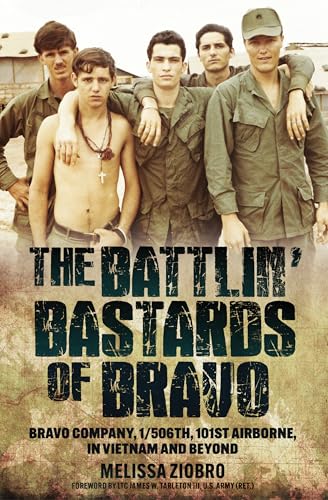
The Battlin' Bastards of Bravo
by Melissa Ziobro
"Bravo Company, 1/506th, 101st Airborne, in Vietnam and Beyond"
Popularity
4.77 / 5
* A book's popularity is determined by how it compares to all other books on this website.
Where to buy?
Buy from Amazon* If you buy this book through the link above, we may receive a small commission at no extra cost to you.
The Battlin' Bastards of Bravo by Melissa Ziobro
Details
War:
Vietnam War
Perspective:
Infantry
Military Unit:
US Army
True Story:
Yes
Biography:
No
Region:
Asia
Published Date:
2025
ISBN13:
9781636244839
Summary
The Battlin Bastards of Bravo chronicles the experiences of Bravo Company, 1st Battalion, 506th Infantry Regiment, 101st Airborne Division during the Vietnam War. Author Melissa Ziobro documents the soldiers' combat experiences, daily challenges, and camaraderie through extensive research and interviews. The book follows the company through intense battles and operations while also examining the lasting impact of war on veterans after their return home. It provides both a military history of the unit and a personal look at the men who served in one of the war's most decorated infantry companies.
Review of The Battlin' Bastards of Bravo by Melissa Ziobro
Melissa Ziobro's "The Battlin' Bastards of Bravo: Bravo Company, 1/506th, 101st Airborne, in Vietnam and Beyond" offers a comprehensive examination of one of the Vietnam War's most decorated infantry companies. Drawing on extensive interviews, personal correspondence, and military records, Ziobro traces the experiences of Bravo Company from their deployment to Vietnam through their return home and subsequent decades, providing readers with an intimate portrait of soldiers caught in one of America's most controversial conflicts.
The book focuses on Bravo Company, part of the 1st Battalion, 506th Infantry Regiment of the 101st Airborne Division, which saw intense combat during the Vietnam War. Ziobro's approach combines traditional military history with social history, examining not only the tactical operations and battles but also the personal experiences of the men who served. The narrative follows these soldiers through their training, deployment, combat operations, and eventually their struggles to reintegrate into civilian life after the war ended.
One of the book's notable strengths lies in its extensive use of primary sources. Ziobro conducted numerous interviews with veterans of Bravo Company, allowing the soldiers themselves to tell their stories in their own words. This methodology provides authenticity and emotional depth that might otherwise be absent from a purely archival account. The veterans' recollections offer insights into the daily realities of combat, the bonds formed between soldiers, and the psychological toll of warfare that extends far beyond the battlefield.
The narrative structure moves chronologically, beginning with the formation and training of the unit before following them through their deployment to Vietnam. Ziobro documents significant engagements and operations while also attending to the mundane aspects of military life that filled the intervals between combat. This balanced approach helps readers understand that war consists not only of dramatic battles but also of long periods of tension, boredom, and uncertainty.
Ziobro does not shy away from difficult subjects. The book addresses the complexities and moral ambiguities inherent in the Vietnam conflict, including the challenges of fighting an unconventional war, the difficulties in distinguishing combatants from civilians, and the frustrations soldiers felt with rules of engagement and command decisions. The author presents these issues without imposing heavy-handed judgments, allowing the veterans' own perspectives and experiences to illustrate the complicated nature of their service.
The book's scope extends beyond the war years themselves, exploring what happened to these men after they returned home. This longitudinal approach distinguishes the work from many military histories that conclude with the end of combat operations. Ziobro examines the veterans' struggles with post-traumatic stress, their difficulties finding employment and maintaining relationships, and the broader societal reception they encountered upon returning to an America deeply divided over the war. This section provides valuable context for understanding the long-term impact of military service and combat exposure.
Throughout the narrative, Ziobro demonstrates careful attention to historical accuracy and context. The book situates Bravo Company's experiences within the larger framework of the Vietnam War, explaining how broader strategic decisions and political considerations affected operations at the company level. This contextualization helps readers understand how the experiences of these individual soldiers fit into the war's overall trajectory.
The writing style remains accessible without sacrificing substance. Ziobro avoids excessive military jargon while still maintaining the precision necessary for discussing tactical operations and unit movements. The prose moves at a steady pace, balancing action sequences with reflective passages that explore the emotional and psychological dimensions of combat and its aftermath.
For readers interested in Vietnam War history, military history more broadly, or the experiences of combat veterans, this book offers substantial value. It serves as both a unit history and a social document, preserving the memories and experiences of men whose service might otherwise be forgotten or reduced to statistics. The book contributes to the growing body of literature that seeks to understand not just the political and strategic aspects of the Vietnam War but the human cost borne by those who fought it.
"The Battlin' Bastards of Bravo" represents a significant contribution to Vietnam War historiography. By combining rigorous research with sensitivity to the human dimensions of warfare, Ziobro has produced a work that honors the experiences of Bravo Company while providing readers with a nuanced understanding of what it meant to serve in Vietnam and to live with those experiences in the decades that followed.