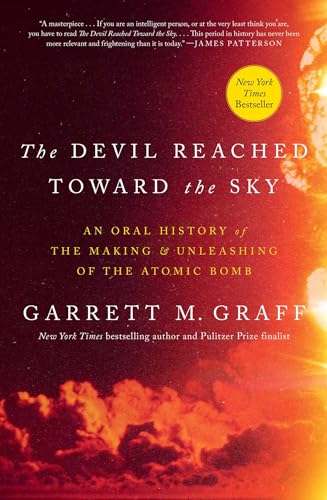
The Devil Reached Toward the Sky
by Garrett M. Graff
"An Oral History of the Making and Unleashing of the Atomic Bomb"
Popularity
4.99 / 5
* A book's popularity is determined by how it compares to all other books on this website.
Where to buy?
Buy from Amazon* If you buy this book through the link above, we may receive a small commission at no extra cost to you.
The Devil Reached Toward the Sky by Garrett M. Graff
Details
War:
World War II
Perspective:
Researcher
True Story:
Yes
Biography:
Yes
Region:
North America
Page Count:
608
Published Date:
2025
ISBN13:
9781668092392
Summary
The Devil Reached Toward the Sky is an oral history by Garrett M. Graff that chronicles the Manhattan Project and the creation of the atomic bomb. Through firsthand accounts and testimonies from scientists, military personnel, and witnesses, the book documents the scientific breakthroughs, ethical dilemmas, and human stories behind developing and deploying nuclear weapons during World War II. Graff weaves together multiple perspectives to create a comprehensive narrative of this pivotal moment in history, examining both the technical achievements and the moral complexities of unleashing atomic power on the world.
Review of The Devil Reached Toward the Sky by Garrett M. Graff
Garrett M. Graff's "The Devil Reached Toward the Sky" presents a meticulously crafted oral history that chronicles one of humanity's most consequential scientific and military endeavors: the development and deployment of the atomic bomb. Through hundreds of firsthand accounts, Graff assembles a narrative mosaic that captures the Manhattan Project's unprecedented scale and the profound moral weight carried by those who participated in bringing nuclear weapons into existence.
The book's strength lies in its commitment to letting participants speak for themselves. Graff has compiled testimonies from scientists, military personnel, technicians, and civilians who witnessed the bomb's creation at Los Alamos, its testing in the New Mexico desert, and its devastating use against Hiroshima and Nagasaki. This approach allows readers to encounter the atomic age through multiple perspectives, revealing the complexity of emotions and motivations that surrounded this watershed moment in history.
The oral history format proves particularly effective in conveying the human dimension of the Manhattan Project. Rather than presenting a single authoritative narrative, the book captures contradictions, uncertainties, and the evolution of understanding among those involved. Some voices express pride in their contributions to ending World War II, while others grapple with lasting guilt over the civilian casualties their work enabled. This polyphonic structure mirrors the genuine ambivalence that characterized the atomic bomb's legacy from its inception.
Graff's editorial work demonstrates impressive research and organizational skill. The accounts are arranged to follow the chronological development of the bomb, from theoretical physics breakthroughs through the Trinity test to the attacks on Japan and their immediate aftermath. This structure provides coherence without flattening the diverse experiences into a simplified storyline. The author's introductions and contextual notes guide readers through technical and historical complexities without overwhelming the primary voices.
The book illuminates lesser-known aspects of the Manhattan Project's vast operation. Testimonies from workers at Oak Ridge and Hanford reveal the compartmentalized nature of the endeavor, where many laborers performed specialized tasks without understanding their role in weapons development. These accounts underscore the project's extraordinary secrecy and the ethical questions raised by keeping workers uninformed about their contributions to a weapon of mass destruction.
Particularly compelling are the recollections of those present at the Trinity test in July 1945. The descriptions of that first nuclear detonation capture both the awesome spectacle of the explosion and the immediate realization among observers that warfare had fundamentally changed. The famous reactions of scientists like J. Robert Oppenheimer are placed alongside those of military observers and technicians, providing a fuller picture of that pivotal moment.
The accounts of Hiroshima and Nagasaki add crucial perspective to the historical record. Graff includes testimonies from American airmen involved in the missions as well as survivors who experienced the bombings from the ground. These parallel narratives create a sobering portrait of nuclear weapons' human cost while avoiding sensationalism. The juxtaposition allows readers to consider the attacks from multiple vantage points without the author imposing interpretive judgments.
The book also addresses the immediate postwar period, when participants began processing what they had created. Scientists' testimonies reveal debates within the community about international control of atomic energy and the morality of developing even more powerful thermonuclear weapons. These discussions remain relevant as nuclear proliferation continues to pose global challenges.
One limitation of the oral history format is its inherent reliance on memory, which can be selective and fallible. Graff acknowledges this constraint while demonstrating how multiple accounts of the same events can corroborate details and reveal different facets of complex situations. The editorial apparatus helps readers navigate potential inconsistencies without undermining the authenticity of individual voices.
The book serves multiple audiences effectively. General readers gain accessible entry into a pivotal historical episode, while those already familiar with the Manhattan Project will find fresh perspectives and lesser-known testimonies. The oral history approach makes the material particularly valuable for educational purposes, offering direct encounters with historical actors rather than mediated interpretations.
"The Devil Reached Toward the Sky" stands as a significant contribution to the literature on the atomic bomb. By foregrounding firsthand accounts, Graff has created a work that honors the complexity of this history while making it immediate and tangible. The book neither glorifies nor condemns but instead presents the voices of those who lived through these events, allowing readers to engage with the profound questions the atomic age continues to raise about science, warfare, and moral responsibility.