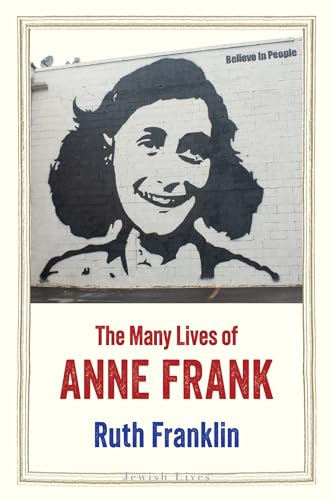
The Many Lives of Anne Frank
by Ruth Franklin
Popularity
4.76 / 5
* A book's popularity is determined by how it compares to all other books on this website.
Where to buy?
Buy from Amazon* If you buy this book through the link above, we may receive a small commission at no extra cost to you.
The Many Lives of Anne Frank by Ruth Franklin
Details
War:
World War II
Perspective:
Researcher
True Story:
Yes
Biography:
Yes
Region:
Europe
Page Count:
441
Published Date:
2025
ISBN13:
9780300281330
Summary
The Many Lives of Anne Frank by Ruth Franklin examines how Anne Frank's diary and legacy have been interpreted, adapted, and sometimes distorted since its publication. Franklin explores the complex history of how different cultures, artists, and political movements have shaped Anne's story to serve various purposes. The book analyzes the diary's journey from personal wartime document to global cultural phenomenon, investigating how Anne Frank became an enduring symbol while questioning what has been lost or changed in her transformation into an icon. It's a critical look at memory, representation, and the uses of Holocaust history.
Review of The Many Lives of Anne Frank by Ruth Franklin
Ruth Franklin's "The Many Lives of Anne Frank" offers a comprehensive examination of how Anne Frank's diary has been received, interpreted, and transformed across different cultures and time periods since its first publication in 1947. Franklin, a literary critic and cultural historian, moves beyond the diary itself to explore the complex legacy of one of the most widely read books in the world. The result is a meticulously researched work that illuminates not only Anne Frank's enduring impact but also the ways in which successive generations have shaped her story to reflect their own needs and values.
The book traces the remarkable journey of "The Diary of a Young Girl" from its initial publication in the Netherlands through its many translations and adaptations. Franklin examines how Anne Frank's father, Otto Frank, the sole survivor of the family, played a crucial role in bringing his daughter's words to the public while also making editorial decisions that would influence how readers understood her story. These choices, including the omission of certain passages in early editions, have sparked ongoing debates about authenticity and the responsibility of presenting historical documents.
Franklin devotes considerable attention to the theatrical and film adaptations that brought Anne Frank's story to mass audiences. The 1955 Broadway play and the 1959 film adaptation reached millions of people who might never have read the diary, yet these versions also altered the narrative in significant ways. Franklin analyzes how these adaptations sometimes minimized the specifically Jewish aspects of the Frank family's persecution, instead presenting a more universal message about human suffering and hope. This tendency to universalize Anne Frank's experience has been a source of controversy, with some arguing that it dilutes the historical reality of the Holocaust while others maintain that such universality has helped the diary reach broader audiences.
The book also explores the diary's reception in different national contexts, revealing how various countries have interpreted Anne Frank's story through their own historical lenses. In Germany, the diary became part of post-war efforts to confront the Nazi past. In the United States, it was often read as an affirmation of faith in human goodness. Franklin demonstrates how these varying interpretations reflect the cultural and political concerns of different societies at different moments in time.
Franklin addresses the persistent phenomenon of Holocaust denial and the attacks on the diary's authenticity. She documents the legal battles fought by Otto Frank and later by the Anne Frank Foundation to defend the diary against those who falsely claimed it was a forgery. These sections underscore the ongoing struggle to preserve historical truth in the face of willful distortion and the importance of the diary as a primary source document from the Holocaust.
One of the book's strengths lies in its examination of how Anne Frank has been appropriated for various causes and movements, some of which would likely have been foreign to her own experience and understanding. Franklin traces references to Anne Frank in contexts ranging from civil rights struggles to contemporary political debates, showing how her image has been invoked to lend moral authority to diverse agendas. This analysis raises important questions about the responsibilities that come with interpreting and deploying the stories of historical figures, particularly those who did not live to shape their own legacies.
Franklin's research draws on extensive archival materials, including correspondence, unpublished manuscripts, and documents from various institutions dedicated to preserving Anne Frank's memory. The book benefits from this thorough scholarly approach while remaining accessible to general readers interested in history, literature, and cultural memory. Franklin writes with clarity and precision, making complex issues of reception theory and cultural appropriation understandable without oversimplification.
The work also considers the physical spaces associated with Anne Frank's memory, particularly the Secret Annex in Amsterdam, which has become one of the most visited museums in the Netherlands. Franklin examines how this space has been preserved and presented to the public, and what such preservation efforts reveal about contemporary attitudes toward the Holocaust and historical memory.
"The Many Lives of Anne Frank" ultimately serves as both a biography of a book and a meditation on the nature of memory, representation, and historical understanding. Franklin demonstrates that the story of Anne Frank's diary is not simply about its initial creation but about its continuous reinterpretation across decades. The book challenges readers to think critically about how historical narratives are constructed and maintained, and what responsibilities accompany the act of remembering. For anyone seeking to understand not just Anne Frank's diary but its profound and sometimes problematic impact on global consciousness, Franklin's study provides an essential and thought-provoking resource.