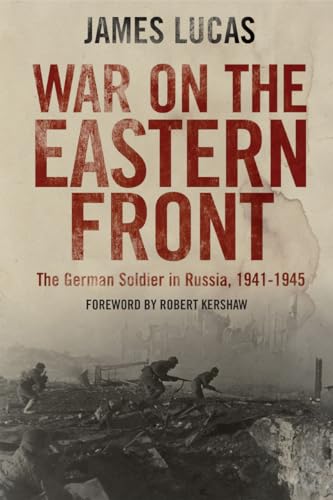
War on the Eastern Front
by James Lucas
"The German Soldier in Russia, 1941-1945"
Popularity
4.74 / 5
* A book's popularity is determined by how it compares to all other books on this website.
Where to buy?
Buy from Amazon* If you buy this book through the link above, we may receive a small commission at no extra cost to you.
War on the Eastern Front by James Lucas
Details
War:
World War II
Perspective:
Infantry
Military Unit:
Wehrmacht
True Story:
Yes
Biography:
No
Region:
Europe
Page Count:
356
Published Date:
2025
ISBN13:
9781805001386
Summary
War on the Eastern Front by James Lucas examines the experiences of German soldiers fighting against the Soviet Union during World War II from 1941 to 1945. Drawing on firsthand accounts and military records, Lucas explores the brutal conditions, combat tactics, and daily struggles faced by troops on this vast and devastating front. The book offers insight into the harsh realities of the campaign, including extreme weather, logistical challenges, and the intensity of combat against the Red Army, providing readers with a ground level perspective on one of history's most destructive military conflicts.
Review of War on the Eastern Front by James Lucas
James Lucas's "War on the Eastern Front: The German Soldier in Russia, 1941-1945" offers a focused examination of one of the most brutal theaters of the Second World War, approached from the perspective of the ordinary German soldier rather than the generals and strategists who typically dominate accounts of the conflict. Lucas, a British military historian who served in the war himself and later worked at the Imperial War Museum, brings a practitioner's understanding to his subject, drawing on interviews, memoirs, and firsthand accounts to reconstruct what daily life and combat were like for the men who fought on the Eastern Front.
The book moves chronologically through the campaign, beginning with the initial invasion of the Soviet Union in June 1941 and continuing through the grinding retreat and eventual collapse of German forces by 1945. Rather than offering a comprehensive strategic history, Lucas concentrates on the human experience of combat: the physical hardships of extreme cold, the psychological toll of prolonged fighting, the logistical failures that left soldiers without adequate supplies, and the sheer scale of violence that characterized the Eastern Front compared to other theaters of the war. This ground-level perspective distinguishes the work from more conventional military histories that tend to emphasize troop movements and command decisions.
One of the strengths of Lucas's approach is his reliance on primary testimony. Throughout the book, he incorporates quotations and accounts from German veterans, giving readers direct access to the language and observations of men who lived through the campaign. These firsthand voices lend immediacy to descriptions of combat, weather conditions, and the deteriorating circumstances faced by German forces as the war progressed. The accounts of the Russian winter, often cited as a decisive factor in the German failure to achieve quick victory, are particularly vivid, conveying the physical suffering caused by inadequate winter equipment and the psychological strain of fighting in an unfamiliar and hostile environment.
Lucas also addresses the organizational and logistical dimensions of the German war effort, examining how supply lines stretched thin across the vast distances of the Eastern Front and how this affected the soldiers' ability to sustain offensive operations. The book touches on the structure of German units, weaponry, and tactics, though these technical discussions remain accessible to general readers rather than specialists. This balance between human interest and military detail makes the book suitable for those with a general interest in the Second World War as well as readers seeking more specific insight into the German military experience.
The scope of the book inevitably means that it cannot address every aspect of the Eastern Front in depth. Readers seeking detailed analysis of Soviet strategy, the broader geopolitical context, or the experiences of Soviet soldiers and civilians will need to look elsewhere, as Lucas's focus remains firmly on the German perspective. This narrower lens is both a limitation and a deliberate choice, allowing the author to explore his chosen subject with greater depth than a more comprehensive history might permit.
Published in an era before many archival sources became widely accessible following the end of the Cold War, the book reflects the historiographical landscape of its time. Readers approaching it today should be aware that subsequent scholarship has expanded and sometimes revised understanding of specific events and figures discussed in the text. Nonetheless, the book remains a useful entry point for those interested in the lived experience of German soldiers during one of history's most consequential military campaigns.
Overall, "War on the Eastern Front" succeeds in its primary aim of illuminating the human dimension of a conflict often reduced to strategic maps and statistics. Lucas's background as both a veteran and a museum historian informs his sensitivity to the realities of soldiering, and his use of firsthand testimony gives the book an authenticity that resonates with readers interested in military history from the perspective of those who actually fought. For anyone seeking to understand the day-to-day experience of German soldiers in Russia, this book offers a solid and engaging starting point.