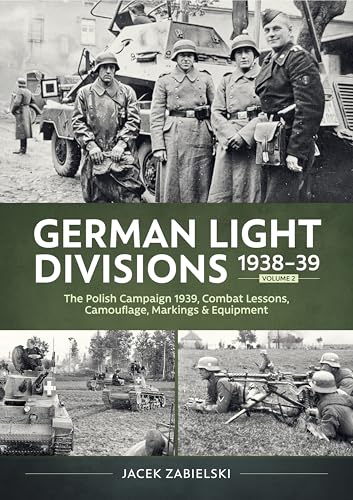
German Light Divisions 1938-39 Volume 2
by JACEK. ZABIELSKI
"Polish Campaign 1939, Combat Lessons, Camouflage, Markings & Equipment"
Popularity
4.74 / 5
* A book's popularity is determined by how it compares to all other books on this website.
Where to buy?
Buy from Amazon* If you buy this book through the link above, we may receive a small commission at no extra cost to you.
German Light Divisions 1938-39 Volume 2 by JACEK. ZABIELSKI
Details
War:
World War II
Perspective:
Infantry
Military Unit:
Wehrmacht
True Story:
Yes
Biography:
No
Region:
Europe
Published Date:
2025
ISBN13:
9781804517673
Summary
This volume examines German light divisions during the 1939 Polish campaign, focusing on their tactical employment and operational lessons learned. The book provides detailed coverage of camouflage schemes, unit markings, and equipment used by these formations. It offers military historians and modelers comprehensive documentation of how these divisions functioned in combat, including analysis of their effectiveness and the practical insights gained from the campaign. The work combines historical narrative with technical specifications, making it valuable for understanding German armored reconnaissance and light division doctrine in the early stages of World War II.
Review of German Light Divisions 1938-39 Volume 2 by JACEK. ZABIELSKI
Jacek Zabielski's "German Light Divisions 1938-39, Volume 2: Polish Campaign 1939, Combat Lessons, Camouflage, Markings & Equipment" continues the study of a short-lived but historically significant category of German military formation. The light divisions were an experimental unit type created during the interwar reorganization of the Wehrmacht, blending elements of infantry and motorized reconnaissance forces. Their existence was brief, as combat experience during the invasion of Poland quickly revealed structural weaknesses that led to their reorganization into panzer divisions shortly afterward. This second volume focuses specifically on the September 1939 campaign, examining how these divisions performed in the field and what lessons German commanders drew from their use.
The book is structured in the detailed, reference-oriented style typical of specialist military history publishers. Rather than offering a narrative history of the invasion of Poland as a whole, Zabielski concentrates on the specific experiences of the light divisions within that campaign. This includes their organizational structure, the equipment they fielded, and the operational challenges they encountered against Polish forces. The author draws on period documentation and unit records to reconstruct how these formations were actually employed, as opposed to how they were originally intended to function on paper.
A significant portion of the volume is devoted to visual documentation, a hallmark of this type of reference work. Readers interested in modeling, wargaming, or simply understanding the material culture of the German army in this period will find detailed coverage of camouflage patterns, unit markings, and equipment used by light division troops during the campaign. This visual material is presented alongside explanatory text that helps contextualize the significance of specific markings or equipment variations, which is useful for those trying to accurately identify or replicate period-specific details.
The emphasis on combat lessons distinguishes this volume from a purely descriptive equipment catalog. Zabielski addresses how the Polish campaign served as a practical test for the light division concept, and how the difficulties encountered in September 1939 informed the German army's subsequent decision to dissolve these units and reorganize their components into more conventional panzer divisions. This transitional moment in German armored doctrine is presented with attention to the operational realities on the ground, rather than relying on hindsight-driven interpretation.
As with many specialist publications in this niche, the book assumes a degree of prior familiarity with German military organization of the late 1930s. Readers coming to the subject without background knowledge of the broader context of German rearmament and doctrinal experimentation may find some sections dense. However, for its intended audience, likely researchers, modelers, and enthusiasts of early World War II German armored forces, this specificity is a strength rather than a weakness. The book does not attempt to serve as a general introduction to the Polish campaign, and readers expecting a broader strategic overview should look elsewhere.
The photographic and illustrative content appears to be a central selling point of the volume, consistent with the publisher's typical output in this genre. For those with an interest in accurately depicting German light division troops and vehicles from this specific period, the detailed treatment of camouflage schemes and unit insignia offers practical value that goes beyond general historical interest.
Overall, this volume serves as a focused, detailed resource on a narrow but historically interesting subject. It fills a gap for those researching the transitional period in German armored doctrine between the pre-war organizational experiments and the more standardized panzer division structure that emerged from the lessons of the Polish campaign. The book's value lies in its specificity and its attention to visual and material detail, making it most useful as a reference tool rather than a standalone historical narrative. Those with a specific interest in German light divisions, the September 1939 campaign, or the visual documentation of period uniforms and equipment will likely find this volume a worthwhile addition to their research library, provided they approach it with realistic expectations about its scope and intended audience.


