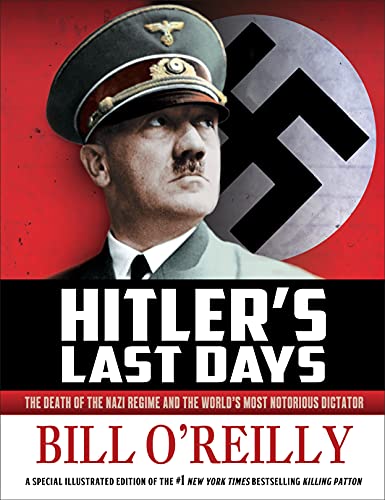
Hitler's Last Days
by Bill O'Reilly
"The Death of the Nazi Regime and the World's Most Notorious Dictator"
Popularity
4.91 / 5
* A book's popularity is determined by how it compares to all other books on this website.
Where to buy?
Buy from Amazon* If you buy this book through the link above, we may receive a small commission at no extra cost to you.
Hitler's Last Days by Bill O'Reilly
Details
War:
World War II
Perspective:
Researcher
True Story:
Yes
Biography:
No
Region:
Europe
Page Count:
321
Published Date:
2015
ISBN13:
9781627793964
Summary
Hitler's Last Days chronicles the final weeks of Adolf Hitler's life during the closing days of World War II in Europe. The book follows Hitler's retreat to his underground bunker in Berlin as Allied forces close in on the Nazi capital. It details the deteriorating situation of the Third Reich, Hitler's declining mental and physical state, and the chaotic atmosphere within the bunker. The narrative culminates with Hitler's suicide on April 30, 1945, alongside Eva Braun, and the subsequent fall of Berlin to Soviet forces, marking the end of Nazi Germany.
Review of Hitler's Last Days by Bill O'Reilly
Bill O'Reilly's "Hitler's Last Days" presents a condensed narrative of Adolf Hitler's final weeks in the spring of 1945, adapted from his bestselling book "Killing Patton." This work, co-authored with Martin Dugard, aims to bring the dramatic conclusion of the Nazi regime to a younger audience while maintaining the accessible storytelling approach that has characterized O'Reilly's historical series.
The book chronicles the collapse of the Third Reich through the lens of Hitler's deteriorating physical and mental state during his final days in the Führerbunker beneath Berlin. O'Reilly constructs a narrative that follows the dictator's retreat underground as Soviet forces closed in on the German capital, capturing the claustrophobic atmosphere of the bunker complex where Hitler spent his last days surrounded by a shrinking circle of loyalists.
The narrative strength of "Hitler's Last Days" lies in its straightforward chronological structure. O'Reilly traces the military situation as it deteriorated rapidly for Germany in April 1945, with Allied forces advancing from both east and west. The book details how Hitler refused to flee Berlin despite pleas from his inner circle, instead choosing to remain in the bunker even as the reality of imminent defeat became undeniable.
O'Reilly devotes considerable attention to the cast of characters surrounding Hitler in his final days, including Joseph Goebbels, Eva Braun, and various military officers. The book describes the surreal atmosphere within the bunker, where routine protocols continued even as the sounds of Soviet artillery grew closer. Eva Braun's presence and her marriage to Hitler shortly before their deaths receives notable coverage, adding a personal dimension to the historical events.
The author incorporates the military context necessary to understand the timeline, explaining how Soviet forces methodically fought their way through Berlin's streets while American and British forces held their positions further west. This broader perspective helps readers grasp why escape became impossible and how the net closed around the Nazi leadership.
One of the book's objectives involves making this historical period accessible to readers who might find more comprehensive historical texts overwhelming. O'Reilly employs short chapters and maintains narrative momentum throughout, techniques that serve the goal of engaging readers who might be encountering this material for the first time. The writing style favors clarity and pace over analytical depth.
The book covers Hitler's suicide on April 30, 1945, and the subsequent deaths of other Nazi leaders who remained in the bunker. O'Reilly describes the disposal of the bodies and the confusion that followed in the final days before Germany's surrender. The narrative extends slightly beyond Hitler's death to provide closure on the immediate aftermath and the end of the war in Europe.
As with other entries in O'Reilly's historical series, "Hitler's Last Days" prioritizes narrative drive over scholarly analysis. The book does not present new historical research or offer fresh interpretations of well-documented events. Instead, it synthesizes existing historical knowledge into a readable account aimed at general audiences. Readers seeking detailed citations, historiographical debate, or nuanced analysis will need to consult more academic sources.
The book's brevity represents both a strength and limitation. At a relatively short length, it maintains focus and avoids bogging down in details that might lose less committed readers. However, this conciseness necessarily means that complex political, military, and social factors receive limited treatment. The psychological portrait of Hitler remains surface-level, and the broader context of the Holocaust and Nazi atrocities, while acknowledged, does not receive extensive examination.
"Hitler's Last Days" functions effectively as an entry point into this historical period. The straightforward prose and clear narrative arc make the events comprehensible without requiring prior extensive knowledge of World War II. For readers seeking a quick, readable overview of Hitler's final weeks, the book accomplishes its modest goals.
The work fits within O'Reilly's larger project of popularizing history through accessible storytelling. Whether this approach serves historical understanding or oversimplifies complex events remains a matter of perspective. The book delivers what it promises: a fast-paced account of a dramatic historical moment, presented in a format designed for broad appeal rather than scholarly rigor.
Overall, "Hitler's Last Days" succeeds as popular history aimed at readers wanting a digestible introduction to the end of the Nazi regime. Those seeking comprehensive historical analysis or new insights will find the treatment too basic, but readers looking for an accessible narrative of these final, chaotic weeks will find the book serves that purpose adequately.