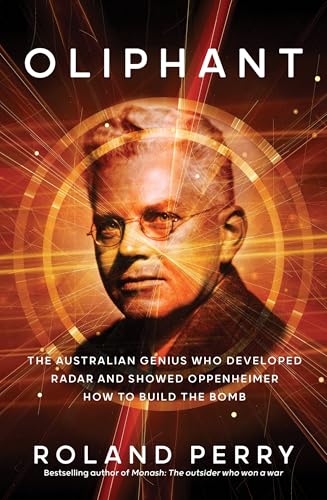
Oliphant
by Roland Perry
"Australia's True Genius Behind the Bomb"
Popularity
3.54 / 5
* A book's popularity is determined by how it compares to all other books on this website.
Where to buy?
Buy from Amazon* If you buy this book through the link above, we may receive a small commission at no extra cost to you.
Oliphant by Roland Perry
Details
War:
World War II
Perspective:
Researcher
True Story:
Yes
Biography:
Yes
Region:
Australia/Oceania
Published Date:
2025
ISBN13:
9781761472190
Summary
This biography chronicles the life of Mark Oliphant, an Australian physicist who made crucial contributions to World War II technology and the atomic age. The book details how Oliphant played a pivotal role in developing radar technology for Britain and later provided essential insights to Robert Oppenheimer for the Manhattan Project. Author Roland Perry explores how this relatively unknown scientist influenced some of the twentieth century's most significant technological advances, while examining Oliphant's later advocacy for peaceful uses of nuclear energy and his legacy in Australian science.
Review of Oliphant by Roland Perry
Roland Perry's biography brings to light one of the twentieth century's most influential yet relatively unknown scientific figures. Mark Oliphant, an Australian physicist whose contributions to radar technology and nuclear weapons development proved pivotal during World War II and beyond, receives long-overdue recognition in this comprehensive work. Perry traces Oliphant's journey from his humble beginnings in Adelaide to the heights of international scientific achievement, revealing how this brilliant mind shaped the course of modern history.
The narrative begins with Oliphant's early years in South Australia, establishing the foundation of his character and intellectual curiosity. Born in 1901, Oliphant grew up in modest circumstances that might have limited his opportunities, yet his natural aptitude for science and mathematics propelled him forward. Perry effectively demonstrates how Oliphant's Australian upbringing influenced his direct, pragmatic approach to problem-solving, characteristics that would later distinguish him from many of his European and American colleagues.
The book devotes considerable attention to Oliphant's work at the Cavendish Laboratory in Cambridge under Ernest Rutherford, one of the giants of nuclear physics. During this period in the 1930s, Oliphant made significant contributions to understanding nuclear reactions and particle acceleration. Perry details how Oliphant's experimental skills and innovative thinking earned him respect among the scientific elite of the era, positioning him as a key figure in the emerging field of nuclear physics.
A central focus of Perry's biography concerns Oliphant's crucial role in radar development during World War II. The cavity magnetron, a device essential to the advancement of microwave radar, benefited significantly from Oliphant's contributions. Perry explains how this technology transformed aerial warfare and maritime defense, giving the Allies a decisive advantage. The author presents Oliphant not merely as a contributor but as a driving force who recognized the military potential of these technologies and worked tirelessly to ensure their rapid development and deployment.
Perhaps the most striking aspect of the biography involves Oliphant's connection to the Manhattan Project. Perry documents how Oliphant traveled to the United States in 1941 and played a critical role in convincing American authorities, including J. Robert Oppenheimer, of the feasibility and urgency of developing an atomic bomb. At a time when American scientists remained uncertain about the project's viability, Oliphant's technical knowledge and persuasive advocacy helped catalyze the massive undertaking that would ultimately produce the weapons used against Japan.
The relationship between Oliphant and Oppenheimer receives particular attention, with Perry exploring how the Australian physicist's insights influenced the direction of the Manhattan Project. The author describes meetings and conversations that shaped key decisions, though he relies primarily on historical records and documented accounts rather than speculation. This restraint strengthens the narrative's credibility while still conveying the significance of these interactions.
Perry does not shy away from the moral complexities surrounding Oliphant's work. The biography addresses how Oliphant grappled with the consequences of his contributions to nuclear weapons development, particularly after witnessing the devastation caused by the atomic bombs. The scientist's later advocacy for peaceful applications of nuclear energy and his concerns about the arms race receive thorough treatment, presenting a more complete picture of a man who recognized the dual-edged nature of scientific progress.
The post-war period of Oliphant's life, including his return to Australia and his role in establishing the Australian National University, demonstrates his commitment to advancing science in his homeland. Perry shows how Oliphant worked to build research infrastructure and foster scientific talent in Australia, attempting to ensure that future generations would have opportunities he had to seek abroad.
The biography benefits from Perry's accessible writing style, which makes complex scientific concepts understandable without oversimplification. Technical explanations appear when necessary but never overwhelm the human story at the book's core. This balance makes the work appealing to general readers while maintaining sufficient detail to satisfy those with deeper scientific knowledge.
Perry's research appears thorough, drawing on archival materials, scientific papers, and historical records. The author presents Oliphant's achievements within their proper historical context, acknowledging both his individual brilliance and the collaborative nature of scientific advancement during this era. The result is a biography that educates readers about both a remarkable individual and a transformative period in scientific history, filling a significant gap in the public understanding of twentieth-century physics and its practitioners.